
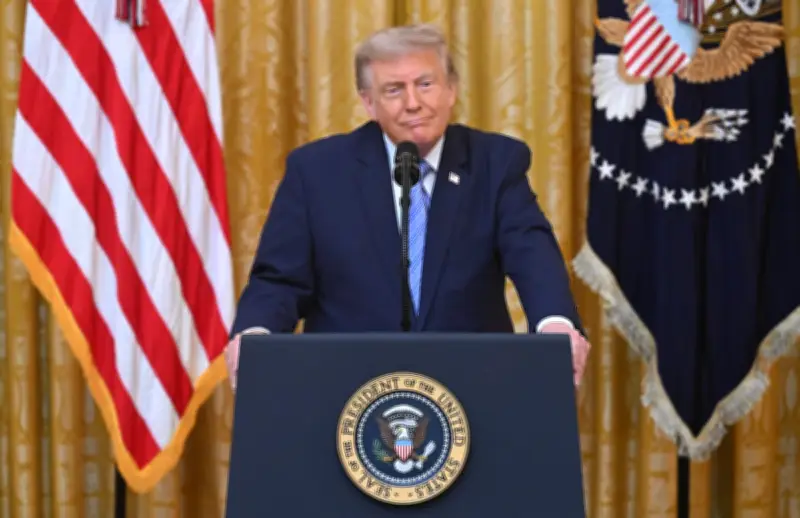
Donald Trump offered a litany of misleading and false claims during his Thursday speech on threats to US elections, and released previously classified documents to try to support his specious assertions. In some cases, those were not supported by the documents. Here is a look at some of the key statements that could mislead the American public.
Claim 1: China hacked voter files
Trump claimed China had illicitly acquired the voter information of 220 million US voters beginning in 2020. “That information includes names, addresses, phone numbers, political party preferences and other sensitive data that would be needed to register to vote and engage in other nefarious activities, which is exactly what was happening,” Trump said. Nearly every US state allows public access to voter roll information, which often includes party preference and address. The documents released by the White House are heavily redacted and do not provide clear evidence. One document says someone acting on behalf of China downloaded commercially available voter registration information from at least six states in 2022. Intelligence officials have long known about China’s data collection, but possessing that data does not mean votes were changed. “We heard from officials saying that, because China had this voter data, which almost everybody has, they could change voter registration records, and they could vote on behalf of people. That is 100% false,” said David Becker, executive director of the Center for Election Innovation & Research. “I could have a list of all the students at a particular university. That doesn’t mean I can change their grades.”
Claim 2: Intelligence officials covered up information about China’s election meddling
Trump claimed US intelligence officials conspired to keep information about China’s election meddling from him. In 2021, the National Intelligence Council released a report concluding China did not interfere in the 2020 election, with high confidence. A dissenting view from the national intelligence officer for cyber argued China took steps to undermine Trump’s re-election campaign but agreed there was no evidence of interference in election processes. Documents released by Trump show debate about language in the report. One official wrote about “massaging” the president’s daily intelligence brief to avoid direct links to the election, but the email chain lacks context. Trump also cited chat messages from an FBI official discussing a “shadow government,” but the messages lack context.
Claim 3: Venezuela hacked voting machines
Trump claimed Venezuela plotted to manipulate voting machines to rig that country’s presidential elections, gesturing at a debunked conspiracy theory that Venezuela hacked US voting machines in 2020. A CIA note released Thursday says intelligence officials “developed sustained interest and likely some capability in manipulating electronic voting systems, including Smartmatic technology, to influence electoral outcomes in Venezuela.” Smartmatic is only used in Los Angeles county. The note says it did not definitively confirm large-scale electronic fraud in specific Venezuelan elections. John Solomon, a Trump ally, told reporters there wasn’t evidence Venezuela tampered in US elections.
Claim 4: Voter fraud in Michigan in 2020 not fully investigated
Trump claimed the Biden administration “slow-walked” and “killed” an investigation into fraudulent voter-registration applications in Michigan. The case was cheered by the far-right site The Gateway Pundit, but public reporting suggests it was not systematic fraud. The local clerk in Muskegon flagged the problematic applications, and the Michigan attorney general referred the case to the FBI. Documents released by Trump show the FBI investigated throughout the Biden administration, consulting with the justice department’s public integrity section. One document from September 2025 says “no further investigation is warranted because logical investigation and/or leads have been exhausted, and the investigation to date did not identify a criminal violation.”
Claim 5: 278,000 noncitizens registered to vote
Trump said the Department of Homeland Security identified 278,000 noncitizens on the rolls in California, Nevada, New Jersey and Pennsylvania, which have about 40 million registered voters. DHS did not reveal its methodology or confidence level. The tool used to flag noncitizens is known to be inaccurate. Letters sent to Nevada and Pennsylvania suggest less certainty: the Nevada letter identified up to 15,903 noncitizens, including 8,576 with matching data, but did not explain how the rest were flagged. “These numbers are wildly speculative at best and the Department of Homeland Security hasn’t shared anything that backs it up,” said Cisco Aguilar, Democratic Nevada secretary of state. Several studies show voter fraud by noncitizens is extremely rare.




