The recent US-led incursion in Venezuela and President Donald Trump's expressed interest in purchasing Greenland are not isolated foreign policy quirks, according to a damning new analysis. They are instead seen as part of a coherent and alarming 'Trump doctrine' that exposes the United States as operating under the logic of a mafia state.
The Mafia State Theory Applied to US Policy
Princeton professor and Guardian columnist Jan-Werner Müller argues that Trump's actions align with a framework first outlined by Hungarian sociologist Bálint Magyar in 2016. This model moves beyond simple corruption to describe a system where public resources and institutions are rigged to benefit a ruling 'political family' and its loyal oligarchs. Loyalty, not law, becomes the paramount currency.
Under Trump, Müller contends, these practices have been brazenly brought into the open. The 'pausing' of the Foreign Corrupt Practices Act, the apparent sale of pardons, and the direct financial benefits flowing to the president's billionaire associates from foreign deals and military adventures all fit the pattern. The analyst points to investigative reports suggesting Trump-linked oligarch Paul Singer, owner of oil company Citgo, stands to gain significantly from a US-controlled government in Caracas.

Venezuela: Extraction and Extortion, Not Regime Change
The botched incursion in Venezuela, which Trump justified by invoking the Monroe Doctrine, is a prime example. While traditional geopolitical arguments about pushing back against Iran, China, and Russia are present, Müller identifies a more fundamental driver. The operation advances a vision of dividing the world into 'great spaces' controlled by major powers, but with a distinctly Trumpian twist.
The president's promise to 'run the country' for US oil companies reveals the core motive: extraction. The goal is not necessarily regime change, but creating a scenario for exploitation. The implied threat to Venezuela's leadership, characterised as a 'mafia state of sorts' itself, is one of extortion: grant 'total access' to US interests or face the consequences of a 'bigger boss'. This logic, Müller writes, 'internationalises' the predatory domestic practices of the Trump administration.
Greenland and the Fantasy of Blank-Slate Exploitation
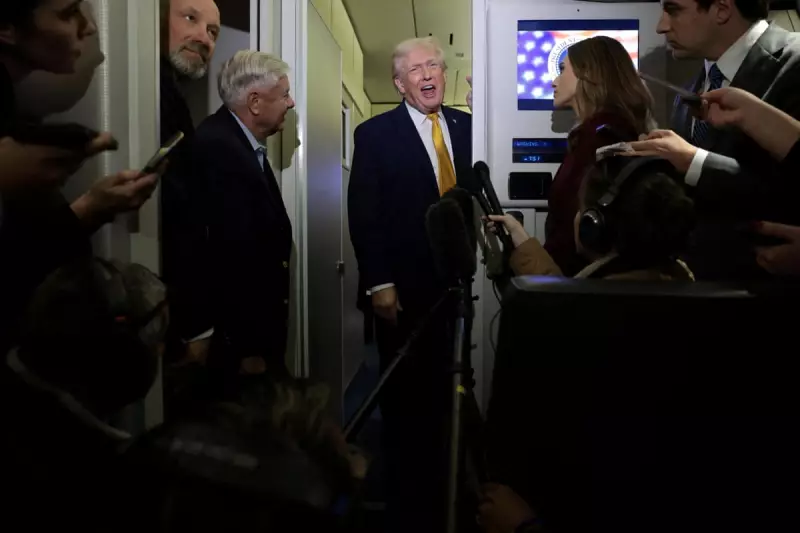
The 'almost immediate follow-up chatter' about Greenland, following the Venezuela episode, is what truly 'gives the game away,' according to the analysis. Aboard Air Force One, Trump, billionaire ally Howard Lutnick, and Senator Lindsey Graham joked dismissively about Danish security in the Arctic, revealing a cavalier attitude towards sovereign nations.
The interest, however, is deadly serious. Beyond critical minerals, Greenland represents a 'blank slate' for the settler-colonial fantasies of Trump's tech billionaire allies, like Peter Thiel. Projects involving cryptocurrency-based 'network states,' 'seasteading,' and terraforming with advanced AI are being openly discussed. A company called Praxis, funded by Thiel, has explicitly stated ambitions to 'extract critical resources' and 'build a mythical city in the North' on Greenlandic territory.
The historical precedent is stark: during the Cold War, the US flew nuclear-armed B-52s over Greenland with the tacit consent of Denmark, despite an official policy against nuclear weapons. Today, Danish politicians are slowly realising the threat is framed as 'economic security'—a Trumpian euphemism for corporate and oligarchic plunder.
A Doctrine of Power Without Principle
Ultimately, Müller concludes that the Trump doctrine represents more than a return to old-school imperialism. It is the projection of a mafia state's operating manual onto the global stage. The logic is consistent: extraction, exploitation, and, if necessary, extortion. Whether in Latin America or the Arctic, the principle is that might makes right, international law is an inconvenience, and national resources are there for the taking by those with the power and the lack of scruples to seize them.