In a remarkable legal twist, former President Donald Trump's recent pardon of Rudy Giuliani and other allies may have inadvertently granted clemency to every American citizen who committed voter fraud during the 2020 presidential election, legal experts have revealed.
The Sweeping Language of the Pardon
The controversy stems from a pardon issued on 7 November 2024 that contained extraordinarily broad language. The document applies to "any US citizen for conduct relating to the advice, creation, organization, execution, submission, support, voting, activities, participation in, or advocacy for or of any slate or proposed slate of presidential electors... in connection with the 2020 presidential election."
While specifically naming individuals including Rudy Giuliani, the pardon explicitly states it is "not limited to those named," creating a potential legal loophole that could benefit anyone involved in election-related activities during that contentious period.
Real-World Consequences in Pennsylvania Case
The practical implications of this sweeping pardon are already being tested in court. Matthew Alan Laiss, accused of voting in both Pennsylvania and Florida during the 2020 election, has seen his lawyers argue that the charges against him should be dismissed because of Trump's pardon.
According to federal indictments from September 2024, Laiss moved from Pennsylvania to Florida in August 2020 and subsequently voted by mail-in ballot in Pennsylvania before voting again in person in Florida on election day. Court documents reveal both votes were cast for Donald Trump, and Laiss has pleaded not guilty to the charges.
Public defenders Katrina Young and Elizabeth Toplin contend that when "Mr Laiss cast two votes in the general election for President Trump for the office of president of the United States in Pennsylvania and Florida, he support[ed], vot[ed for] ... [and] advoca[ted] for [a] slate or proposed slate of presidential electors." They argue the pardon's plain language extends to their client and have filed a motion to dismiss the case.
Legal Experts Weigh In on Pardon Implications
Derek Muller, a law professor at the University of Notre Dame, finds this interpretation credible. "Here you've got kind of a broad set of conduct and an undefined group of individuals who are protected," Muller explained. "It's quite plausible to read this and suggest that anyone involved in voting for slates of presidential electors in 2020 has now been pardoned."
Justin Levitt, a law professor at Loyola Law School in Los Angeles, concurred that the federal pardon appears to apply to citizens who may have committed voting crimes in 2020, though he noted they could still face state prosecution. Levitt also observed that the pardon language could protect election officials who oversaw voting in 2020, many of whom faced intense pressure and criticism from Trump and his supporters.
"I think this language gives election officials some much-needed ability to breathe just a bit easier, taking sham federal prosecutions off the table for officials who ran the 2020 elections," Levitt wrote in a blog post.
The justice department has not yet responded to the motion filed by Laiss's legal team, and federal prosecutors in the eastern district of Pennsylvania, who are handling the case, remain silent on the matter.
Paradoxical Outcome for Trump Administration
This potential blanket pardon creates a paradoxical situation for the Trump administration. Throughout his political career, Trump has repeatedly raised concerns about voter fraud to advocate for stricter voting measures including restrictions on mail-in voting, voter ID requirements, and same-day registration.
An unintentional pardon covering all 2020 voter fraud could prove particularly embarrassing for Ed Martin, the Trump ally appointed as the justice department's pardon attorney after failing to secure sufficient support to become the top federal prosecutor in the District of Columbia. Martin currently leads a justice department committee focused on punishing the president's political opponents.
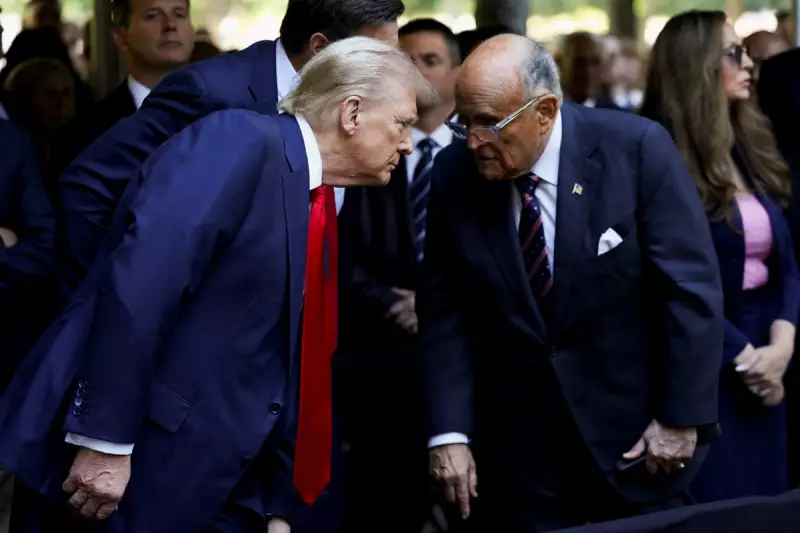
The development comes as Trump and Giuliani were photographed attending a 9/11 memorial ceremony in New York on 11 September 2024, a solemn occasion that contrasted sharply with the ongoing legal controversies surrounding the former president's attempts to overturn the 2020 election results.