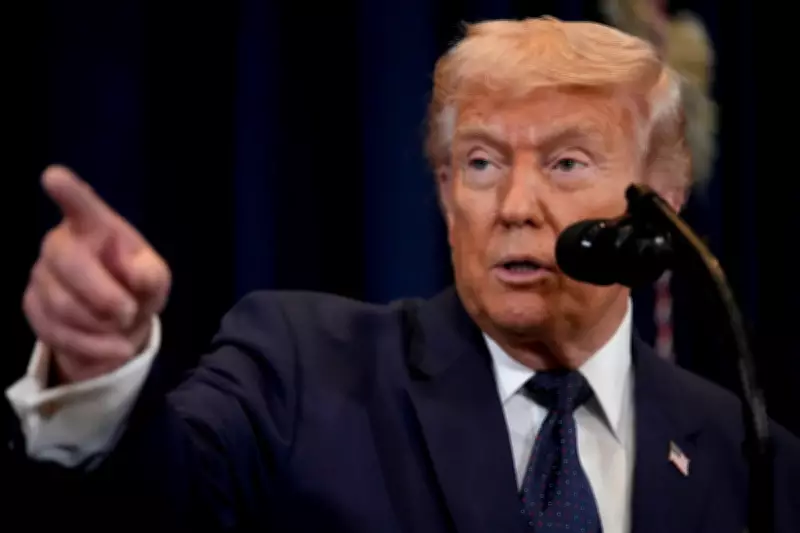
In a significant development on Monday, President Donald Trump announced at a news conference in Miami that the United States will ease oil-related sanctions for "some countries." This decision follows a phone conversation with Russian President Vladimir Putin, aimed at mitigating the severe shortage triggered by the ongoing US-Israel war on Iran.
Details of the Sanctions Easing
Trump stated, "So we have sanctions on some countries. We're going to take those sanctions off until the strait [of Hormuz] is up," though he declined to provide further specifics. According to Reuters, this move could involve a further relaxation of sanctions on Russian oil, potentially complicating international efforts to penalize Moscow for its war in Ukraine, now in its 1,475th day.
Market Impact and Alternative Measures
The announcement comes as the blockade of the Strait of Hormuz to nearly all oil tankers has caused benchmark crude oil prices to skyrocket past $100 per barrel, reaching their highest levels since Russia's invasion of Ukraine in 2022, before a slight pullback. Other strategies to stabilize the market include a possible release from strategic reserves or restrictions on US exports, as sources indicated.

Last week, the US issued a temporary waiver allowing India to purchase certain Russian oil cargoes to cope with Middle Eastern supply losses. However, a White House plan to provide naval escorts and insurance for tankers has so far failed to significantly boost traffic through this vital waterway.
International Reactions and Broader Context
Trump described his call with Putin as "upbeat," noting discussions on Ukraine, which he called "a never-ending fight." Putin's adviser, Yuri Ushakov, characterized the conversation as "frank and businesslike," lasting about an hour. Putin reiterated Russia's readiness to supply oil and gas to Europe, warning that the Iran war has sparked a global energy crisis and could halt production dependent on Hormuz transport.
As the world's second-largest oil exporter with the biggest natural gas reserves, Russia stands to benefit from the current situation, though Putin acknowledged the price spike might be temporary. Meanwhile, Ukraine's President Volodymyr Zelenskyy revealed that Ukraine sent interceptor drones and operators to protect US bases in Jordan, responding to requests from 11 countries amid the conflict.
Ongoing Conflicts and Diplomatic Moves
Zelenskyy expressed readiness for US-backed peace talks with Russia "at any moment," but noted partners' focus has shifted to the Iran conflict, leading to a postponed meeting. In Ukraine, a Russian drone strike in Kharkiv injured six people, including a child, and set cars ablaze, while shelling in Dnipro injured seven others, as regional officials reported.
On the cultural front, Ukraine has urged the Venice Biennale to reconsider Russia's participation, arguing against it becoming "a stage for whitewashing ... war crimes." Despite criticism, including from Italy's culture ministry, organizers have allowed Russia to take part in the event from May to November.
Financial and Political Ramifications
In a related dispute, Russian oligarch Roman Abramovich has intensified his conflict with the British government over the £2.5 billion from the sale of Chelsea FC. Sanctioned in 2022 for ties to Putin's regime, Abramovich insists the funds are his to allocate, while Britain seeks to ringfence them for use in Ukraine, highlighting the ongoing economic and political fallout from the war.