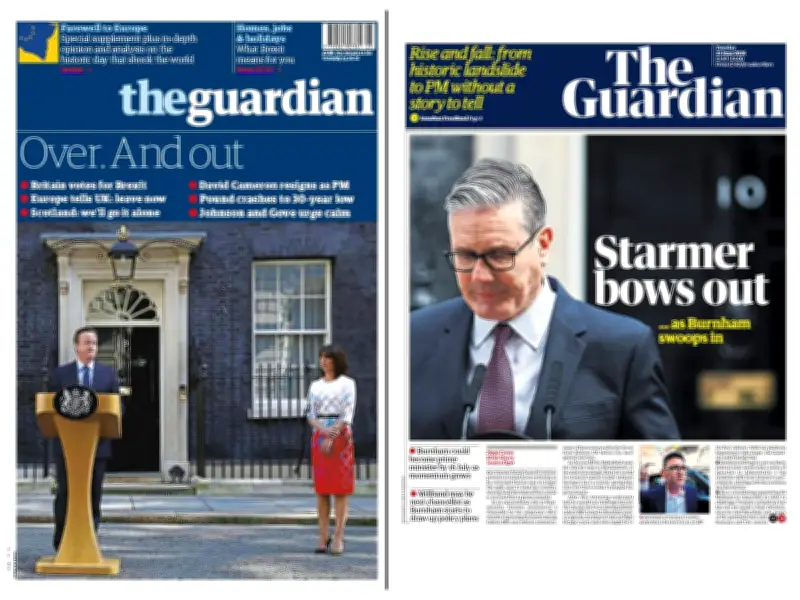
Seven times in ten years, a lone lectern has been placed outside 10 Downing Street, casting what political sketch writer John Crace calls the "podium of doom." Keir Starmer's resignation on Monday was the latest in a series that began with David Cameron's departure after the 2016 Brexit referendum. The anniversary of that vote, marked this week, underscores a decade of political instability.
Deja Vu in the Newsroom
Dan Sabbagh, the Guardian's defence and security editor and former national news editor, described a sense of deja vu when he saw the lectern this week. "With David Cameron, it was a shock. He’d been prime minister for six years and, until that moment, he felt like a strong and dominant figure in British politics. Since then, his successors have come and gone – with none of them going from a position of strength or on a point of principle," Sabbagh said.
He recalled the morning of June 24, 2016, when the UK voted to leave the EU. "In the small hours of that morning, it was clear he’d lost all authority, but it still wasn’t clear that he would resign. That’s what I sometimes call the moment after the moment, where you crash into the next news cycle immediately after the one you’d been focusing on concludes."

The Morning After: Uncertainty and Shock
Sabbagh remembered waking up in the middle of the night, discovering the UK had voted to leave, and taking a taxi to work at 3am. "We had lots of senior journalists working at 4am – a full home news staff, senior editing staff, and a range of key reporters. And you knew right away that you were in this extraordinary moment of profound political uncertainty."
By the time Cameron resigned at around 8.15am, the newsroom was in a state of nervous exhaustion. "Boris Johnson and Michael Gove held a press conference at 11am and they looked shell-shocked, kind of like: 'Oh, my God, what have we done?' They were in no sense ready to take over," Sabbagh said.
The Role of the Media in a Post-Truth Era
Sabbagh noted that the Leave campaign's slogans, such as "take back control" and the claim about saving £350m a week for the NHS, were effective but simplistic. "I don’t think there was a feeling then that there was any sort of online disinformation campaign. A lot of that came out later on as people engaged in a kind of intellectual archeology about how it had come to this."
The murder of Labour MP Jo Cox a week before the referendum by a far-right extremist profoundly affected the campaign. "There was a feeling of revulsion that the campaign had been so divisive. One of the emotional reactions to her murder was a feeling that the UK surely wouldn’t vote for Brexit now because it had unleashed these darker forces," Sabbagh recalled.
Brexit's Lasting Impact
Sabbagh argued that Brexit has not delivered the economic growth promised by the Leave campaign. "Brexit hasn’t brought the things the Leave campaign claimed it would and it certainly hasn’t brought better economic growth. So the country has been left with this massively pent-up frustration about British politics, and no economic growth to offset that."
He concluded: "It’s hard not to conclude that Brexit represents a kind of faultline in British history. We’ve traded away a much more stable politics for a messy panoply of resignations. Each prime minister since David Cameron has had a habit of becoming the most unpopular prime minister. And always in the background there’s Nigel Farage."