Tehran Residents Return to Devastated City Amid Fragile Ceasefire Fears
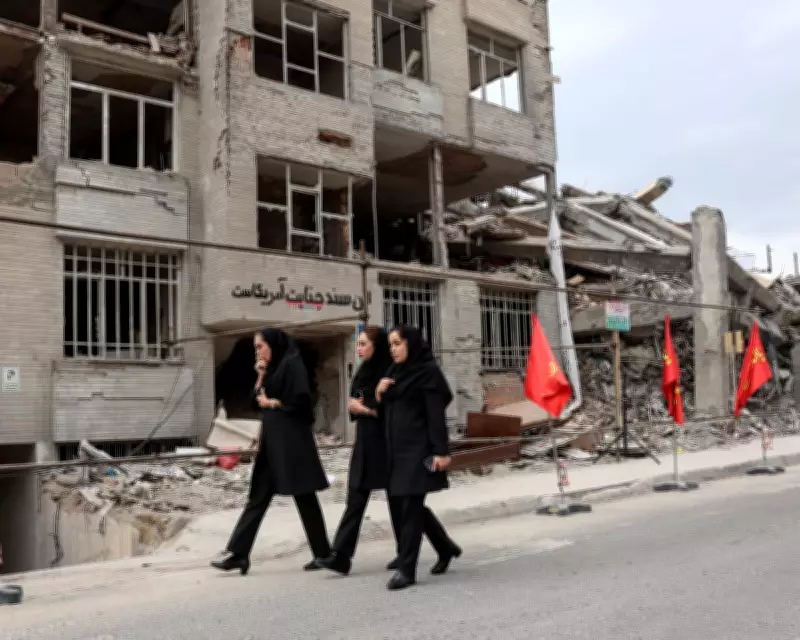
In Tehran, countless homes and civilian infrastructure including schools and hospitals have been destroyed by US and Israeli airstrikes, creating what residents describe as a "ticking timebomb" situation as they return to their ruined city.
Personal Accounts of Destruction
Mehdi, a 36-year-old IT professional, fled Tehran during the early days of the war but returned to find his home severely damaged with shattered glass and blown-out window frames. "There's a whistling sound I hope you never hear," he says, describing missiles hitting his street within seconds. "My favorite fast food place has been hit by a missile. The clinic we used to visit is gone. Even the garden where I spent some of the best moments of my childhood was hit."
Now sleeping in their living room as the least damaged part of their home, Mehdi and his wife are trying to piece together insurance paperwork while waiting for whatever comes next. "Our home is now barely livable," he says. "In some sense, we've become war refugees."

Widespread Infrastructure Damage
The toll on civilian infrastructure across Iran has been immense, according to Noor, an activist based in Tehran who stayed through the US-Israeli onslaught. Explosions have destroyed schools, universities, pharmaceutical production centers, hospitals, civilian homes, private cars, and city buses.
Although streets are filling again with returning residents, many people have lost their livelihoods, particularly those who rely on internet access. The Iranian authorities' internet blackout has now crossed 45 days, leaving most of Iran's population cut off from the world, with only a few able to pay large sums for Starlink and VPN connections.
"Internet shutdowns have destroyed online jobs," Noor explains, "which were a source of income for many people, especially young people." Approximately 10 million Iranians depend on internet access to run small businesses or generate income.
Economic Crisis Deepens
Iran faced an affordability crisis before the war, but the situation has dramatically worsened. Medications for patients with serious or chronic illnesses are difficult to find, and while food remains available in shops, "we can't afford it," according to Noor.
The economic pressure has become unbearable, with almost all food items increasing in price. Most people can no longer afford red meat and fish, while dairy products have increased in price by more than 40%. Factories struggle to operate due to lack of raw materials, construction workers have lost jobs, and many workplaces are laying off staff or reducing their workforce.
Banks, international businesses, and government offices are all under strain as unstable internet disrupts basic operations. Many schools remain shuttered, creating additional difficulties for working parents.
Security Concerns and Surveillance
Arash, a 21-year-old student from Tehran, describes a city filled with tension and heavy surveillance despite the ceasefire. "I am hyper alert all the time," he says, noting security forces including police, the Islamic Revolutionary Guard Corps, and Basij militia running roadblocks and checking vehicles.
"They search vehicles and phones," Arash explains. "One day, I saw all three sets of security forces in a single street and crossed all three checkpoints. They are all heavily armed with Dushka rifles and AK-47s."
Disturbingly, some checkpoints have recruited children as young as 10 or 12, armed with Kalashnikov rifles. This practice amounts to the use of child soldiers, which constitutes a war crime. Arash feels devastated that children are "trapped between two wars"—the US-Israeli assault and the regime's abuse of them.
Fears for the Future
As the two-week ceasefire deadline approaches, all residents who spoke expressed deep apprehension about what comes next. "Even if we think of rebuilding, we can't," Arash says. "The ceasefire is fragile and the war can start anytime. Hope is all we have, but that's fragile too."
Mehdi fears a future filled with "one-tonne bombs, nightly bombardments, the destruction of this country's infrastructure." He references former US President Donald Trump's threat to bomb Iran "back to the stone ages," saying, "It feels like nothing awaits us but that."

Despite the economic hardship and what feels like a "ticking timebomb" situation, Noor says the people of Iran remain hopeful. "We just have to be hopeful in ourselves," she says. "We believe in the power of our nation."
For Arash, this period of limbo represents "the worst outcome ... the city is in ruins and we are in a worse economic situation than we were in." He concludes, "I don't know who is winning this war, but we know who's losing. It's us, ordinary Iranians."