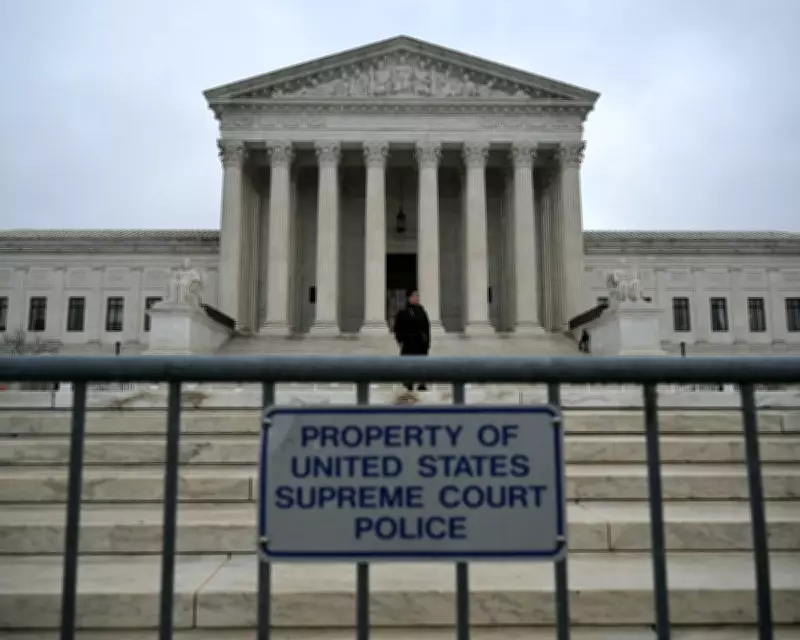
Supreme Court Declares Trump's Tariff Policy Unconstitutional in Landmark Ruling
The United States Supreme Court has delivered a decisive blow to former President Donald Trump's signature trade policy, ruling that his administration exceeded executive authority by imposing sweeping global tariffs without obtaining congressional approval. The conservative-majority court issued a 6-3 decision that declared Trump's use of the International Emergency Economic Powers Act to implement tariffs was unlawful and unconstitutional.
Judicial Rebuke of Presidential Power
The court's ruling specifically addressed tariffs that Trump announced last April on what he termed "liberation day," covering dozens of countries including war-torn Syria, impoverished Lesotho, the United Kingdom, China, Canada, Mexico, Japan, and European Union nations. The justices determined that the 1977 International Emergency Economic Powers Act, which Trump had invoked to justify the tariffs, "does not authorise the president to impose tariffs" of this nature and scope.
This decision affirms earlier findings by lower courts that had similarly ruled the tariffs illegal. Trump reportedly called the Supreme Court's verdict a "disgrace," reflecting his administration's frustration with judicial limits on executive trade authority.

Economic Implications and Future Strategies
Despite this significant legal setback, trade experts and economists widely agree that Trump is unlikely to abandon his international trade war. The former president faces a backdrop of slowing economic growth and has consistently emphasized his commitment to aggressive trade policies designed to revitalize American manufacturing.
Basil Woodd-Walker, disputes and investigations partner at global law firm Simmons & Simmons, noted that "the US administration may pivot to other tariff regimes or trade barriers to replace the lost income." Erin McLaughlin, senior economist at The Conference Board thinktank, described the ruling as a "blow" to Trump but emphasized it was "not a knockout one," pointing to alternative legal mechanisms available to continue similar trade strategies.
These alternatives include Section 232 investigations that have already imposed targeted tariffs on sectors like steel, with the EU facing 50% tariffs on steel and derivatives and the UK paying 25%. Additionally, Section 122 of the 1974 Trade Act would permit temporary import surcharges of up to 15% for 150 days to address alleged "large and serious" balance of payment deficits.
Financial Fallout and Repayment Questions
The financial implications of the ruling are substantial, with tariff revenues for last year estimated between $240 billion and $300 billion. McLaughlin highlighted that "many studies show that US firms have paid 90% of that" amount, with much of the cost ultimately passed to consumers through price increases in retail markets.
Even if the US government were compelled to repay these tariff revenues to importers, the process would be complex and protracted. Supreme Court Justice Brett Kavanaugh acknowledged that any refund procedure would likely become a "mess," suggesting that repayment would "not be paid back soon" according to economic analysts.
International Reactions and Trade Relationships
The United Kingdom's Department for Business and Trade stated that the ruling does not impact preferential agreements negotiated on steel, automobiles, and pharmaceuticals. A spokesperson emphasized that "the UK enjoys the lowest reciprocal tariffs globally" and expects this privileged trading position to continue regardless of the court's decision.
European Commission trade spokesperson Olof Gill indicated that the EU is "analysing the ruling carefully," adding that "businesses on both sides of the Atlantic depend on stability and predictability in the trading relationship." The German Confederation of Industries welcomed the decision as sending "a strong signal for the rules-based trade order."
Political and Legislative Ramifications
The European Parliament has yet to ratify a trade deal struck with the United States last year and may consider pausing ratification proceedings in light of the Supreme Court's ruling. Previously, MEPs paused ratification during diplomatic tensions over Trump's tariff threats related to Greenland, only to resume the process later.

A formal vote by the International Partnership Committee is scheduled for Tuesday, with a full session of all Members of the European Parliament expected in early March. This timing coincides with Trump's upcoming State of the Union address, which may provide insight into his administration's next strategic moves regarding international trade policy.
Business leaders on both sides of the Atlantic are calling for clarity and stability. Richard Rumbelow, director of international business at Make UK, emphasized that "businesses now need clear, practical guidance on how the ruling will be implemented" alongside resolution of remaining Section 232 tariffs affecting UK steel and aluminum exports.