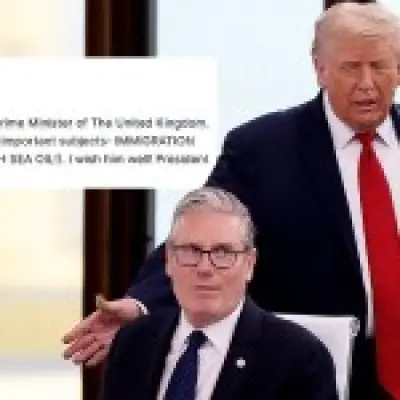
Prime Minister Sir Keir Starmer has delivered a sobering assessment, declaring the UK faces the most severe crisis in its transatlantic relationship with the United States in decades. The warning came during an emergency news conference in Downing Street on Monday 19 January 2026, prompted by threats from US President Donald Trump to impose tariffs on the UK and pursue control of Greenland.
A Prime Ministerial Warning and a Diplomatic Stance
Sir Keir Starmer appeared graver than ever as he levelled with the public about the national predicament. He strongly criticised President Trump's proposed tariffs and was unequivocal on the issue of Greenland, insisting the UK "would not bend, whatever the consequences." The Prime Minister reminded the US that alliances are built on partnership, "not pressure."
However, in an effort to de-escalate the situation, Starmer also stressed the fundamental importance of the US-UK relationship. He notably dodged questions about potential UK retaliatory tariffs, a stance that pointedly differed from the European Union, which is preparing its own tariff package. The UK has not ruled out this option but considers it a last resort, preferring dialogue behind closed doors.

The Depth of the Transatlantic Rift Revealed
The gravity of the situation was further underscored by Danish Foreign Minister Lars Lokke Rasmussen. In London for talks with Foreign Secretary Yvette Cooper, Rasmussen revealed details of a meeting in Washington with Vice President JD Vance and Secretary of State Marco Rubio.
He stated that President Trump "honestly and full-heartedly, wants to acquire Greenland," a move Denmark calls a "red line." Discussions had focused on increasing the US and NATO presence in Greenland to address Arctic security concerns, but these were disrupted by Trump's public statements. Rasmussen expressed appreciation for the UK and other allies standing with Denmark.
Hours after Starmer's plea for dialogue, President Trump told reporters he would impose 10% tariffs on the UK and other European nations that sent troops to a NATO exercise in Greenland, and refused to rule out military force.
Unimaginable Consequences and a Search for Solutions
The escalating row threatens to rupture the NATO alliance, trigger a damaging trade war, and could lead to a US withdrawal from Ukraine, emboldening Russia. With President Trump wielding significant economic and military power, European diplomacy alone may not suffice.
The focus now turns to Washington, where Republicans in Congress may be the last hope to rein in the President. House Speaker Mike Johnson met with Sir Keir in London on Monday, with the Prime Minister reiterating the UK's position. The best hope for Europe is to persuade the US Congress to act, underscoring that the transatlantic relationship is bigger than any one individual.
Amid the crisis, Sir Keir Starmer is "very unlikely" to attend the World Economic Forum in Davos this week, opting instead for intense private diplomacy while maintaining public restraint.