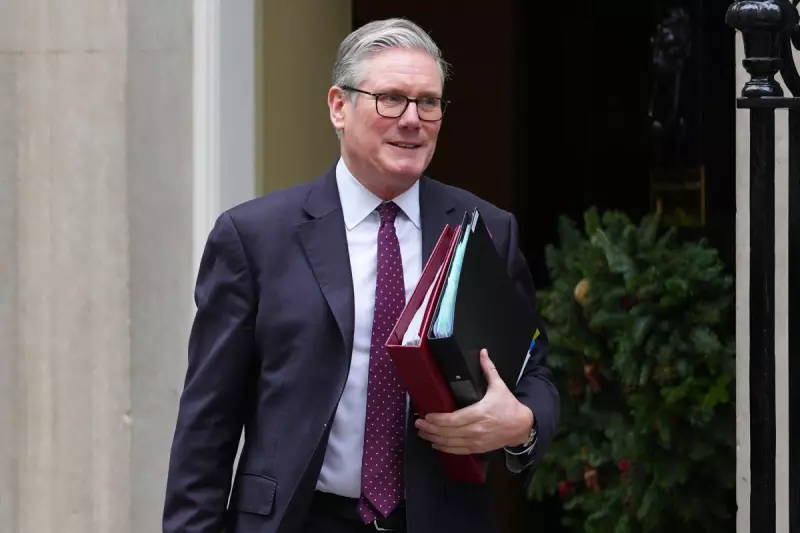
As the new political year begins, Prime Minister Keir Starmer faces a pivotal moment. According to veteran strategist John McTernan, the survival of the Labour government hinges on Starmer making a decisive New Year's resolution: to fully embrace the power of his office and become a transformative political leader.
A Government on the Brink
The coming year presents a severe test for Starmer's administration. Both the Prime Minister and Chancellor Rachel Reeves are among the most unpopular politicians to have ever held their posts, with ratings even lower than Margaret Thatcher or Liz Truss at their lowest points. Labour's public support has nearly halved, plummeting from 34 per cent at the 2024 election to just 18 per cent.
This political weakness will be starkly exposed in May 2026, when the UK holds its version of 'mid-term' elections. Votes for the Scottish Parliament, the Welsh Senedd, all London Boroughs, and numerous English councils are expected to result in significant humiliation for the governing party.

The Power of Elective Dictatorship
McTernan argues the solution lies in Starmer recognising and utilising the immense constitutional power he already possesses. He urges Number 10 staff to revisit Lord Hailsham's seminal 1976 Dimbleby Lecture, which coined the term 'elective dictatorship'.
The core thesis is that a UK government with a working Commons majority, like Starmer's, can effectively do what it wishes. Despite the Human Rights Act and the Supreme Court, no elected government in the West is more powerful than a British one with a landslide mandate. This reality, McTernan contends, should end the 'willed powerlessness' emanating from the centre, where blame is placed on bond markets, the civil service, or the layout of Downing Street itself.
He points to a series of self-inflicted wounds that have damaged the government's standing:
- Cutting winter fuel payments for pensioners.
- Refusing to lift the two-child benefit cap until pressured by backbenchers.
- Proposing then abandoning punitive cuts to disability benefits.
- The 'hokey-cokey' Budget that floated then ditched income tax rises.
A Call for Ruthless, Purposeful Leadership
The political irony, according to McTernan, is that Starmer has demonstrated a capacity for ruthless action when motivated. Examples include using the full force of the law against racist rioters, deploying King Charles to charm President Trump, slashing foreign aid to boost defence, and forcing through a private member's bill on assisted dying.
The challenge is to channel that same single-minded energy into a coherent, transformative political project. This could involve major initiatives like marshalling resources to build the promised 1.5 million homes, or simpler popular reforms like banning smartphones in schools. It could also mean pursuing a definitional shift, such as negotiating a new, deep relationship with the European Union.
Ultimately, McTernan states that technocrats get buried in process, while political leaders have a cause. Great governments are driven by great causes, whether reducing inequality, empowering labour, enabling a green transition, or tackling the affordability crisis. The fundamental question for Starmer as he enters 2026 is, in the words of a taxi driver to philosopher Bertrand Russell: 'What's it all about?'
For McTernan, the answer is clear: Starmer must resolve to be a politician, pick his fights, and use the formidable power of elective dictatorship to win them, thereby saving his party and defining his premiership.