UK Front Pages Chronicle Starmer's Battle for Survival Amid Party Revolt
Tuesday's UK newspapers are dominated by Prime Minister Keir Starmer's dramatic survival of renewed calls for his resignation from within his own party, though political commentators suggest his premiership remains on shaky ground. The political crisis has erupted following the ongoing fallout from the Peter Mandelson scandal, which has already claimed the departure of Starmer's chief of staff, Morgan McSweeney.
Scottish Labour Leader Demands Prime Minister's Resignation
The immediate trigger for the latest turmoil came on Monday when Scottish Labour leader Anas Sarwar publicly urged the prime minister to step down. This intervention from a senior party figure has sent shockwaves through Westminster, creating what many observers describe as the most serious challenge to Starmer's leadership since he took office.
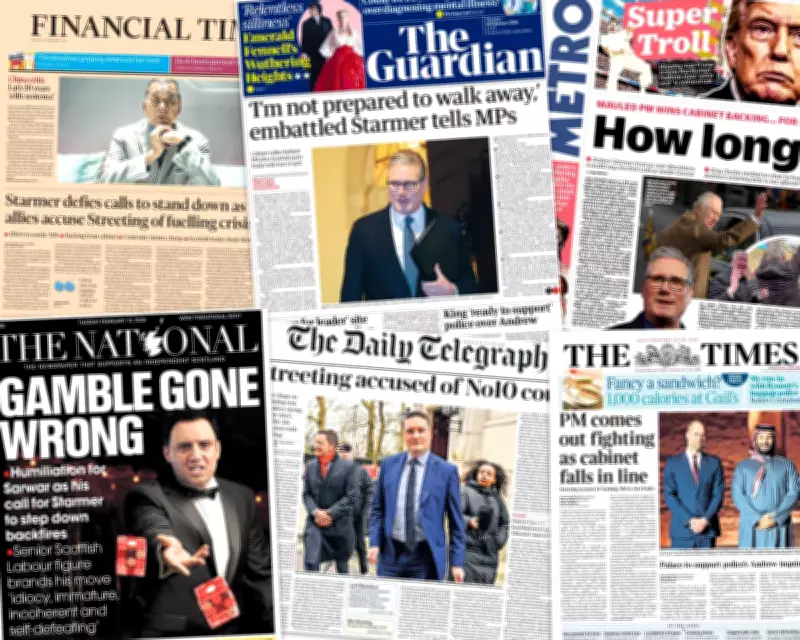
The Guardian led its front page with the headline: "'I'm not prepared to walk away,' embattled Starmer tells MPs." The paper reported that the prime minister had emerged "badly damaged" from what it described as a tumultuous 24 hours that "brought his premiership to the brink." According to their political correspondents, Starmer delivered a defiant message to parliamentary colleagues behind closed doors, insisting he would not be forced from office.

Newspapers Paint Picture of Deepening Crisis
The Daily Telegraph focused its lead story on potential leadership rival Wes Streeting with the headline: "Streeting accused of No10 coup." The paper reported that while Starmer had clung to power, his prime ministership was "entering its final stage." In a particularly pointed piece of political gossip, an unnamed Labour source claimed the push to remove McSweeney came from a man whose "name rhymes with Les Weeting" - a thinly-veiled reference to Streeting himself.
The Daily Mail took a dramatic approach with its headline: "Cabinet bounced into giving PM stay of execution." Their political editor reported that Starmer had been "rocked" by Sarwar's public demand for his resignation, forcing an emergency cabinet meeting where ministers were compelled to offer public support.
Scottish Editions Highlight Regional Political Dimensions
The Times Scotland edition framed the crisis through a distinctly Scottish political lens with: "Desperate Sarwar calls for Starmer to step aside." Their analysis suggested Sarwar's move represented a "betrayal of the beleaguered prime minister" and characterized it as "a last-gasp bid to save his faltering campaign for the Holyrood elections."
The National took a different angle entirely, portraying Starmer's survival as a "humiliation" for Sarwar with its front page declaring: "Gamble gone wrong." Their political editor suggested the Scottish Labour leader's intervention had backfired spectacularly, strengthening Starmer's position within the wider party despite the obvious damage to his authority.
Business and Broadsheet Analysis of the Crisis
The Financial Times splashed with: "Starmer defies calls to stand down as allies accuse Streeting of fuelling crisis." The business-focused paper provided detailed analysis of the leadership dynamics, reporting that Streeting is widely seen within Westminster as a leading contender for the leadership "if and when" Starmer eventually leaves office. Their political correspondent noted the unusual public nature of the crisis, with senior figures openly briefing against each other through the media.
The Times led with a more optimistic headline for Starmer supporters: "PM comes out fighting as cabinet falls in line." However, their reporting contained significant caveats, including claims that Streeting had "bottled" a more direct bid to oust the prime minister when the moment of maximum opportunity presented itself.
Tabioid Coverage Reflects Public Political Drama
The Daily Express adopted a more sensational tone with: "Resign now! PM on brink as calls to go mount." Their political team reported that Starmer had been forced to "plead for his future" as pressure mounted from multiple directions within his party.

Metro captured the uncertainty of the moment with its simple but pointed front-page question: "How long?" Their reporting described the prime minister as having been "mauled" on his way to securing temporary cabinet backing, suggesting the reprieve might prove short-lived.
The i Paper led with: "Mercy of Cabinet keeps Starmer in power - as endgame nears." Their political editor provided intriguing details about the crisis management response, including accusations from Streeting that Number 10 had been briefing against him, and the revelation that the entire Cabinet had been "told to tweet support" for Starmer in a coordinated show of unity.
The Daily Mirror focused primarily on the Epstein files for its top story but included a notable front-page reference to the political crisis with the punning headline: "I'm Keir to stay." This reflected their editorial position of continued support for the embattled prime minister despite the growing chorus of criticism.
Political Fallout and Future Implications
The collective front-page coverage paints a picture of a prime minister surviving the immediate crisis but facing profound questions about his long-term authority. The public nature of the challenge from within his own party represents an unprecedented moment in Starmer's premiership, with most papers suggesting the Mandelson scandal continues to cast a long shadow over his government.
Political analysts quoted across various publications suggest several key developments to watch in coming days:
- The stability of Starmer's cabinet now that public divisions have emerged
- Whether further resignations might follow McSweeney's departure
- How the Scottish Labour leadership will navigate its relationship with Westminster
- Whether Wes Streeting will make a more direct leadership challenge
- How the ongoing Epstein files revelations might continue to impact the government
While Starmer has survived this particular challenge, the unanimous media assessment suggests his political authority has been significantly diminished, setting the stage for further instability within the Labour Party and potentially reshaping the UK's political landscape in the months ahead.