Why South Korea Is Furious Over Yoon Suk Yeol's Life Imprisonment Sentence
Former South Korean President Yoon Suk Yeol has been found guilty of leading an insurrection and sentenced to life imprisonment with labor, a verdict that has ignited significant public anger and disappointment across the nation. The sentencing, delivered on Thursday, relates to his failed martial law declaration in December 2024, which prosecutors argued constituted a grave threat to democratic order.
Public Reaction: From Cheers to Outrage
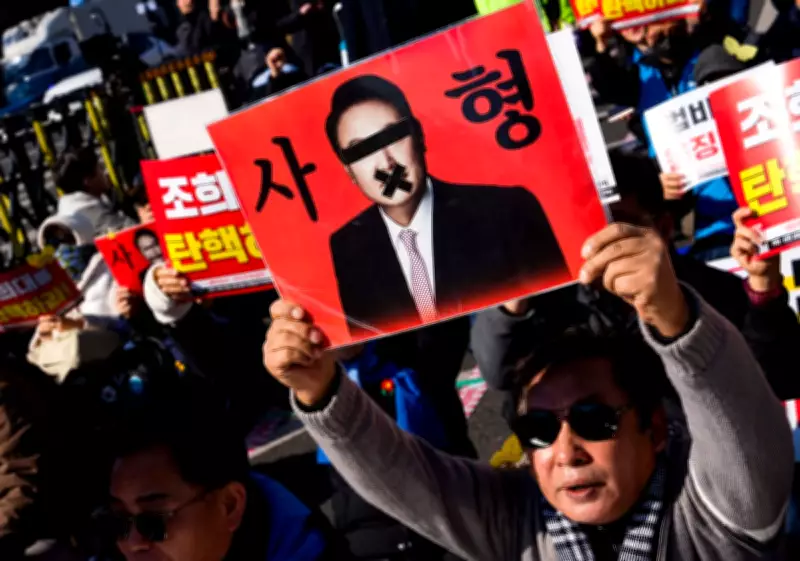
Initially, hundreds of Yoon's opponents celebrated outside the court upon hearing the guilty verdict. However, this mood swiftly transformed into widespread dismay as the life sentence was announced. Many South Koreans perceive the punishment as dangerously lenient, despite the fact that life imprisonment and the death penalty are functionally equivalent in a country that has not carried out an execution since 1997.
A Gwangju civic coalition labeled the life term "a failure to deliver even minimal justice." This sentiment was echoed by numerous human rights organizations, civic groups, labor unions, and political parties, all of which issued statements expressing profound disappointment. Democratic Party leader Jung Chung-rae, who had prepared a speech anticipating a death sentence, criticized the verdict as "a clear retreat" from the citizens' movement that thwarted the December 2024 martial law attempt.

Roots of the Anger: History and Severity
The anger stems deeply from South Korea's historical context of elite impunity and concerns over the severity of the punishment, rather than a mere desire for execution. In 1996, military dictator Chun Doo-hwan received a death sentence for leading a 1979 coup and the subsequent Gwangju massacre. His sentence was later reduced to life on appeal, and he was pardoned and released in 1997, living freely until his death in 2021.
Prosecutors emphasized in their closing arguments that the death penalty in South Korea's criminal justice system "does not mean execution but rather functions as the community's will to respond to crime." Under the criminal code, ringleaders of an insurrection face only three possible punishments: death, life with labor, or life without labor. The court's decision to impose life with labor allows for parole after 20 years, whereas a death sentence would have sent a stronger, unequivocal message that such acts are inexcusable.
Court's Reasoning and Criticism
Judge Jee Kui-youn cited several mitigating factors in the sentencing, including that Yoon's planning did not appear meticulous, he attempted to limit the use of force, most of his plans failed, he had no prior criminal record, had long served in public office, and was relatively old at 65. Critics have dismissed this reasoning as perverse, arguing that long public service should aggravate, not mitigate, abuse of state power.
Lawmakers pointed out that the coup was halted by citizen resistance and parliamentary intervention, not by Yoon's restraint. The progressive newspaper Hankyoreh editorialized that "the judiciary is showing behaviour that falls far short of citizens' standards." Human rights groups highlighted recent German prosecutions of elderly former Auschwitz guards as evidence that state crimes by those in power cannot be excused by age or clean records.
Fear of Future Pardon and Political Moves
Concerns are mounting that a life sentence makes a future pardon more politically feasible, whereas a death sentence would have raised the political cost significantly. South Korea has a history of pardoning convicted conservative former presidents, including Chun Doo-hwan and Roh Tae-woo in 1997, and more recently, Park Geun-hye and Lee Myung-bak after they served only a few years each.
In response, political parties are advancing an insurrection pardon prohibition bill through parliament. Democratic Party leader Jung warned that the judiciary's leniency toward Chun Doo-hwan had "returned like a boomerang" and resulted in "another tragedy," emphasizing the urgency of passing the bill soon.

Yoon's Response and Ongoing Legal Battle
In a statement released on Friday, Yoon maintained that his martial law declaration was "for the nation and the people" and "deeply apologised" for the frustrations and hardships citizens experienced due to his "inadequacies." He showed no remorse for the act itself, calling it a "decision to save the nation."
Yoon questioned the worthiness of appealing, accusing the judiciary of lacking independence, though his legal team clarified that this statement did not indicate he was abandoning a potential appeal. He urged his supporters, "Our fight is not over. We must unite and rise."
This case continues to highlight deep divisions in South Korean society and raises critical questions about justice, accountability, and the legacy of political impunity in the nation's democratic evolution.