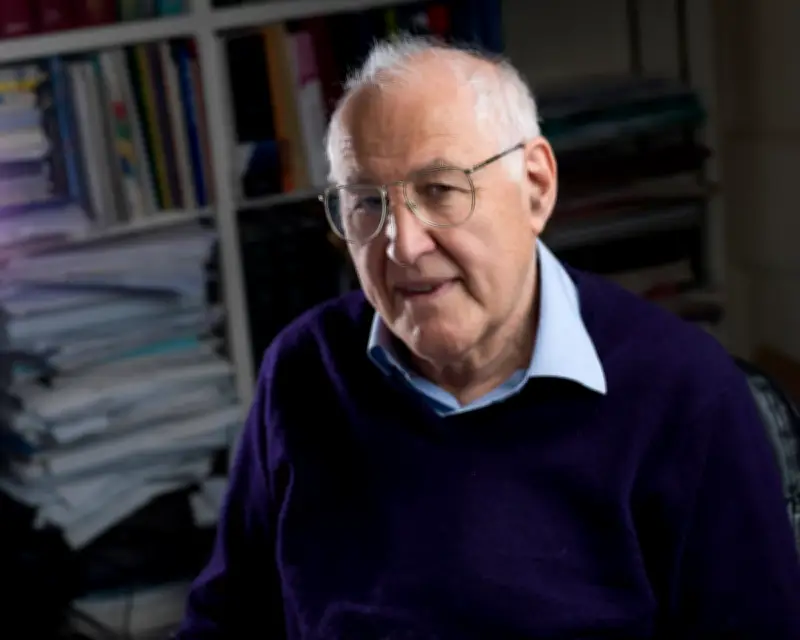
Sir Roy Goode, a towering figure in English commercial law who left school at 16 and went on to found the Centre for Commercial Law Studies (CCLS) at Queen Mary University of London, has died aged 93.
Early life and career
Goode was born in Portsmouth into a Jewish family. His father, Samuel, was a naval outfitter; his mother, Bloom (nee Zeid), worked as a saleswoman marketing Rediffusion televisions and vacuum cleaners and also wrote stories for True Confessions magazine.
Educated at Highgate School in north London, he left at 16 in 1949 to take up articles with a solicitor's firm in Portsmouth at a time when training positions were hard to come by. While working in the courts, he completed both his Law Society exams and, as an external student, a law degree with London University.
His two years of national service were spent in the army's legal aid section, latterly in Cyprus, where he rose to the rank of acting corporal. He later recounted drawing up a treaty permitting British troops to re-enter parts of the Middle East based on his experience of landlords' rights to inspect tenants' premises.
Pioneering work in consumer credit
Keen to fill his evenings after work as a young lawyer in an Essex solicitor's office, Goode decided to write a book. Leafing alphabetically through titles in a legal reference volume, he came across hire purchase. He knew nothing about such credit arrangements but noticed no one had touched the issue for several decades.
His first book, Hire-Purchase Law and Practice (1962), appeared at a time when hire purchase agreements were becoming widely available for consumer goods, including cars. They were criticised for their operation and, due to their popularity, even affected the country's overall money-supply figures.
Research for and publication of his authoritative work brought Goode to the attention of the prominent London law firm Victor Mishcon & Co, where he became a partner in 1966. Lord Crowther, former editor of the Economist, nominated him to serve on a government inquiry into consumer credit in 1968. The Crowther report laid the foundations for the Consumer Credit Act 1974, which regulated loans, provided rebates for customers who settled debts early, and made companies liable for faulty goods.
Academic leadership
Goode's expanding financial expertise led him into academia. A chance expression of interest over a meal in a Chinese restaurant resulted in his recruitment in 1971 as professor of law at Queen Mary's College, where he later established the CCLS in 1980 to bring together practising commercial lawyers with academics in the field.
Now based in Lincoln's Inn Fields, near the Royal Courts of Justice, the centre has continued to grow. More than a thousand master's and doctoral students from around the world are currently enrolled. A scholarship scheme named in Goode's honour has existed since 2011.
Maintaining links with CCLS, in 1990 Goode moved to Oxford University, where he was appointed Norton Rose professor of English law and became a fellow of St John's College.
Public service and pension reform
Goode chaired the Pension Law Review Committee from 1992 to 1993, set up following the scandal over Robert Maxwell's theft of about £480 million from the Mirror Group's pension fund. The committee's report led to improvements enshrined in the Pensions Act 1995.
He also served on the Monopolies and Mergers Commission, the Department of Trade and Industry's advisory committee on arbitration, and was a leading figure in Unidroit, the international body seeking harmonisation of commercial and private law across borders. In the UK, he chaired the executive committee of Justice, the legal reform charity, from 1994 to 1996 and volunteered at the Camden Community Law Centre.
Legacy and honours
Goode wrote almost 40 textbooks, including Commercial Law (1982), Legal Problems of Credit and Security (1982), and Principles of Corporate Insolvency Law (1990), each with several later editions. He was appointed OBE in 1972, advanced to CBE in 1994, and knighted for services to academic law in 2000. He was elected a fellow of the British Academy in 1988, qualified as a barrister, and made a QC in 1990.
One colleague described him as the 'father of modern English commercial law'. He continued to teach university seminars into his 90s and had been due to deliver a lecture shortly before he died.
Away from law, Goode maintained a lifelong interest in chess. In his youth he played for his county, Hampshire, and in retirement set up a chess club to teach the game to children in an Oxford primary school. He collected old British county maps, was a member of the Reform Club, and enjoyed browsing in bookshops.
He is survived by his wife, Catherine, whom he married in 1964 after meeting at a party and being engaged within a month, and their daughter, Naomi.