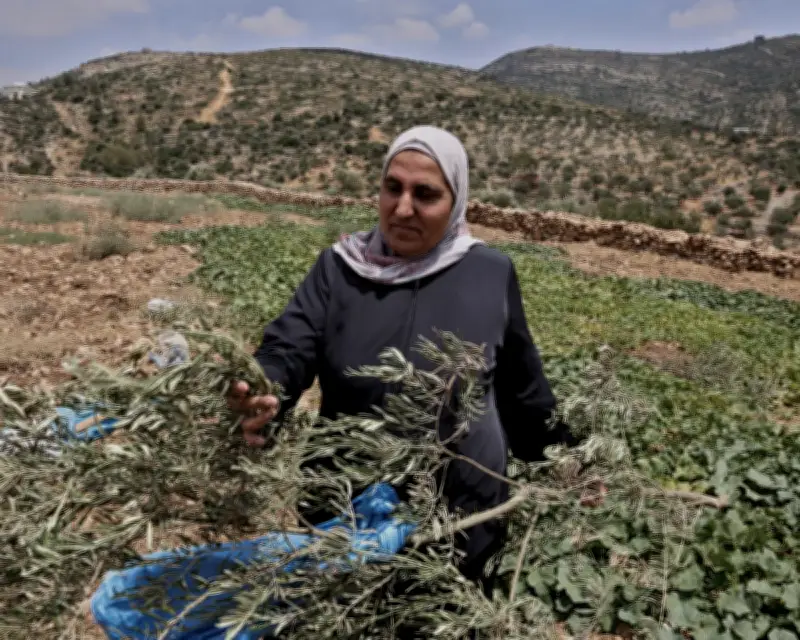
Ilham Karajeh awoke last Friday to find her family allotment raided and ruined. The thin black irrigation pipes had been sliced, grape vines cut and 70 young olive trees, the embodiment of the family’s aspirations for the future, had been uprooted. On Sunday, Karajeh and her husband, Mohammed, were collecting the severed branches. “See – they are still wet with sap,” she cried out in horror at the cruelty of the act.
Settler outpost fuels violence in Ein Arik
Since a new settler outpost called Maoz Tzur was established last year on a neighbouring hill, violence has flowed down into the valleys in a gathering tide. The outpost began with just a handful of Israeli settlers but they quickly set about seizing territory. Their first target was the Bedouin shepherd community on the surrounding hills and valleys. Then the pressure was turned up on the villagers. For more than a year they have been prevented from reaching family olive and citrus groves and springs on the hillsides to the south, nearest the new settler outpost. Those brave enough to venture in that direction were repeatedly attacked with clubs and stones.
Election dynamics drive land grab
The attack reflects an acceleration in the intimidation campaign around Ein Arik, extending northwards and up the slope towards the neighbouring village of Deir Ibzi. It is part of a surge of settler aggression across the West Bank driven by the febrile dynamics of Israeli politics. Elections loom, with Benjamin Netanyahu’s far-right bloc facing the prospect of defeat. The radical settler elements in the coalition are scrambling to impose facts on the ground before the vote.
“These are going to be very tough months,” said Dror Etkes, founder of Kerem Navot, an advocacy group monitoring settlement growth. “Firstly, it doesn’t look good for the current coalition, so there could be a new government. Secondly, all the attention is on the elections so the settlers can use this period to do whatever they want.”
Farm outposts control 18% of West Bank
Throughout 2025 and the first half of this year, the creeping de facto annexation of the West Bank has broken into a gallop, driven primarily by farm outposts such as Maoz Tzur. According to a report published on Monday by Kerem Navot and Peace Now, farm outposts now control more than 1m dunams (100,000 hectares), 18% of the entire West Bank. Nearly a third of that wholesale seizure took place in 2025 alone.
The report concludes that “the government has advanced de facto annexation at an unprecedented pace”. It argues that the process relies on a sustained pattern of violence. “These amount to thousands of incidents, ranging from verbal abuse to murder. The vast majority of these incidents are neither documented nor counted by any authority, as they do not meet the threshold for news reporting,” the report notes. “This violence is part of a funded and institutionalised system whose purpose is to expel Palestinians and take over their land.”
Smotrich’s role in legitimising outposts
At the top of this system sits Bezalel Smotrich, a hardline settler who is now finance minister but has taken over the authority to approve settlements from the defence ministry. In April, Smotrich came to Maoz Tzur to celebrate its recognition as an official settlement and its 12 “core families” who he hailed as “pioneers”. Outposts like Maoz Tzur, Smotrich said, would “completely destroy the idea of a Palestinian state within our heartland”.
Palestinians cut off from legal recourse
Recourse to the law has been cut off almost entirely for Palestinians since Itamar Ben-Gvir was made national security minister. Villagers in Ein Arik said it has proved futile to complain to the police or go to court for redress. “We went to so many lawyers but they all said there is nothing they could do as the government is with the settlers,” said Ahmad Abu Mayala, whose family was attacked on 22 May. “They said: ‘Wait for the election to see if it will change the government. Then maybe we can do something.’”
The local mayor, Mohannad Othman, was pessimistic. “The way things in the Middle East work, there will be someone even worse than Smotrich,” Othman said. He is thinking of inviting representatives of foreign embassies to accompany villagers for the olive harvest in the hope of protection.
Last month, the UK, Australia, Canada, France and Norway imposed sanctions on networks behind settler violence. France banned Smotrich from entering the country. However, such measures are unlikely to have significant impact given US support and EU disunity.
“Any attempt to change policies in the West Bank will be confronted with the very strong opposition of the people who are today in the government,” Etkes said. “So it would be very, very hard for any new Israeli government to try to reverse things.”