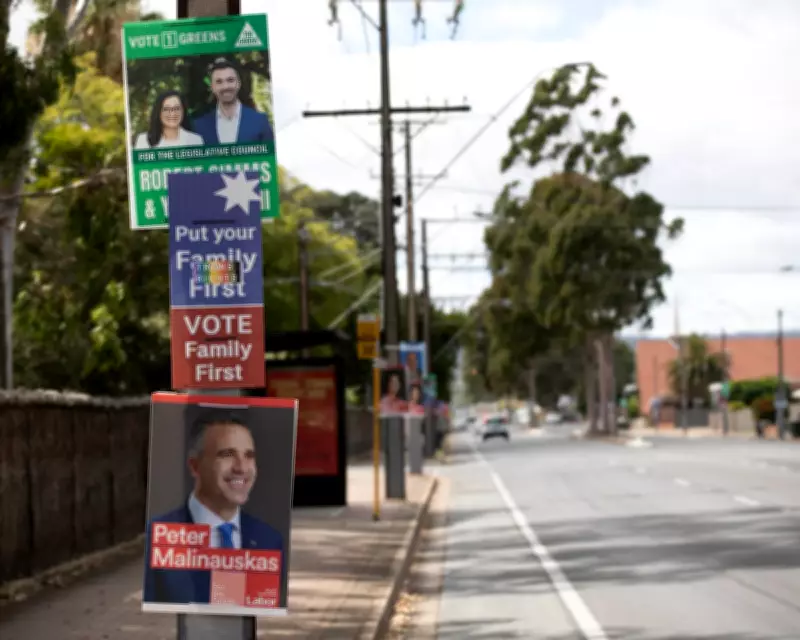
South Australia's Political Donation Ban Sparks Fears of Lobbyist Dominance
As South Australia approaches its first state election since implementing groundbreaking political donation reforms, experts are raising alarms about potential unintended consequences. The legislation, passed last year, prohibits all donations and gifts to registered political parties, members of parliament, and candidates, replacing private funding with public financing while imposing strict caps on contributions and expenditures.
The New Landscape of Political Funding
The comprehensive ban represents one of Australia's most ambitious attempts to remove private money from politics. Under the new framework, political parties can no longer accept donations, with public funds allocated based on electoral performance rather than wealthy backers. Premier Peter Malinauskas has championed the reforms, arguing they ensure elections are determined by policy quality rather than financial resources.
"This election is going to be determined by the quality of policies, the quality of candidates, not the size of the bank balance in candidates' or political parties' pockets," Malinauskas stated recently, emphasizing that public financing would reflect voter preferences rather than donor interests.
Third-Party Loopholes Emerge
Despite these intentions, the legislation has created what critics describe as significant loopholes. While direct donations to political entities are banned, third-party organizations face fewer restrictions. These groups can accept individual donations up to $5,000 and spend up to $450,000 on election campaigning, with disclosure deadlines falling weeks after polling day.
Bill Browne, director of the Australia Institute's democracy and accountability program, warns that the reforms may have created "loopholes and perverse outcomes." He explains, "The problem with a so-called political donation ban is that the money can be spent on third-party campaigning which, if anything, is less accountable."
Constitutional law expert Professor Anne Twomey has similarly cautioned that the donation ban risks redirecting political money toward lobbyists, potentially allowing "well-funded interest groups [to dominate] the discourse and [force] political parties to dance to their tune."
Registered Third Parties Enter the Fray
Several organizations have registered as third parties ahead of Saturday's election, including prominent groups across the political spectrum. The right-wing Turning Point Australia, progressive advocacy organization GetUp, various trade unions, the Australian Christian Lobby, anti-abortion activist Joanna Howe, and former Liberal MP Christopher Pyne have all registered to participate in the electoral process.
These groups can raise and spend substantial funds without disclosing the full amounts until April 7th, several weeks after voters cast their ballots. This timing means the electorate will make decisions without complete knowledge of who is funding which campaigns.
One Nation Becomes Focal Point
Several third-party groups are explicitly supporting One Nation, which recent polls show gaining significant traction with primary support in the twenties, potentially ahead of the Coalition. Turning Point Australia's South Australian coordinator George Mamalis and activist Joanna Howe, who each command hundreds of thousands of social media followers, are actively urging supporters to vote for One Nation candidates.
In a recent podcast appearance, Mamalis and Howe discussed their support for One Nation, drawing parallels to Nigel Farage's Reform movement in the United Kingdom while addressing controversial topics including abortion access and gender identity issues. Mamalis made inflammatory remarks about political opponents possessing "demonic ideas" and suggested misogynist influencer Andrew Tate represented a "necessary evil" in certain contexts.
Accountability Concerns Mount
Browne highlights the fundamental accountability gap created by the current system: "Under the new laws, a candidate who takes on a powerful interest group can be out-fundraised and out-spent by that group many times over. That's perverse given the candidate is accountable to voters while the lobby group may be opaque, self-interested or an astroturfing operation."
The government maintains strong enforcement mechanisms, with penalties including fines up to $50,000 or ten years imprisonment for deliberate circumvention of the laws. A government spokesperson emphasized that these penalties apply equally to third parties colluding with registered political parties.
Progressive Response and Justifications
GetUp has registered as a third party specifically in response to Turning Point Australia's involvement and concerns about "opacity, astroturfing and dark money distorting elections." Interim chief executive Paul Ferris stated, "One Nation is surging in the polls. GetUp's campaign is about making sure ... the voters hear another perspective."
Howe, when questioned about her funding and objectives, stated she encourages voting for candidates committed to restricting abortion access and "opposing discrimination against children based on their age, location, disability, sex or stage of development."
Political Cross-Pollination
The blurred lines between formal politics and third-party activism have become increasingly evident. Several prominent Liberal figures, including leader Ashton Hurn, shadow treasurer Ben Hood, and former leader David Speirs (now running as an independent), have appeared on Turning Point Australia's podcast in recent days.
Howe has criticized the Liberal Party's decision to disendorse candidate Carston Woodhouse, who made controversial comments about feminism and homosexuality, arguing the party punished him for "mainstream Christian views."
Looking Beyond Election Day
As South Australians prepare to vote, the experiment in donation-free politics faces its first major test. The outcome may determine whether the reforms successfully reduce wealthy influence or simply redirect political money through less transparent channels. With third-party expenditure capped but disclosure delayed, the full financial picture of this election will only emerge weeks after the results are known, leaving fundamental questions about political accountability unanswered during the crucial decision-making period.
The situation highlights the complex challenge of balancing democratic participation, free speech, and transparency in modern electoral systems. As Professor Twomey observed, well-resourced interest groups now potentially hold unprecedented power to shape political discourse, creating new dynamics that could redefine South Australian politics for elections to come.