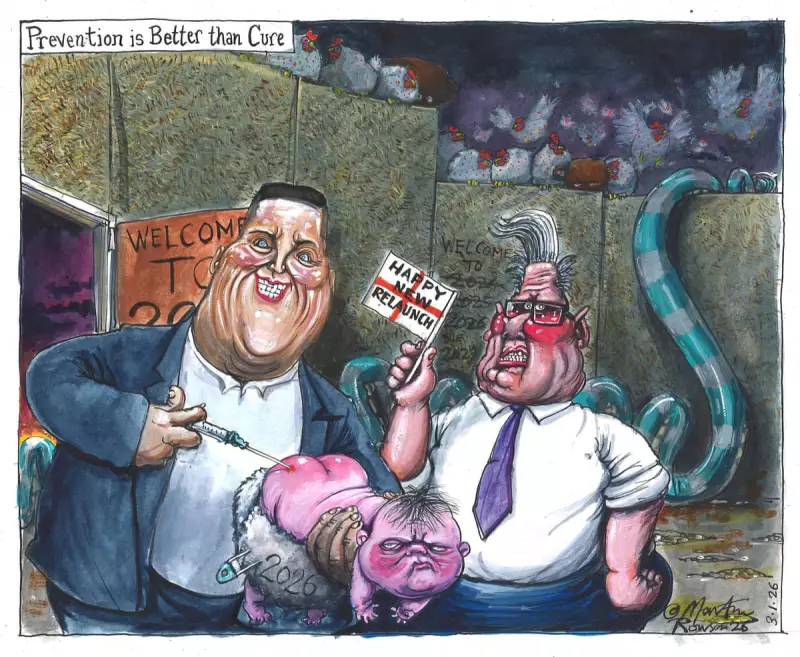
Acclaimed political cartoonist Martin Rowson has unleashed a stark and provocative vision of the UK's future under a Labour government. His latest work, published on 2nd January 2026, casts a critical eye on Labour leader Sir Keir Starmer and Shadow Health Secretary Wes Streeting, questioning their commitment to the National Health Service.
A Grim Prognosis for the NHS
The cartoon presents a fictionalised, dystopian scene set in the year 2026. It depicts Sir Keir Starmer and Wes Streeting in a context that strongly implies the continued or accelerated involvement of private interests within the NHS. Rowson's signature style, known for its sharp lines and unflinching commentary, is used to visualise fears that a Labour administration might not reverse the trends of privatisation many associate with previous Conservative governments.
While the original artwork in The Guardian uses visual metaphor and caricature, the core message is a direct critique of perceived policy directions. The date of 2nd January 2026 is deliberately chosen, placing the satire in a near-future that forces viewers to consider the long-term consequences of current political stances on healthcare.

The Central Figures in the Frame
Rowson's focus rests squarely on two key Labour figures. Sir Keir Starmer, as the party leader and potential future Prime Minister, is portrayed as bearing ultimate responsibility for the direction of policy. Alongside him, Wes Streeting, the Shadow Health and Social Care Secretary, is highlighted due to his central role in shaping Labour's approach to the NHS. Streeting has publicly stated the need for reform and a pragmatic use of private sector capacity to reduce waiting lists, positions that have drawn both support and criticism from within the party and the wider public.
The cartoon interprets these political statements through a satirical lens, suggesting a future where such pragmatism morphs into something more detrimental to the founding principles of the health service. The artwork serves as a potent piece of political commentary, aimed at stimulating debate and holding potential leaders to account.
Satire as a Political Weapon
Martin Rowson's work continues a long British tradition of using cartooning as a powerful tool for political dissent and scrutiny. By projecting current anxieties forward to a specific date in 2026, he makes abstract policy concerns feel immediate and tangible. The cartoon does not merely report on a news event but actively creates a narrative, warning of a potential outcome based on the trajectory of today's political discourse.
The publication of this piece in The Guardian's Comment is Free section underscores its role as opinion and analysis. It is a crafted argument in visual form, intended to challenge supporters and detractors of Labour's health policy alike. For readers, it raises urgent questions about the future of one of the UK's most cherished institutions.
The lasting impact of such satire lies in its ability to simplify complex issues into a single, memorable image. Rowson's 2026 cartoon ensures that the debate around NHS reform, private sector involvement, and Labour's promises remains vividly in the public consciousness, framed not by statistics but by a compelling and worrying vision of what might be to come.