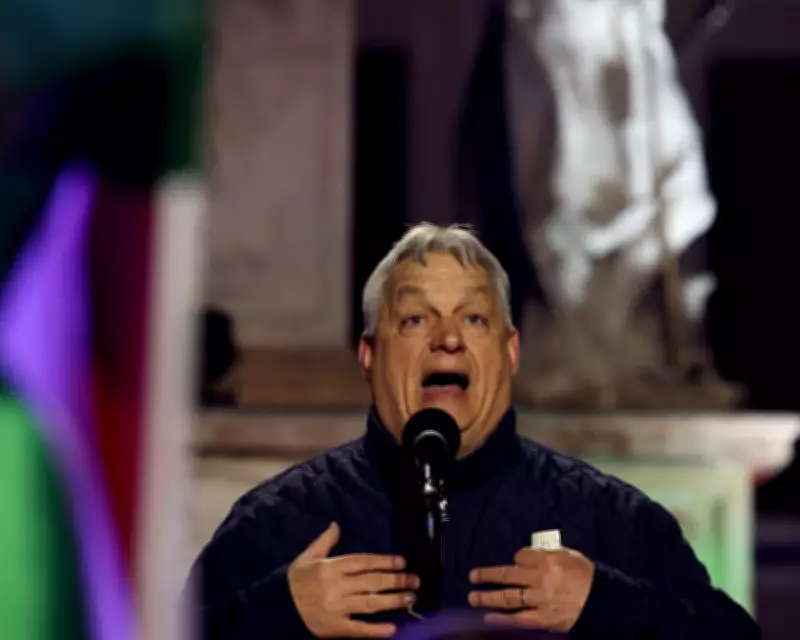
Hungary's Orbán Persists in Blocking Vital EU Aid to Ukraine
Ukrainian President Volodymyr Zelenskyy has expressed profound frustration following discussions with European Union foreign ministers this week. The central issue remains Hungary's Prime Minister Viktor Orbán's continued obstruction of a crucial €90 billion European Union loan package destined for Kyiv. With American financial support for Ukraine evaporating under the Trump administration, this European funding has become desperately urgent for Ukraine's survival.
Political Maneuvering Ahead of Hungarian Elections
Facing challenging poll numbers before Hungary's April 12th election, Orbán appears to be intensifying efforts to rally his nationalist base. His strategy involves amplifying anti-Ukraine and anti-European Union sentiments, creating significant diplomatic friction within the bloc. European officials have grown increasingly concerned about allegations suggesting coordination between Hungarian and Russian diplomatic channels, though Budapest's foreign minister Péter Szijjártó has firmly denied these claims.
The geopolitical landscape has grown more complex with recent developments in the Middle East. President Trump's military actions against Iran have created damaging ripple effects for Ukraine's defensive capabilities. Rising oil prices following the closure of the Strait of Hormuz, combined with Washington's decision to ease restrictions on Russian oil exports, have inadvertently strengthened Vladimir Putin's war economy.

Defensive Resources Diverted to New Conflicts
Critical military supplies essential to Ukraine's defense are being redirected to address emerging Middle Eastern threats. Stocks of Patriot missile interceptors, vital for protecting Ukrainian cities and infrastructure, are diminishing rapidly as Gulf nations deploy these systems against Iranian attacks. U.S. Secretary of State Marco Rubio has explicitly stated that Washington's military priorities in the Gulf region will take precedence over Ukraine's defensive requirements.
Meanwhile, peace negotiations with Moscow have stalled, and President Trump has resumed his characteristic diplomatic pressure on Kyiv. In recent comments, Trump suggested Ukraine lacks negotiating leverage and must accept territorial concessions. Ukrainian officials report that future American security guarantees are being linked to surrendering unoccupied territory in the Donbas region, though Washington has denied making such demands.
Ukraine's Strategic Adaptations and European Imperatives
President Zelenskyy has responded to these challenges by forging new international partnerships, including defensive technology exports to Qatar, Saudi Arabia, and the United Arab Emirates. Ukrainian forces have also achieved tactical successes with strikes against Russian oil facilities, partially undermining Moscow's ability to capitalize fully on energy exports.
However, the Middle Eastern conflicts have underscored a fundamental reality that European and Ukrainian leaders have long recognized: Ukraine's future is inextricably connected to Europe's capacity to assert and defend its geopolitical interests. The immediate priority involves circumventing Orbán's obstruction to release the financial assistance approved last December.
Looking beyond Hungary's upcoming election, European institutions must develop more robust mechanisms to prevent individual member states from employing blocking tactics that undermine collective decision-making. As transatlantic cooperation becomes increasingly uncertain, the European Union cannot afford to be paralyzed by actors who disregard its fundamental values and strategic imperatives.