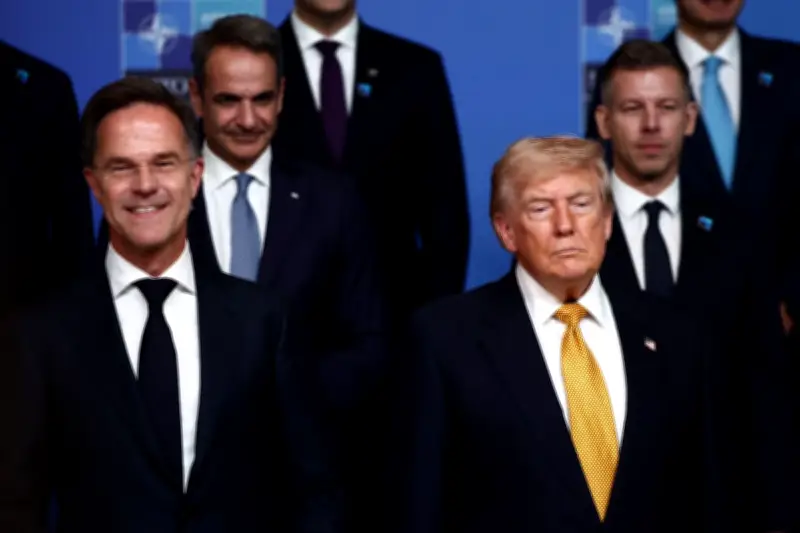
At the recently concluded Nato summit, President Donald Trump lashed out at other Nato members, expressing disappointment and questioning why the United States spends hundreds of billions of dollars while allies do not reciprocate. He reiterated his desire to acquire Greenland, criticized European energy and immigration policies, insulted Spain, and alarmed allies by stating that the conflict between Kyiv and Moscow does not affect the US. Despite this, other Nato leaders treated Trump with remarkable courtesy and respect, perhaps more than any previous US president has received. Trump himself remarked, 'It was a great meeting, there was a lot of love in that room, a lot of unity.'
The Real Source of Trump's Power
According to Robert Reich, a former US secretary of labor and a Guardian US columnist, the source of Trump's power is often misunderstood. It does not derive from his position as president of the most powerful nation; in fact, his arbitrary tariffs, the war with Iran, and the abduction of Nicolás Maduro have diminished US standing globally. Nor does it come from his Maga base, which is reconsidering support due to the Middle Eastern war, rising prices, and the administration's refusal to release the complete Epstein files. It is not due to strategic brilliance or cunning either.
Willingness to Violate Norms
Reich argues that Trump's power comes from his willingness to violate all norms, rules, and laws governing presidential conduct. He does whatever helps him accumulate wealth, power, and glory, and seeks vengeance on those who obstruct him. Nato leaders treated him with deference because they fear what he might do if thwarted. 'Whether it's Nato, Iran, the World Cup, the 2020 election, making billions off his presidency – or anything else – he's unconstrained by norms, rules, treaties, and laws,' Reich writes.
Trump's Non-Ethical Approach
Reich contends that labeling Trump as unethical misses the point. Ethics assumes agreed-upon standards, but Trump has no standards. His approach to life, business, and the presidency is about winning at all costs. 'Trump isn't unethical. He's non-ethical. He isn't immoral. He's amoral,' Reich states. This worldview, composed solely of transactions and calculations, is difficult for most to grasp, yet that difficulty is key to his power.
First-Mover Advantage in Breaking Trust
Reich uses the analogy of a small town where doors are left unlocked due to an unwritten rule against stealing. The first thief gains a huge advantage, easily entering homes. Once trust is destroyed, the community bears the cost of locks and security, while the thief exploits the trust and leaves others to protect themselves. This asymmetry—low cost for the violator, high cost for everyone else—is Trump's modus operandi. He shatters norms for personal gain, leaving others to pick up the pieces.
Long-Term Damage
As president, Trump has shattered far larger norms, benefiting himself but damaging institutions like Nato, Fifa, and the US Department of Justice, which relied on trust that no president would act as he has. Reich concludes, 'He'll be remembered as the most powerful president the US has ever had, but also the worst. When he's gone, all of us will be paying to clean up the mess.'