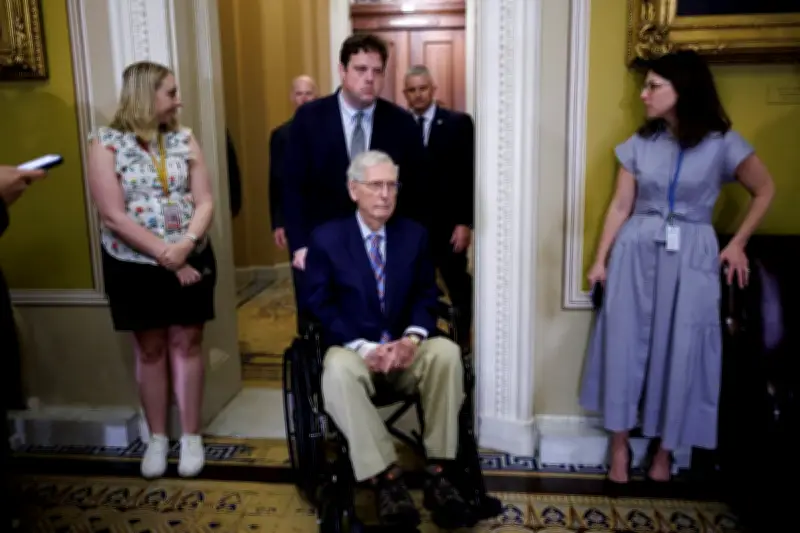
The mystery surrounding Senator Mitch McConnell's health is intensifying as the US Congress prepares to reconvene next week. McConnell, 84, has not been seen publicly since his hospitalization on 14 June. Nearly a month later, his office has released only minimal updates, stating he is "continuing to improve" and remains engaged with Senate business, while refusing to disclose the nature of his illness or reasons for continued hospitalization.
Emergency Response and Speculation
Emergency dispatch audio obtained by media outlets indicates first responders were sent to his home following reports of an unconscious person and that CPR was administered. CNN released video footage on Friday showing a person on a stretcher being wheeled toward an ambulance, though their face was not visible. The senator's office has neither confirmed nor denied these reports, leaving a vacuum filled with intense speculation based on circumstantial evidence.
Malcolm Nance, a former counter-terrorism intelligence officer, opined on the Truth in the Barrel podcast: "I think he's dead. It's very clear. I heard that 911 tape and I was an EMT when I was in the military... the probability of coming back from CPR is very, very, very small." Amy McGrath, who lost to McConnell in 2020, replied: "Well, it's an interesting take. We'll see what happens."
Impact on Senate Business
The Senate returns on Monday for a four-week legislative session focused on defense spending, national security, and government funding bills. McConnell's absence threatens to complicate Republican efforts with only a narrow 53-47 majority. He chairs the Senate rules committee and a defense appropriations panel, where Republicans hold just a one-seat advantage. Without him, partisan disputes over annual appropriations could become harder to resolve before the 1 October deadline for new federal spending. Congressional leaders are already signaling that another temporary spending measure may be needed to avert a government shutdown.
Political Reactions and Comparisons
Kentucky's Democratic governor, Andy Beshear, published an open letter urging McConnell to provide reassurance to constituents. "Kentuckians have grown increasingly concerned about the current state of your health and well-being, and ability to hold office," Beshear wrote, adding that persistent uncertainty was unfair to both the senator and the people he represents.
Senior Republican colleagues have attempted to dampen speculation. Senate majority leader John Thune and Republican whip John Barrasso both said this week they had spoken with McConnell, describing him as alert and engaged. Asked aboard Air Force One how the senator was faring, Donald Trump replied: "I have no idea how he's doing."
Historical Context and Constitutional Questions
McConnell was the longest-serving party leader in Senate history. His health has been an increasing concern: he suffered a concussion after a fall in 2023, froze twice while speaking to reporters later that year, sprained his wrist in another fall, and spent more than a week in hospital earlier this year with flu-like symptoms.
His absence has drawn comparisons to Congressman Thomas Kean, a New Jersey Republican who was out for nearly four months before disclosing depression treatment. Some detect parallels with Democratic efforts to conceal declines of Joe Biden and Dianne Feinstein, who died in office at 90 amid concerns over mental acuity.
Reed Galen, president of JoinTheUnion.us, said: "I assume he's still alive because if he was not alive that would be news too hard to keep. But while he is incapacitated... there are staff making decisions on behalf of the people of Kentucky. It's the next example of a gerontocracy in Washington DC."
Legal and Procedural Ramifications
Should McConnell remain in office but be unable to return before January, there is little constitutional remedy. Senate rules do not permit proxy voting, meaning Republicans lose one vote whenever he is absent. His resignation or death would trigger a special election under Kentucky law changed by the Republican-controlled legislature in 2024 to eliminate the governor's power to appoint a temporary replacement. The timing remains legally untested and could become subject to court challenges, potentially leaving the seat empty until the new Congress is sworn in next January.
John Zogby, an author and pollster, offered another analogy: "This in some ways reminds me of Generalissimo Franco in the 1970s, who was reported to be unawake but still alive, and no one believed it after about six weeks, because they hadn't figured out a transition yet in Spain."