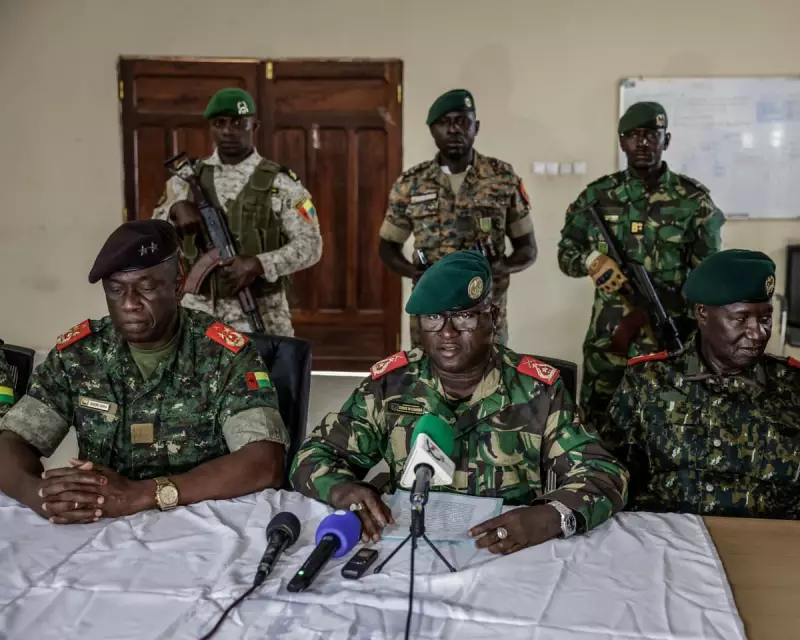
Military forces in Guinea-Bissau have declared they are taking 'total control' of the West African nation, plunging the country into fresh political turmoil just days after contentious presidential elections.
Military Seizes Control
In a dramatic statement broadcast on state television, military officers announced they had formed 'the high military command for the restoration of order' and would rule the country until further notice. The military suspended Guinea-Bissau's electoral process and closed all borders, effectively isolating the nation of 2.2 million people.
The announcement came from the army's headquarters in the capital Bissau, where tensions had been escalating throughout Wednesday. Residents reported hearing gunshots near key government buildings, including the election commission headquarters, presidential palace, and interior ministry.
Election Controversy Sparks Crisis
The military intervention follows Sunday's presidential elections, where both incumbent President Umaro Sissoco Embaló and his main rival Fernando Dias claimed victory in the first round. The election commission had been scheduled to announce provisional results on Thursday before the military takeover.
Accusations flew between the rival camps as the situation deteriorated. A spokesperson for President Embaló claimed the gunshots were being fired by gunmen affiliated with Dias, while an ally of Dias countered that Embaló was attempting to simulate a coup to declare an emergency and retain power. Neither side provided evidence for their claims.
History of Political Instability
This latest military intervention continues Guinea-Bissau's troubled political history since gaining independence from Portugal in 1974. According to Reuters records, there have been at least nine coups between independence and Embaló taking office in 2020.
President Embaló himself claimed to have survived three coup attempts during his first term, the most recent occurring in October. However, critics have alleged that Embaló fabricated these putsch attempts as pretexts to repress opposition.
The country faces severe economic challenges, with the World Bank reporting an average yearly income of just $963 (£728) in 2024. Guinea-Bissau gained international notoriety in 2008 when the UN labelled it a 'narco state' due to its role as a hub for the global cocaine trade.
Experts note that the country's geography - situated between Senegal and Guinea with numerous river deltas and the 88 islands of the Bijagós archipelago - provides natural, discrete drop-off points that have been exploited by Colombian drug cartels.
The political future remains uncertain as the military consolidates control, marking another chapter in Guinea-Bissau's long struggle for stable governance.