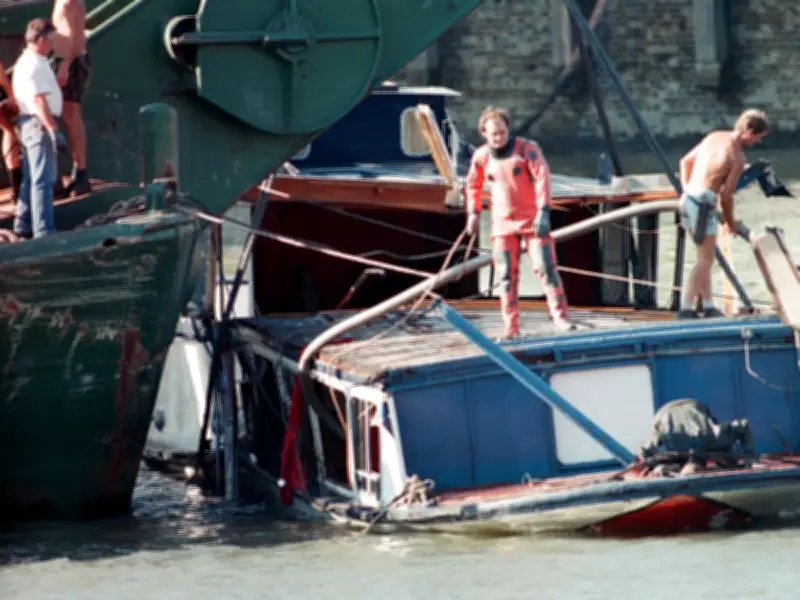
The Rivers Thames party boat disaster where 51 drowned in 30 seconds after enormous dredger crash. The 1989 boat crash saw 51 drown with survivors traumatised, living with horrific PTSD and nightmare for life.
News by Emilia Randall, GAU Writer, 06:00, 19 Jun 2026.
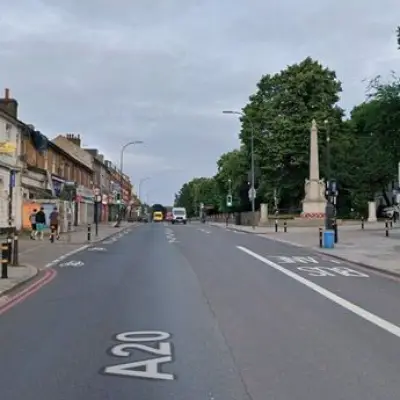
The pleasure boat Marchioness sank after being hit by the dredger Bowbelle on the River Thames. Tragedy struck on the River Thames for a pleasure boat of party-goers one summer day that resulted in 51 people drowning - with no one ever convicted over the disaster. The Marchioness, a 1923 boat, collided with a dredger on August 20, 1989 on the Thames in Central London.

Two years later, the dredger's captain was prosecuted for failing to keep a proper lookout on the boat, but was cleared. In April 1995, an inquest recorded a verdict of unlawful killing on the 51 people who were killed, but nobody was ever found guilty.
The party boat sank just before 2am on August 20, carrying 132 people, following a collision with the Bowbelle on the River Thames. The late-night party cruise had been arranged to celebrate the birthday of Antonio de Vasconcellos, a wealthy 26 year old banker, who had invited friends including several emerging talents from fashion, photography and finance.
Among those who perished was Francesca Dallaglio, the 19 year old ballerina sister of rugby player Lawrence Dallaglio. The 85ft Marchioness was wrecked by the 262 foot dredger, which struck the boat at its rear, until it was forced beneath the dredger's bow. It sank in just 30 seconds.
However, the Bowbelle operator was later fined for refusing to provide a breath sample while working aboard a vessel in an unrelated incident, decades later in 2025. Douglas Henderson was detained on a cargo ship in Hull after police were understood to have boarded the MV Velox following an alert from a customs official who, during a standard inspection, suspected Henderson might have been consuming alcohol.
He was subsequently convicted of failing to provide a specimen at a police station and handed a £281 fine on 11 September at Hull Magistrates' Court. Henderson was cleared in relation to the Marchioness disaster, facing charges of failing to maintain a proper lookout, after two juries were unable to reach verdicts. The Bowbelle captain had consumed six pints of lager three hours prior to the collision in Central London but maintained the alcohol had not impaired his judgement.
Henderson, who acknowledged that rescuing drowning passengers had not been his primary concern, faced criticism in the Marchioness public inquiry report. Judy Wellington, 74, from Greenford, Middlesex, whose son Simon Senior, 20, a model and musician, died in the tragedy, responded to news of Henderson's court case, saying: 'I am horrified, disgusted. I am so hurt and upset by this. I lost my first son. He was just starting out on life. It was snatched from him.'
Among those who perished when the vessel sank between Southwark Bridge and Cannon Street Railway Bridge were rugby legend Lawrence Dallaglio's sister Francesca, aged 19, and Marchioness skipper Steve Faldo, father of television personality Jeff Brazier. The Marchioness went down so rapidly that the vast majority of those on board were unable to find or use life boats, buoys or jackets. Nobody aboard the Bowbelle sustained any injuries.
Campaigning by the Marchioness Action Group ultimately resulted in the deployment of lifeboats on the Thames in 2001, alongside new legislation governing the operation of vessels while under the influence of alcohol. A survivor of the Marchioness disaster, which killed 51 people, said he is angry no one has faced justice three decades after the catastrophe.
'I put my head down in to the water and we were pretty much nose to nose and I knew it was Tony. That moment is basically frozen in time for me. But he was obviously caught on the front of the boat and he was dragged away from me. It was impossible. I had to help my girlfriend to keep her afloat.' Andrew Sutton, 58, continues to wrestle with haunting flashbacks of being plunged into the Thames and witnessing his friends die. His memory of events remain as sharp 'as if it was yesterday', he told the Mirror.

Just 79 people escaped the Thames alive, with numerous victims drowning beneath the Marchioness's decks—which sank below the waterline in merely 30 seconds under the bow of the 1,850-tonne dredger. Amongst the many fatalities were Andrew's friends Chris Garnham, a gifted portrait photographer, and Tony Loh Manyem, a photographic assistant. The terrifying image of Tony being pulled into the Thames's depths—trapped in the sinking remains of the boat. It then came to light that the lookout aboard the dredger, the Bowbelle, had been drinking.
However, two prosecutions against him for failing to maintain an effective lookout resulted in a hung jury. And as Andrew, now running a photography business, approaches the 30th anniversary of his friends' deaths, he remains 'still angry' that nobody has accepted responsibility.
He said: 'It still feels inconceivable that somebody can be at the helm of a boat like that in the middle of London, drunk. You read about pilots being arrested now at Heathrow for drinking. My brother is a senior merchant navy navigational officer - I know how strict he is. To know that somebody is in charge of a massive piece of equipment like that drunk is just not right. I still feel angry towards every single system that failed that allowed him to do that. As far as I'm concerned, everybody who was involved in allowing that situation to happen in the first place has the blood of the 51 people that died on their hands. It's like getting in a car drunk.'
He also continues to feel the sharp sense of injustice that survivors were dismissed as a 'bunch of Hooray Henry's'. Despite the devastating loss of life, victims were left feeling 'not important', he added. 'It felt like the Marchioness was not important – like we were just a bunch of hooray Henrys,' he said. 'If half the amount of people died today in central London - virtually in front of the houses of Parliament - there would be outrage. But for us it was like no, go home. I was given a taxi from the hospital and had to walk through all these cameras and photographers pushing at you. I just went home and it took a couple of days before anyone official tried to contact me.'
He added: 'There were ordinary people on that boat - Tony wasn't rich and I am certainly not from a posh background. That aspect - that people thought everybody was so privileged - was probably the most hurtful thing you could imagine. Some of the things they alleged were just awful. They were very hurtful and they made us feel really, really bad inside. That's why I didn't talk about it for 20 years because it made me feel ashamed of myself to be caught up in disaster like that.'
Andrew—an accomplished swimmer—and his girlfriend at the time were amongst the final survivors rescued from the Thames after enduring 20 minutes in powerful currents. However, he has suffered from PTSD ever since, with the image of the Bowbelle's approaching bow tormenting his sleep and the scent of diesel alongside the vessel's engine noise returning without warning.
Andrew, aged 28 at the time, worked as a graphic designer within the music industry and was recuperating at home from summer flu before his friend Chris persuaded him to come out, so he spent most of the evening at the front of the Marchioness — until the enormous dredger came crashing into them near Southwark Bridge at 1.46am. 'Thats the memory that lives with me daily, with PTSD. You just can't get it out of your head - the vision - the sight - the memory - it's just indelibly etched on to your brain,' he said.
'One minute you are looking at the London skyline and the next minute the whole city starts tipping over at 45 degrees and you're staring down in to the Thames with nowhere else to go but there. My first action was to get away from a sinking boat and get away from another large boat that's likely to mow you down. I managed to kick off from the bow. I grabbed my girlfriend at the time, Helen, whose clothes were dragging her down. On top of that Tony - I didn't know where he was - then he grabbed hold of my legs underwater. I couldn't work out what was going on - I had someone on my arms and someone pulling on my legs. I put my head down in to the water and we were pretty much nose to nose and I knew it was Tony. That moment is basically frozen in time for me. But he was obviously caught on the front of the boat and he was dragged away from me. It was impossible. I had to help my girlfriend to keep her afloat.'
'After that as the Bowbelle passed by I thought how the hell are we going to stop ourselves from getting sucked in to these propellors. I could see the tops of propellors going round distinctly on the water - it was really banging and clunking not the water as it passed by. We were only about 15 feet from the motors. I come from a maritime family and know the dangers of propellors and being in the water. I made an effort to pull Helen away from the wreckage out into the water. And that's where we stayed. I spent the next 15 to 20 minutes trying to keep her afloat. She was getting heavier and heavier. I tried to help some other people but they drowned in front of me - or I never saw them again and consequently found out they'd perished. We were floating around not too far off the Southbank centre near the National Theatre, and that's when I basically started to lose consciousness. After that long trying to keep someone else afloat you are very tired. That's when my energy gave up.'
'A police boat turned up. I was in state of semi-consciousness. They thought I was dead. Your mind is confused – I thought have I died now?' After being pulled from the river, he spent several hours receiving hospital treatment before being sent home alone in a taxi. By Thursday, he had returned to work.
It took eleven years of persistent campaigning by survivors and victims' families before officials finally held a public inquiry into the horrific accident, in 2000. The report determined that inadequate lookout on both vessels was responsible for the collision. The Bowbelle was sold to a Portuguese firm shortly after the tragedy and was renamed the Bom Rei in 1990. In May 1996, the vessel broke apart and sank in just over 30m of water off the coast of Madeira.
A decade ago, Andrew, now a seasoned diver, led a team beneath the surface to face the wreck of the ship that had taken his friends' lives. He said: 'I think I cried for about three days after the dive. It was so intense. It was very emotional - it was the thing that killed my two friends and it f****d my life up quite royally and continues to do so.'