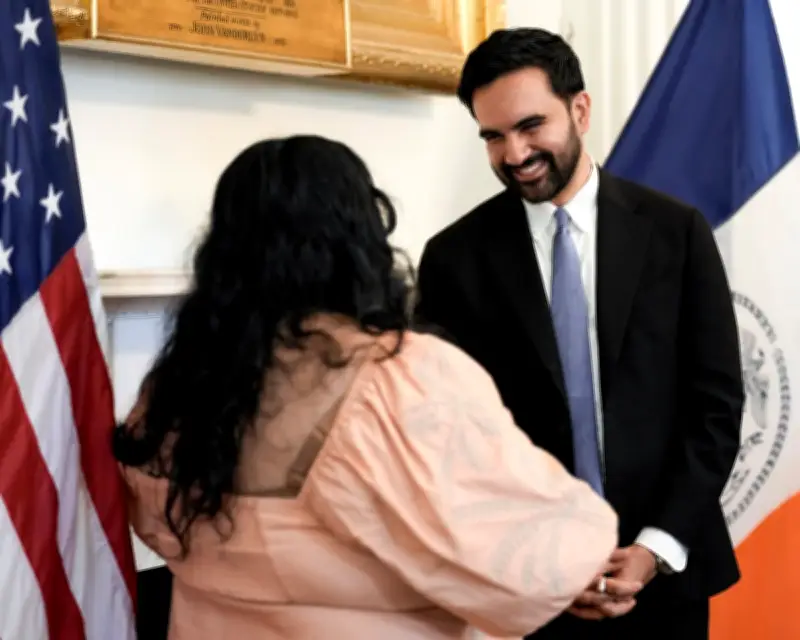
On July 3, 2025, New York City Mayor Zohran Mamdani delivered a speech at George Washington's desk, flanked by newly naturalized citizens, offering a vision of unity and historical reflection. In contrast, President Donald Trump spoke from Mount Rushmore, rewriting the past and attacking opponents as "godless communists." The dueling addresses highlighted competing visions for America's future.
Mamdani's Call for Unity and Historical Honesty
Mamdani's speech, about half the length of Trump's 28-minute address, acknowledged America's contradictions. "We see a city of contradictions within a nation of contradictions," he said. "We see the wealthiest country in the history of the world – one where children go to sleep hungry while the world's first trillionaire hungers for more."
The mayor referenced the Lenape people, chattel slavery, and immigration, noting Irish immigrants escaping famine and Jewish people fleeing pogroms. He warned against authoritarianism: "Those ideals upon which our nation was built – they are strong enough to endure any authoritarian regime, but only if we reach for them."

Trump's Revisionist History and Stump Speech
Trump's Mount Rushmore address, delivered on stolen Lakota land, attacked "Marxist lies" and promised to protect America's heritage. He repeated his claim that the U.S. was "laughed at, mocked" two years ago but now is "the hottest country anywhere in the world." However, Pew Research Center found sharp declines in U.S. favorability globally. Trump also labeled opponents "godless communists," a cold war-era term.
On July 4, Trump's Washington speech, nearly rained out, featured centenarian veterans and old flags, but offered less substance. He continues to rally for Republicans facing tough midterm elections.
Divisions and Polling Realities
Mamdani, a Muslim democratic socialist, directly addressed political division: "Division is the oldest trick in politics, and the cheapest." Trump's approval rating stands at 39%, while Mamdani polls at 48%, according to recent data. Historian Nick Estes noted that the Lakota people refuse compensation for the Black Hills, demanding the land's return.
As Moustafa Bayoumi, author of How Does It Feel To Be a Problem?, wrote: "Between reality and fiction, we must choose where we want to live."