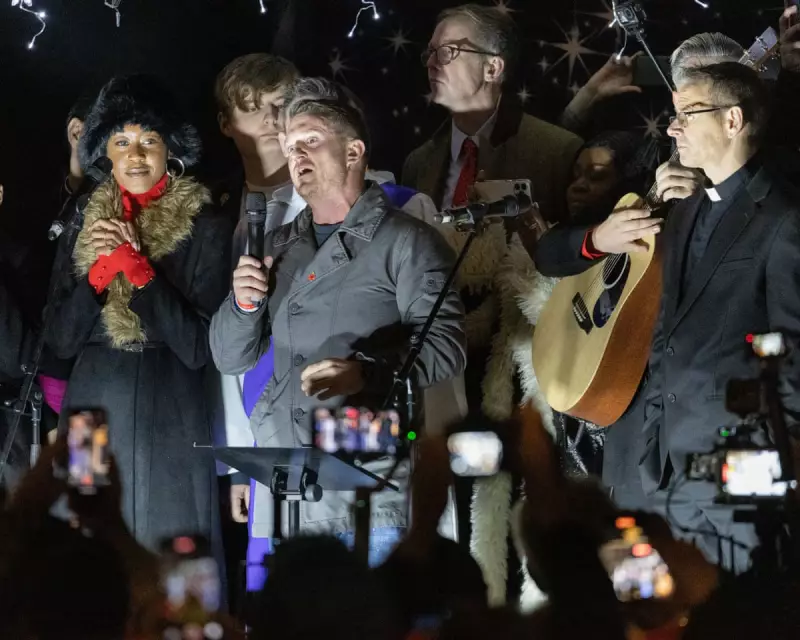
The leader of the anti-migrant far-right movement, Tommy Robinson, presided over a Christmas carol service on Whitehall in London on 13 December, but the event was marked by a strikingly low turnout. Approximately 1,500 people attended, a figure that stands in stark contrast to the estimated 150,000 who joined his 'Unite the Kingdom' (UTK) rally in central London just three months earlier in September.
A Subdued Gathering in Whitehall
Robinson, whose real name is Stephen Yaxley-Lennon, had publicly framed the event as a non-political celebration of Christmas. This may have deterred some of his more ardent political activists. While crosses and flags were visible among the crowd in the mid-December twilight, there was little overt discussion of his typical political themes from the preachers or most attendees.
One attendee, Gary, who arrived early to secure a prime spot, told reporters he was a believer but did not attend church, a sentiment echoed by others. The subdued atmosphere was punctuated only by isolated complaints about schools and small groups handing out leaflets on immigration.

The Church's Conundrum Over Christian Nationalism
Since Robinson's release from HMP Woodhill in May, where he emerged wearing a wooden cross and claiming a prison conversion, UK churches have faced a profound dilemma. Robinson has repeatedly positioned himself as an advocate for a Christian revival, telling the Visegrád 24 platform that "it is Christianity" that made Britain.
This embrace of Christian symbolism by the far right has created deep divisions within the Church. The Bishop of Kirkstall, Arun Arora, who co-leads on racial justice for the Church of England, stated he "rejoiced" at Robinson's conversion but insisted he must now hear the gospel's core messages of love, compassion, and justice.
"Not everyone who goes on a UTK march is racist. No one is in favour of uncontrolled immigration. But that doesn't mean you stand neutral in the face of Robinson's message," Arora argued, highlighting the nuanced challenge.
Internal Debates and a Tepid Official Response
Pressure mounted on the Church of England to respond firmly in the lead-up to the carol service, with criticism also voiced by the Baptist Union, Methodists, and the United Reformed Church. The day before the event, the C of E's national office released a 43-second video stating "Christmas belongs to all of us," which officials indicated was an indirect response to Robinson's rally.
Differences in approach are believed to exist at the highest levels of the Church. The incoming Archbishop of Canterbury, Sarah Mullally, condemned the use of "Christian symbols to oppress" but is thought to be wary of a direct political battle. In contrast, the Archbishop of York, Stephen Cottrell, has a long record on racial justice issues.
In January, C of E bishops are scheduled to discuss the church's official response to Christian nationalism and the far right at a regular meeting. Thinktank Theos's senior fellow, Nick Spencer, who is studying the phenomenon, described the Church's position as a genuine bind: "If it embraced rightwing activists... it would 'get its head kicked in'; if it slammed the door... it would be 'missionally-speaking a catastrophe'."
Baptist minister and activist Steve Chalke warned that ignoring Christian nationalism was "really unwise. You don't ignore a cancer in your body." He pointed to a broader societal search for meaning in a "post-secular" Britain.
The future trajectory remains uncertain. Robinson and UTK have already announced plans for a 16 May demonstration in central London billed as the "largest demonstration for national unity and strength this country has ever witnessed," notably without any mention of Christianity. Whether Robinson persists with his Christian nationalist rhetoric or quietly abandons it may define the next chapter of this complex intersection of faith, identity, and politics in the UK.