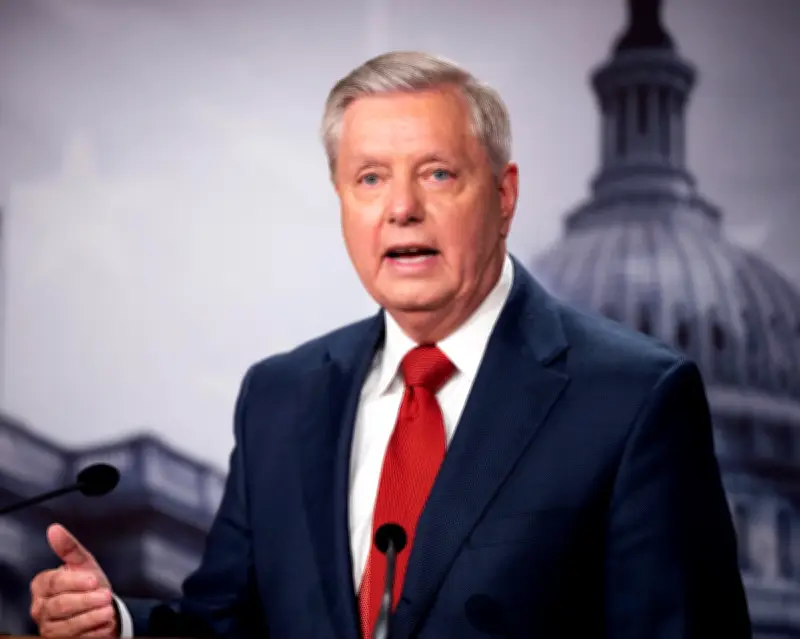
Senator Lindsey Graham died on Saturday at age 71 after a brief and sudden illness, his office confirmed. The South Carolina Republican, known for his hawkish foreign policy and role in shaping the conservative Supreme Court, suffered a cardiac arrest near his Washington D.C. home, according to a report from The Washington Post. Emergency services were called around 8:30 a.m., but the senator could not be revived.
Trump leads tributes
Former President Donald Trump was among the first to honor Graham, calling him “a true American Patriot” on his Truth Social platform. “Senator Lindsey Graham, one of the greatest people and Senators I have ever known, is dead! He was always working, and was a true American Patriot. Lindsey will be greatly missed!!! DETAILS AND ARRANGEMENTS TO FOLLOW. So sad!” Trump wrote.
In an interview with NBC’s Meet the Press on Sunday, Trump highlighted Graham’s key role in confirming Supreme Court Justice Brett Kavanaugh in 2018. “I don’t think he could have gotten through without Lindsey,” Trump said. “He was a great politician. He really was. He got along with a lot of people that you wouldn’t think of. He was somebody that loved our country. And he fought very hard for the country.” Trump added that he had spoken with Graham on Saturday after the senator returned from a trip to Ukraine, urging him to rest.
Vance, McMaster, and Bush remember Graham
Vice-President JD Vance described Graham’s life as “a fundamentally American one,” noting his humble beginnings and rise to power. “He fought like hell for the things he believed in, and he was just as willing to go to bat for you when it counted. Lindsey had the best sense of humor in the Senate. He loved the game of politics ... we certainly had our disagreements. But I couldn’t help but like him,” Vance said on X.
South Carolina Governor Henry McMaster released a statement calling Graham “irreplaceable” and “the fiercest of fighters for South Carolina and America.” Former President George W. Bush praised Graham as “a knowledgeable Senator who understood how the world works and how important America’s engagement is to resist tyranny.” Senate Majority Leader John Thune said his “heart is heavy” and noted Graham’s long service in the Air Force and Congress made him “a strong advocate for the United States and a strong ally to freedom-loving countries across the globe.”
International leaders react
Ukrainian President Volodymyr Zelenskyy expressed deep sadness, recalling that Graham had visited Ukraine ten times since the Russian invasion in 2022. “He was a true defender of freedom and the values that make our world safer,” Zelenskyy said on X. “He … was here with our people when it was most needed. We remained in constant dialogue, and I will miss our conversations.” Zelenskyy noted that Graham had been working on initiatives for stronger sanctions against Russia, which were due to be introduced in the Senate.
Israeli Prime Minister Benjamin Netanyahu called Graham “one of Israel’s greatest friends,” stating, “Lindsey understood that the security of Israel and America are inseparable. He devoted his life to defending America, strengthening our alliance and standing up for the free world.” NATO Secretary General Mark Rutte said he was “so sad to learn of the sudden passing of my friend,” adding that Graham was “a powerful advocate for America who believed strongly in the NATO Alliance and was actively working to bring an end to Russia’s war against Ukraine.” German Chancellor Friedrich Merz hailed Graham as “a true friend and partner of Germany,” with whom he stood “side by side for more than four decades.”
Legacy and policy impact
Graham’s influence extended across the Middle East, Russia, and Ukraine. Texas Congressman Michael McCaul credited Graham with a new Russia sanctions bill, saying on ABC News This Week, “I think in his honor that we owe it to Lindsey Graham to pass that tough Russian sanctions bill. He would love nothing more than that.” Graham’s death comes just after his latest trip to Ukraine and before Congress was set to return to session on Monday. His office described the cause as a “brief and sudden illness,” with the Post reporting the cardiac arrest call at 8:30 a.m. near his D.C. home.