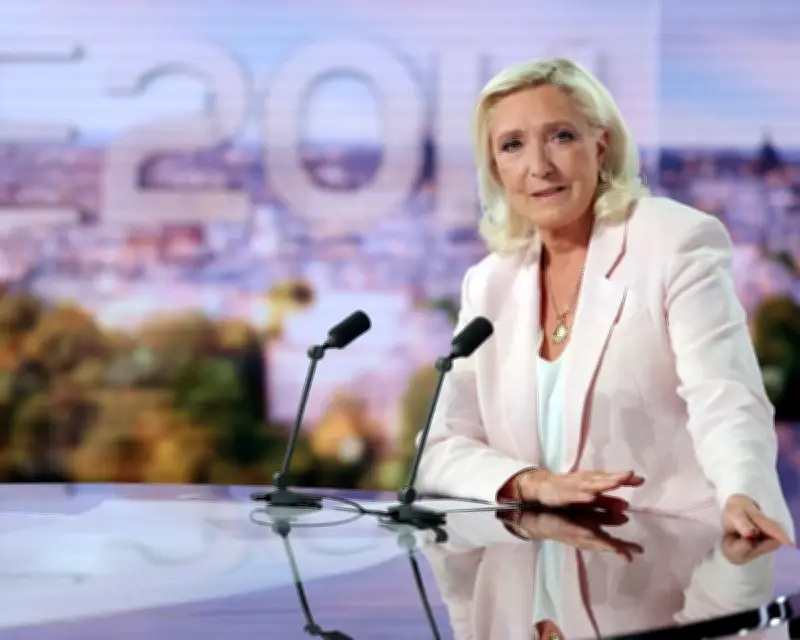
Marine Le Pen, the far-right National Rally (RN) figurehead, has been cleared to run for the French presidency in 2027 after a court of appeal upheld her conviction for misappropriation of public funds but shortened the ban on holding electoral office. The court sentenced her to a fine of €100,000 (£85,000), a commuted prison sentence, and electronic tagging for one year. However, the original five-year ban from running for office—which would have eliminated her from the presidential race—was reduced, allowing her to stand.
Court ruling sparks political debate
The verdict, delivered on Tuesday, was seen as a masterful move by the judiciary. By upholding the conviction while enabling Le Pen to run, the court preserved the rule of law and avoided accusations of politically motivated interference in democratic rights. Le Pen had previously promised not to campaign while under curfew with an ankle device, but she quickly announced on TF1 evening news that she would stand as the RN candidate, appealing to France's highest court on a point of law to potentially avoid the tag.
According to Catherine Fieschi, a visiting scholar with Carnegie Europe, the ruling forces Le Pen to wrestle with a dilemma: keep her promise or let her protégé Jordan Bardella run. She chose the former, appearing defiantly on television to declare that it would be up to French voters to decide.
Populist parallels with Nigel Farage
The timing of Le Pen's appeal coincided with Nigel Farage's response to a UK parliamentary investigation into alleged financial misconduct. Farage lashed out against what he called a system hounding him for success, framing it as a "people versus the establishment" election. Both Le Pen and Farage, as populists, weaponize democratic institutions or bypass them, claiming that "the people" know better than state institutions.
Fieschi notes that Le Pen's decision to run rather than Bardella is a greater risk to France and Europe. Her experience as a campaigner makes her a tougher opponent than the 30-year-old Bardella, who would struggle under the scrutiny of a presidential campaign. Moreover, Le Pen is more belligerent toward the EU and closer to Russia than Bardella.
Implications for French democracy and EU
Should Le Pen win, she would be ruthless in undermining French democratic institutions. The presidential system concentrates significant power in the executive, making comparisons with Italy's Giorgia Meloni irrelevant—France's president is far more powerful. Le Pen's win would be an earthquake at the heart of Europe, Fieschi warns.
The verdict raises two immediate questions: Will Bardella accept his fate as a potential prime minister to Le Pen, or will it trigger a succession battle? More seriously, can a credible candidate emerge to defeat her in the second round? The left remains fragmented, and the mainstream right is embroiled in infighting, egged on by radical left leader Jean-Luc Mélenchon. Since the 2024 crisis and Macron's snap election decision, the political class has failed to mount an orderly challenge.
Le Pen's defeat depends on whether a capable candidate can rally support. In 2017 and 2022, she lost to Emmanuel Macron, but the margin narrowed. After a decade of Macron, Russian disinformation, and a polarized public, she is closer than ever to power.