A late-night earthquake with a magnitude of 3.3 struck off the coast of Lancashire, shaking homes and waking residents across the North West of England.
Residents Woken by Late-Night Tremor
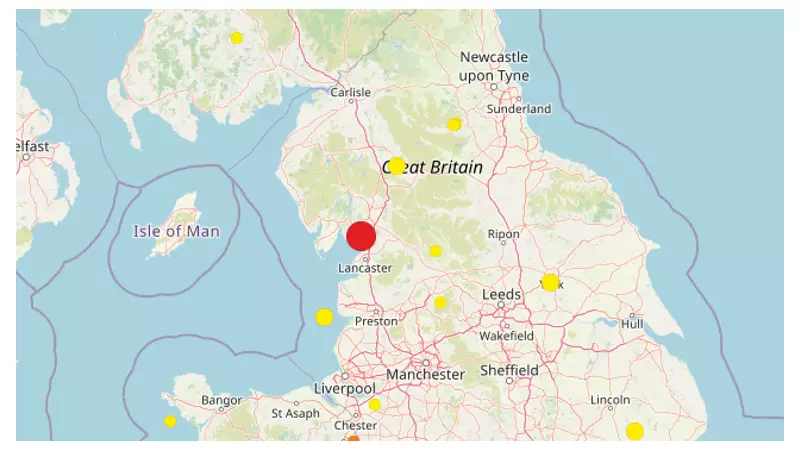
The British Geological Survey (BGS) confirmed the quake occurred at 11.23pm on Thursday, 4 December 2025. Its epicentre was located off the coast of Silverdale in north Lancashire, at a depth of approximately 1.86 miles (3km).
Seismologists reported the tremor was felt across the South Lakes and Lancashire, mainly within a 20km radius. This included areas in neighbouring Cumbria such as Kendal and Ulverston.

Social Media Buzz with Eyewitness Reports
Dozens of people took to social media to describe their experiences. One individual in a lakeside holiday rental in Carnforth reported, "Whole place shook twice."
Other vivid accounts emerged online. One person described the sensation as "like an explosion and vibration coming from underground," while another said it "sounded like bricks falling/the roof falling in." A further comment noted the quake was "so powerful to shake the whole house."
While most reports clustered near the epicentre, some unverified accounts suggested the shaking was felt further afield on the Fylde Peninsula, in locations like Poulton-le-Fylde and Fleetwood.
Understanding Earthquakes in the UK
The BGS detects and locates between 200 and 300 earthquakes in the UK each year. Of these, only 20 to 30 are typically felt by people, with the remainder being minor tremors picked up by sensitive instruments. Most are very small and cause no damage.
The most recent UK earthquake stronger than this event was a 3.7-magnitude tremor recorded near Loch Lyon in Perth and Kinross on 20 October 2025.
The region has experienced human-induced seismic activity in the past, notably linked to fracking operations. A 2.1-magnitude tremor at Cuadrilla's site near Blackpool in 2019 contributed to the ban on fracking in England. Interestingly, the BGS has also registered ground vibrations from major crowd events, such as Liverpool FC goal celebrations.
This latest event serves as a reminder that the UK, while not on a major tectonic boundary, still experiences occasional natural seismic activity that can capture public attention.