The Unseen Power: How Khalifa Haftar Controls Libya from the Shadows
In July 2025, a high-level European delegation arrived in eastern Libya with urgent concerns over surging migrant arrivals and failing agreements. They sought a private audience with Khalifa Haftar, the 82-year-old former CIA asset who unofficially runs the country. However, Haftar imposed a condition: the Europeans must first meet publicly with ministers from the eastern administration, a government not officially recognized by any country. When they declined, they were denied entry, left waiting in the airport lounge. This humiliation exposed Libya's central fiction: to access the nation's most powerful man, one must pretend he is not in charge.
A Nation Torn by Foreign Intervention
When NATO helped overthrow Muammar Gaddafi in 2011, hopes for a new beginning were high. A decade later, Libya remains a cautionary tale of unintended consequences from foreign intervention. The country is split between two governments—one in Tripoli and one in Benghazi—neither of which effectively governs. The UN and Europe recognize the Government of National Unity in Tripoli, formed in 2021 to oversee elections that never materialized. In response, the House of Representatives, Libya's parliament elected in 2014, appointed a rival government in Benghazi in 2022, though it lacks international recognition. Both administrations claim national authority, yet neither controls the oilfields, military bases, or migration routes that make Libya strategically important to Europe.
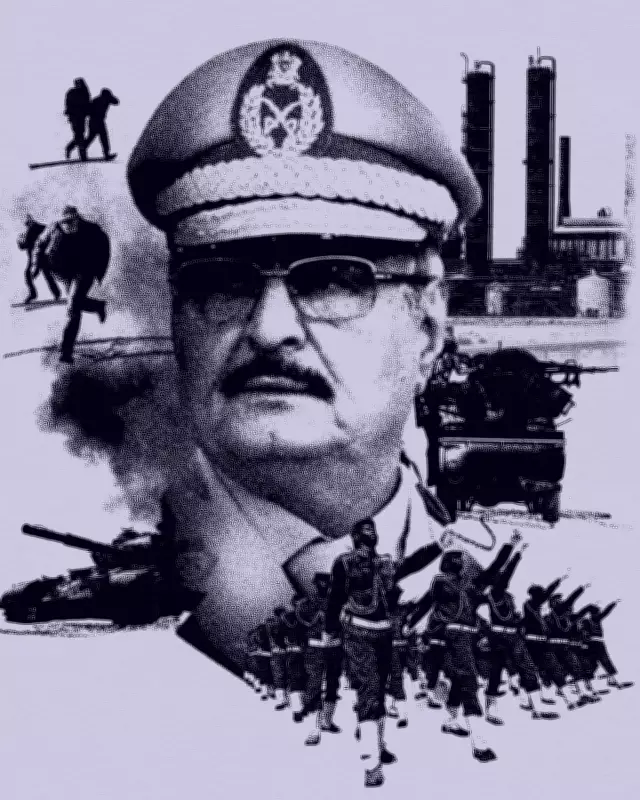
Khalifa Haftar, with the title of general commander of the Libyan National Army—a coalition of militias assembled in 2014 and later endorsed by the eastern parliament—holds real power. His forces dominate the oilfields and export terminals across central Libya, police the eastern coastline, and manage smuggling routes fueling Europe's migration crisis. His bases host foreign militaries involved in Sudan's civil war, which drives refugees north toward Libya. For Europe, grappling with migration, energy insecurity, and regional spillover, Haftar controls everything that matters.

The Foundations of Haftar's Power
Haftar's political journey began with betrayal. In 1969, as a 25-year-old officer, he stood alongside Gaddafi to overthrow King Idris. Rising through the ranks, he became a trusted military commander. In 1986, Gaddafi sent him to command Libyan forces in Chad, where a disastrous defeat led to Haftar's capture. Gaddafi denied his existence, mocking him as "a shepherd in the desert." This betrayal fueled Haftar's resentment and caught the attention of the CIA, which saw an opportunity to turn him against Gaddafi.
During his imprisonment in Chad, Haftar learned to wield power from behind the scenes. The CIA provided support, and he took control of the camp, enforcing discipline among prisoners. In 1988, he established the Libyan National Army, a name he would revive later, giving the CIA a fiction to support. After a failed coup attempt in the 1990s, Haftar's relationship with the CIA cooled, but he maintained ties with Gaddafi, receiving a villa in Cairo as a gift. By 2011, when the Libyan revolution erupted, Haftar returned to Benghazi with a mission to take over, not just join, the uprising.
Building a System of Control
Initially sidelined by revolutionaries distrustful of his military background and foreign connections, Haftar bided his time. As Libya descended into chaos post-2011, with militias dividing Tripoli and assassinations rampant in the east, Haftar saw an opening. In 2014, he launched Operation Dignity, declaring a "war on terror" against Islamists and reviving the Libyan National Army. Backed by Egypt and the UAE, his forces attacked jihadist factions and revolutionary brigades, plunging the country into civil war.
By 2015, Haftar had been appointed head of the army by the eastern parliament, giving his militias legal cover. He controlled the parliament through intimidation, with dissenters disappearing or fleeing. The UN's attempts to broker unity failed, handing Haftar a veto over national governance. Today, from a Soviet-era airbase in Rajma, he runs a system where power exists nowhere on paper but controls everything essential: oil, courts, and armed forces.

The Mechanics of Silent Rule
Haftar's power is propped up by foreign patrons. Egypt, Russia, and the UAE officially recognize the Tripoli government but practically support Haftar. The UAE bankrolls his operations, Egypt provides intelligence and base access, and Russia supplies mercenaries. In May 2025, Vladimir Putin received Haftar at the Kremlin, offering diplomatic protection at the UN Security Council. Without these backers, Haftar's system would collapse; with them, it remains untouchable.
Inside eastern Libya, dissent is met with violence. Since 2014, criticism has been labeled terrorism, with protests, conversations, or social media posts potentially leading to death. Bodies have been found dumped on streets, and disappearances are common. Hanan Salah of Human Rights Watch notes that Haftar operates with total impunity, as the international community chooses appeasement over accountability.
Financial Grip and Future Uncertainties
Haftar's financial control has tightened over time. In late 2024, counterfeit dinars flooded the economy from the east, financing his forces and paying Russian mercenaries. The central bank in Tripoli faced a dilemma: expose the fraud and risk economic collapse or absorb the loss silently. They chose silence, illustrating how institutions survive in Libya by accepting what they cannot confront.
Now at 82, Haftar faces the challenge of succession in a system built for one man. His sons have been groomed to take over: Saddam as deputy commander-in-chief, Khaled as chief of staff, Belkacem managing reconstruction contracts, Al-Siddiq handling tribal politics, and Okba overseeing cryptocurrency and AI. However, dividing power among five heirs in a fractured Libya, with a rival government and militias, poses significant risks. Gaddafi's sons, despite decades of grooming, were torn apart by the revolution; Haftar's sons lack a unifying ideology, relying only on pragmatism for survival.
Libya stands as a parable of intervention gone awry. Every foreign intervention promises freedom after removing a dictator, but Libya shows what happens when the people are forgotten. Haftar's system—controlling everything that matters while being answerable for nothing—forces a global pretence that this arrangement does not exist. As crises converge on Libya's shores, the world continues to navigate the silent rule of a man without a throne.