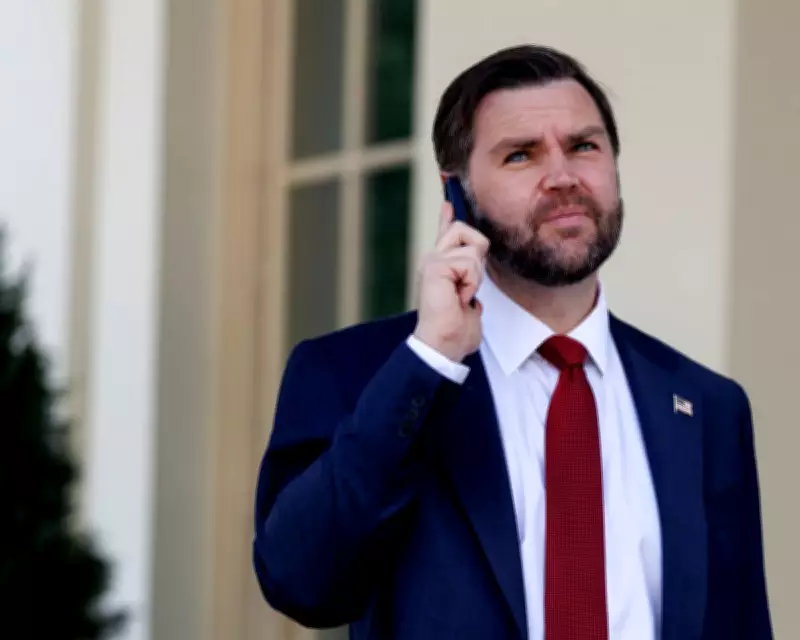
Vice-President JD Vance's Alien Obsession: A Political Escape from Earthly Woes
In a world where filling a gas tank costs a vital organ, unemployment runs rampant, and reality TV shows like Bravo's Summer House crumble, it's no wonder Vice-President JD Vance is turning his gaze skyward. His recent comments on extraterrestrials reveal a deep-seated fascination with the unexplained, but perhaps more tellingly, they hint at a desire to flee the mounting crises on Earth.
The Vice-President's Unconventional Theory
During an appearance on The Benny Show, a conservative podcast, Vance outlined his obsession with UFOs, dismissing the idea of aliens in favor of a more theological explanation. He stated, "I don't think they're aliens, I think they're demons anyway, but that's a longer discussion." Vance elaborated, drawing from his Christian beliefs to suggest that celestial beings, often misinterpreted as aliens, are part of a broader spiritual reality where good and evil coexist.
This theory, while unconventional, resonates with a significant portion of the American public. A 2023 Gallup poll found that 58% of Americans believe in Satan, a figure that surpasses the voting support for Vance's boss, former President Donald Trump. Vance argued that the devil's greatest trick is convincing people he never existed, yet the poll data suggests otherwise, highlighting a cultural divide in beliefs about the supernatural.

Fueling Interest in the Unexplained
What drives Vance's preoccupation with demons and aliens? Is it boredom, as Secretary of State Marco Rubio takes center stage in Trump's foreign policy maneuvers, such as the folly in Iran? Or perhaps loneliness, with his wife engrossed in her podcasting endeavors? Maybe it's a simple desire for escape, inspired by stories like Project Hail Mary, which envision a better existence among the stars.
Vance's interest might stem from a yearning for a realm free from Earth's troubles—a paradise with short airport wait times, free guacamole at every restaurant, and Major League Baseball games without blackout restrictions. With Trump's approval ratings plummeting and Vance's own political prospects dimming for the 2028 election, a spaceship ride to a distant world could seem like an appealing alternative.
A Political Strategy or a Genuine Belief?
There's a darker possibility: Vance might hope for a rapture-like event to whisk away his political rivals, clearing his path to the White House. Imagine enticing figures like Gavin Newsom with a Michelin-starred restaurant onboard or luring Lindsey Graham through Disney World's Star Wars land. Such fantasies, while humorous, underscore the desperation in today's political landscape.
Ultimately, Vance's musings reflect a broader sentiment. Many people, weary of war, hunger, and disease after decades of turmoil, might welcome a fresh start on a barren celestial body, free from human prejudices and selfish behaviors. And for those tired of reality TV, a world without Summer House could be the ultimate bonus.
In the end, while Vance's theories may seem outlandish, they tap into a universal longing for something better beyond our planet. As Dave Schilling, a Los Angeles-based writer, notes, don't invite Andy Cohen on the spaceship—no one needs the Real Housewives of Tau Ceti. This exploration of the unexplained serves as a poignant commentary on our times, where looking to the stars might just be the only escape left.