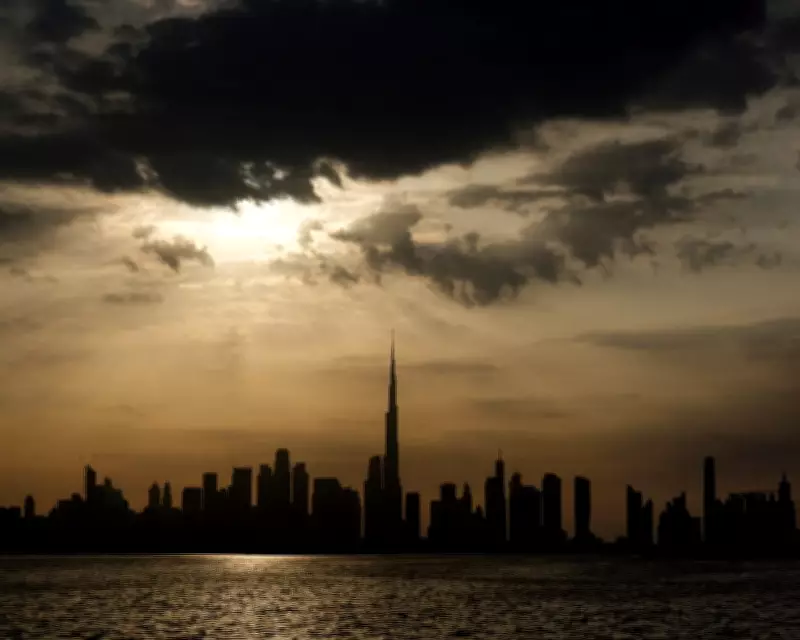
Gulf States Grapple with War's Impact on Image and Economy
The conflict between Iran and US-Israeli forces has dramatically shifted the geopolitical landscape of the Middle East, with Gulf states finding themselves unexpectedly on the frontline. As drones and missiles shower the United Arab Emirates, Qatar, Kuwait, Bahrain, and Saudi Arabia, the region's oil and gas industries have ground to a near standstill, prompting a significant exodus of tourists and expatriates.
Dubai's Strange New Reality
Less than 100 miles from Iran, Dubai has settled into a surreal rhythm amid the ongoing conflict. Fighter jets now share skies traditionally dominated by commercial airliners, while luxury hotels have become surprising targets for Iranian projectiles. This juxtaposition of water skis on the Persian Gulf and military aircraft overhead raises fundamental questions about how Gulf states can maintain their carefully cultivated image of quiet luxury and peace.
Hannah Ellis Peterson, the Guardian's south Asia correspondent covering the war from Dubai, notes that "The UAE never expected to be on the frontline of this war – particularly Dubai, a place that has worked very hard to build itself up as a safe haven of tourism."

Economic Consequences Mount
The economic impact has been severe and multifaceted. Qatar's liquefied natural gas production remains completely suspended, while the Strait of Hormuz – a crucial bottleneck through which approximately 20% of the world's oil normally flows – has become almost entirely impassable due to fears of Iranian attacks. Gulf states are spending billions intercepting missiles and drones, even as their primary revenue sources from oil exports diminish dramatically.
"They can sustain it for another week or two," Peterson explains regarding the economic strain. "But the worst case scenario is that it keeps dragging on." The longer the conflict extends, the more difficult recovery becomes for economies heavily dependent on energy exports and tourism.
Security Partnerships Questioned
The conflict has exposed vulnerabilities in Gulf states' security arrangements with the United States. Despite hosting approximately 40,000 American troops across military bases in the Persian Gulf region, these states have found their protection guarantees tested. Qatar was bombed by Israel in September, and Saudi Arabia has come under attack, with limited American response in both cases.
Peterson observes that "the idea that these bases operated as a form of protection for Gulf states is increasingly becoming undermined." Yet Gulf states face a dilemma – they need superpower protection but cannot afford to publicly criticize their allies, especially as they may soon require additional weapons from the United States for self-defense.
Social Realities Beyond the Luxury Facade
Media coverage has often focused on wealthy influencers leaving Dubai, but this presents a distorted image of the city's actual population. Hundreds of thousands of migrant workers from India and Nepal cannot afford to leave, bound by economic constraints and sometimes coercive work contracts. Additionally, Dubai has become home to refugees from Syria and Afghanistan who were not welcomed in Western nations.
"Lots of rich people come to have a nice life and not pay any taxes and make lots of videos about it, but they are not the only people that live in Dubai," Peterson emphasizes. "The city is also seen as a safe haven for those driven from other places in the Middle East – this conflict is not going to send them away."
Legal Crackdowns and Regional Tensions
Authorities in the UAE have implemented strict measures against sharing conflict-related content, with a 60-year-old British man among twenty people charged for allegedly violating cybercrime laws by posting material about Iranian attacks. Meanwhile, Tehran continues to insist it is not targeting the UAE, a claim Peterson describes as "clearly ridiculous."
The conflict has fundamentally altered regional dynamics, with Gulf states that had pushed hard to avoid war now facing direct consequences. As the fighting enters its third week, questions mount about long-term relations between Gulf states and Iran, particularly if the Iranian regime emerges weakened but volatile from the conflict.

The mirage of perpetual peace and luxury in the Gulf has been perforated by drone strikes, revealing complex realities beneath the glossy surface. How these states navigate security challenges, economic pressures, and social complexities will determine their future trajectory in an increasingly unstable region.