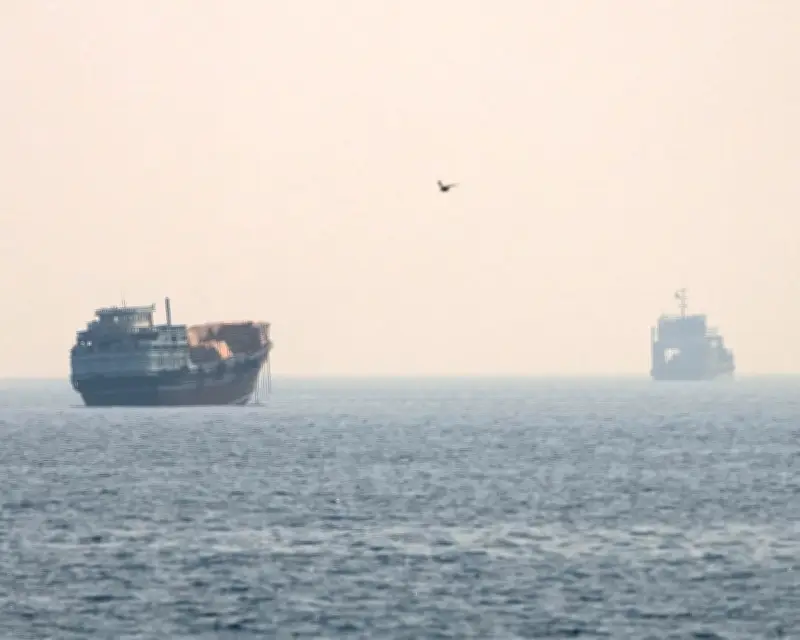
On Tuesday, Iran attacked a new southern route the US attempted to create through the Strait of Hormuz, arguing it was an attempt to undermine the memorandum of understanding (MOU). The attack targeted a shipping lane that the US and Oman had recently tried to establish, escalating military exchanges in the strategic waterway.
Heightened Atmosphere in Iran
The atmosphere in Iran remains highly charged after the funeral of Ayatollah Ali Khamenei and an escalation of grievances with the US. Before a foreign ministry press briefing at the Grand Hotel Tehran, reporters were asked to stand for the national anthem. Spokesperson Esmail Baghaei claimed the world was witnessing a turning point in Shia Islam, comparing the assassinated ayatollah to Imam Hussain and Donald Trump to the tyrannical caliph Yazid.
Baghaei portrayed Iran as the victim of an epochal struggle to protect its independence. Although streets outside were returning to normality after Khamenei's funeral, the wave of religiosity and patriotism had moved to Najaf, Iraq, where the supreme leader's coffin was taken to the shrine of Imam Ali.
Trump's Remarks and Military Flare-Up
At the NATO summit in Turkey, Trump described Iranians as “garbage”, “cancer”, “devils”, and “scum”, declaring further talks a waste of time. The latest military flare-up, including Tuesday's exchange of fire in the Strait of Hormuz, may be seen as a product of this juxtaposition: Trump aggrieved at Europe's free-riding, and Iran asserting itself as a brave nation.
Optimists hope the mood may dissipate, as Trump left the door open for talks and mentioned Israel leaving Lebanon, a key Iranian demand. However, it appears that Iran's military, not diplomats, are now making decisions, as confidence-building measures have failed.
Risk of Escalation
Eric Brewer, a former US national security adviser, said Trump may be reaping consequences of his actions. “He accepted a vague agreement that postponed many issues because he was concerned about economic consequences of continuing the war,” Brewer said. Vali Nasr, author of Iran’s Grand Strategy, warned that escalation could end the MOU, which was designed for peace talks. “Iran believes the US wants to use it to gain control of the strait – and if that is the case, Iran must be prepared to go to war,” Nasr said.
Ellie Geranmayeh, Middle East analyst at the European Council on Foreign Relations, said sequencing is a problem: “Iran does not want to cede leverage over the strait before a broader deal on US economic relief. For Trump, reopening the strait is the heart of the MOU.”
Iran's Stance on MOU
Baghaei insisted the MOU refers to continued Iranian control of the strait for at least 60 days, and argued the US-Omani attempt to create a new southern route is incompatible. “The problem is that the US is interfering in Iran’s business,” he said. Iranian diplomats know the MOU articles by heart, as the agreement was designed to defer nuclear issues until Iran receives tangible gains like sanctions relief.
The recent surge of ships through the southern route and falling oil prices alarmed Iran. Tehran needed to take back control to avoid losing leverage for sanctions relief and a ceasefire in Lebanon. The US says the MOU's main objective was reopening the strait, and an Iranian veto was never part of the deal.
Compounding Crisis
The US on Tuesday revoked its sanctions waiver on Iran’s oil exports only 17 days after its introduction, the one tangible benefit Iran had received. Those close to the crisis aim to create a joint notification system for ships passing through the strait, involving Iran and Gulf Co-operation Council members. This would loosen Iranian sovereignty but not abandon it.
Behind this diplomacy is a bigger problem: Iranian diplomats insist all ships transiting the strait must pay a security fee – a proposal universally rejected but which Iran seems unwilling to give up. For now, the only constraint on all-out war is that it has been tried and failed.