Does it seem as if almost anyone could be Britain’s next prime minister? Blame David Cameron, writes Zoe Williams. In the late 1800s, the boxing and wrestling scene of east and south-east London was going through a transformation. If you are genuinely interested in that, the work of historian Sarah Elizabeth Cox is highly recommended. If, on the other hand, you are more interested in political analogy, consider this: boxing starts as a legitimate contest between men trying to render each other unconscious; then it morphs into strongman pantomime, with one amazing boxer in the ring and have-a-go heroes trying their luck; then it leans into showbiz elements; and after that, chaos ensues. The strongman suddenly wrestles a donkey called Steve (this really happened). People slice lemons with swords during the interval. It becomes a terrible stain on the noble sport, yet it looks revivified because suddenly every idiot in town thinks they can have a go.
This is more or less what has happened to the office of prime minister, and Williams goes out on a limb to say that this, unlike everything else to befall this stricken nation, is not Keir Starmer’s fault. Amazing as it is to even type this, it is not Boris Johnson’s fault either. It started with David Cameron.
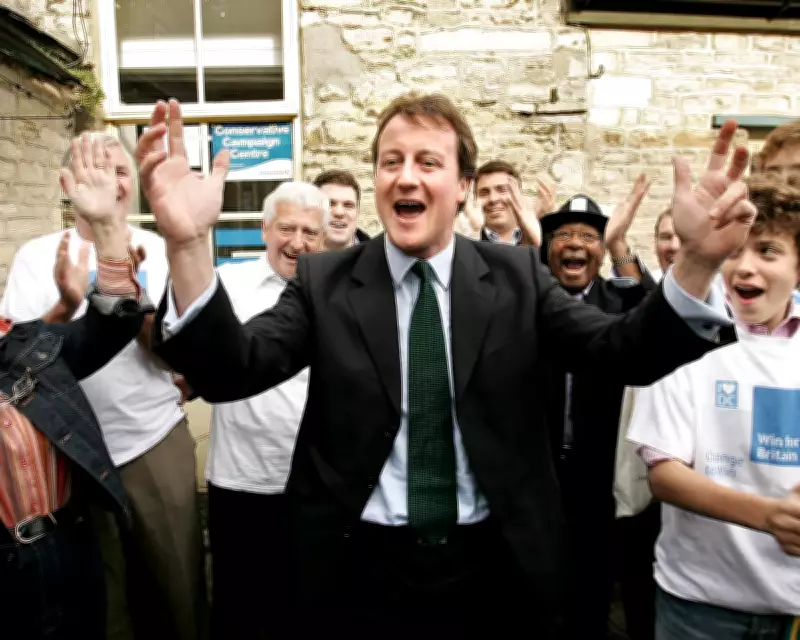
Cameron’s justification for seeking the highest office was: “I think I’d be rather good at it.” But what is often forgotten in that narrative of an indolent, entitled youngish man raised to look at complicated systems and think, “Who better to steward that than myself?” is that his real triumph was at the Tory conference in 2005, when he came off as the breath of fresh air needed by a party that had been uncharacteristically out of power for nearly a decade. Though you know what they say about Conservatives: they are always in power, only sometimes in office. Or at least, that is what they used to say in the old days of wrestling… sorry, Westminster.

Cast your mind back to 2005, unless you want to stay cheerful, in which case go do literally anything else. The other candidates were Ken Clarke, who sounded sane and reasonable, and was therefore dead in the water, the party having already had enough of all that; Liam Fox, who made a racist and sexist joke about the Spice Girls for which he later apologised; David Davis, who actually won the most votes in the first round but did not tip 50% and therefore had to go to round two; and Cameron himself. At the risk of sounding Facebook-nostalgic to the point of being a Tory member, this is not how leaders of political parties used to be chosen: “Please, not any of these candidates we know. Let us give that guy we do not know a shot. He looks quite energetic, or at least pink.”
Before 2005, a leader would have had a rich political hinterland. They would have launched from a power base, would have an origin story going back to a definable political wing of their own party, and would have been forged in the fire of the harshest imaginable competition. Cameron had a stint in the early 90s helping to define Majorism. QED. What was to stop anyone, after that, chancing their arm? Was it really so outlandish for the next battle to be between Theresa May and Andrea Leadsom, whose fundamental political difference (if recollected correctly) was about whether it was sexist to critique your opponent for her childlessness (why yes, it is)? By the time Johnson had flamed out for personal failings that had been visible from space for decades, it would have been almost rude not to have a go, a pattern that deepened into an elemental truth by the time of Liz Truss. Her only distinction – and you cannot take this away from her – is that she did not even spend enough time in office to do any damage, yet managed to do an awesome amount anyway. Can there have been a single Tory MP who did not, on some level, think, “Well, I could not do worse than that”?
And now here we are, Labour going through a strikingly similar back-and-forth psychodrama of: “Not this guy; but there is no one else; but not this guy; but… etc.” You start to look at people who are not MPs, people who are not even politicians, and think, “I do not see why not.” But here, unlike music-hall wrestling, politics hits the buffers of reality. You cannot manifest a David Attenborough prime ministership, with Emily Maitlis as foreign secretary, by force of will.