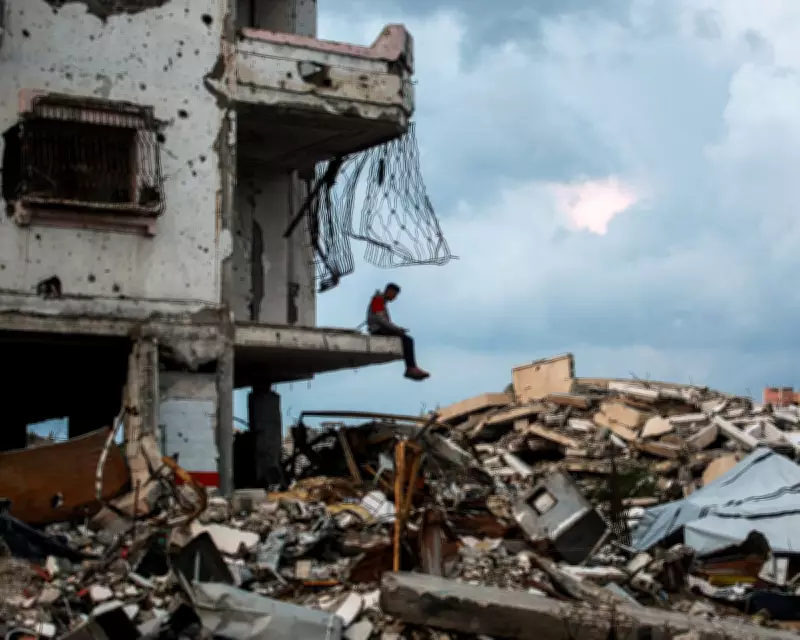
Gaza's Dire Reality: Ceasefire Fails to Halt Suffering Amid Global Distractions
Five months after a ceasefire was officially announced in Gaza, the humanitarian situation remains catastrophic, with airstrikes continuing to claim civilian lives and basic survival becoming an overwhelming daily struggle. The world's attention may have shifted toward Iran, but in the shattered streets of Gaza, Palestinians face a reality stripped of normalcy, where fear, loss, and deprivation define every moment.
A Landscape of Ruin and Constant Threat
The physical and psychological scars of war are omnipresent. Ahmed Baroud, a 56-year-old father of five displaced in Deir al-Balah, describes an environment of unending tension: "Drones never stop buzzing overhead, gunfire and shelling continue almost daily, and naval boats fire towards fishermen." This persistent threat makes the concept of a ceasefire feel distant and theoretical for residents.
Recent violence underscores this grim reality. Health authorities reported that six people were killed and four others injured early on a Sunday by an Israeli airstrike on the al-Mawasi area in western Khan Younis. Since the October ceasefire, more than 680 Palestinians have been killed, including 26 in just the last week, highlighting the fragile and dangerous conditions that persist.

Daily Life: A Fight for Basics Amidst Rubble
Everyday existence has been reduced to a desperate scramble for fundamentals. Long queues form for food and supplies amidst the ruins of destroyed buildings. Displacement camps, waterlogged from persistent spring rains, see muddy waters flooding tents and soaking the few possessions families have left. The struggle for clean water is acute; municipal supplies are erratic and often undrinkable, yet consumption is unavoidable.
"Water, which used to be available, now only reaches us two days a week due to a malfunction in the municipal supply line," said Ibrahim Kaheel, 34, displaced in Gaza City. "It is often not suitable for drinking, yet we are forced to drink it."
Economic Strangulation and Deepening Poverty
The economic blockade has tightened, with many blaming the US and Israeli campaign against Iran for exacerbating shortages and inflation. "The situation has become even more strained since the war on Iran began," Baroud noted, reflecting a common perception that global conflicts directly impact local survival. Prices for food, gas, and essentials have skyrocketed, pushing basic nutrition out of reach for many.
Ibtisam al-Kurdi, 64, from Jabaliya, who lost both her sons in the war, articulated the daily dread: "We are struggling to obtain firewood for cooking due to the closure of crossings and the lack of gas... We can no longer afford vegetables or meat and we rely daily on canned food and legumes, with a constant fear that famine may return."
A Collapsing Healthcare System
The medical infrastructure in Gaza is in a state of near-total collapse. Doctors report a critical shortage of basic diagnostic tools, including biopsy needles, leaving cancer patients undiagnosed and untreated. According to UN figures, before the limited reopening of the Rafah crossing on March 19, there were more than 11,000 cancer patients in Gaza requiring treatment outside the territory. The Gaza health ministry states over 20,000 patients and wounded are waiting to travel abroad for care.
Kaheel's personal story underscores the crisis: "My mother suffers from cancer, and we struggle to purchase her medication from time to time." Aid groups warn that broken infrastructure and inconsistent electricity have turned untreated sewage into a severe public health risk, compounding the medical emergency.
Psychological Trauma and Altered Dreams
The war has fundamentally altered social fabric and personal aspirations. Conversations on makeshift public transport—trailers hooked to 4x4 vehicles—become sessions of shared grief, with passengers recounting losses in a grim competition of suffering. Stories include a man who lost his newly built home, wife, and children in quick succession, and a woman struggling to raise grandchildren after losing all her own children.

Even the dreams of the young have been warped by circumstance. A student's ambition is no longer academic success but earning enough to prevent siblings from begging or securing a few litres of clean water. "I hope that all of this will come to a complete end… that the bombardment will stop, and that our children will no longer have to live in constant fear of the sounds of drones and explosions," al-Kurdi pleaded.
Logistical Bottlenecks and Contradictory Claims
Despite claims from Israeli authorities about sufficient aid flow, reality on the ground tells a different story. The UN agency for Palestinian refugees, UNRWA, reports that Kerem Shalom remains the only operational crossing for cargo, creating a major bottleneck for essential supplies. Cogat, the Israeli army unit coordinating humanitarian efforts, stated there is "a significant, stable and continuous volume of aid" and "sufficient food availability for an extended period." However, the testimonies of Palestinians facing starvation and scarcity directly contradict these assurances.
As global powers focus on geopolitical tensions elsewhere, the people of Gaza remain trapped in a protracted humanitarian disaster, where ceasefire announcements have failed to translate into safety, stability, or hope for a population exhausted by over 30 months of conflict and its devastating aftermath.