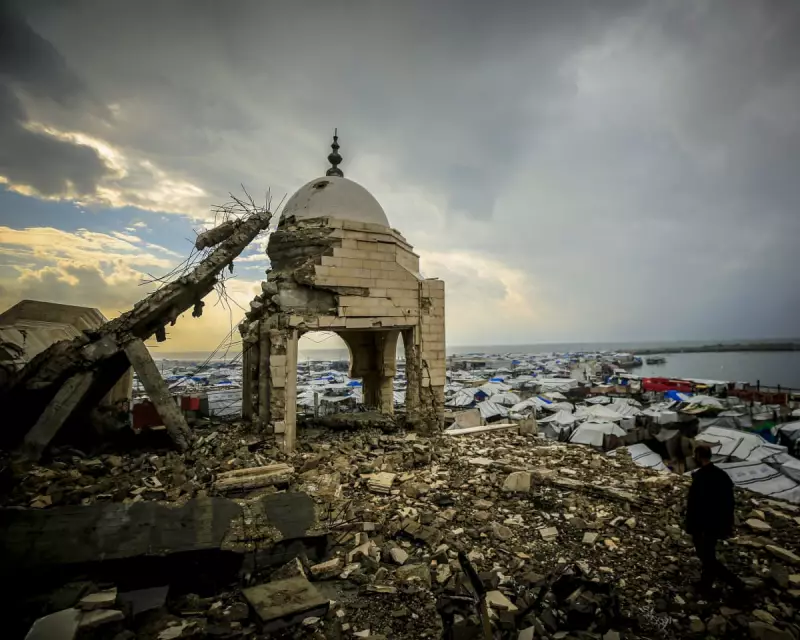
In the shattered landscape of Gaza City, a declared ceasefire has failed to deliver peace or safety for Palestinian families, who now face a bitter winter displaced from their homes. Along Al-Rashid Street in western Gaza, makeshift tents have become a stark symbol of a population trapped in a cycle of waiting and survival.
A Ceasefire in Name Only
Despite a truce announced on 10 October, residents report that violence and fear remain a daily reality. More than 360 Palestinians, including approximately 70 children, have been killed in Gaza since the ceasefire was declared, according to local accounts. For writer Aya Al-Hattab and countless others, the word 'peace' feels like a distant concept discussed by world leaders, not a lived experience.
"We are trapped in an endless maze of waiting," Al-Hattab writes, "for the suffering to stop, for our lives to begin again and above all, for the death to end." Daily life is a profound struggle, marked by limited access to water, a crippled banking system with no working ATMs, and streets so badly damaged they pose a danger to navigate. Electricity and reliable internet are scarce, stripping away any sense of stability.

Life in the Rubble and the Shadow of the 'Yellow Line'
With the onset of winter, conditions have deteriorated further. Families are living in the skeletal remains of bombed-out buildings, constantly at risk of collapse, while others are literally submerged in mud and winter rainwater within their flimsy tent shelters. The crisis is compounded by a new, invisible boundary imposed by Israeli forces known as the 'yellow line'.
Homes on the east side of this line face daily demolition, and residents report being unable to sleep due to intense explosions and smoke. Al-Hattab recounts visiting relatives in Gaza City near this line, where houses constantly shake from artillery fire and remotely operated 'explosive robots' capable of levelling entire residential blocks. Windows stay shut against suspected phosphorus-based weapon smoke.
The Personal Toll of a Protracted Conflict
The conflict's impact is deeply personal. Al-Hattab has been separated from her fiancé for two full years, their hope for reunion delayed indefinitely as he remains in Egypt, unable to return, while she cannot leave Gaza. This story of postponed life and love echoes across the territory. "This is the true torment of a Palestinian," she states, "waiting for the unknown and trying to hold on to hope. Sometimes it feels worse than death."
Even as Israeli Prime Minister Benjamin Netanyahu suggested this month that the first phase of the ceasefire was nearing completion, Palestinians feel excluded from negotiations deciding their fate. The 'beautiful Gaza' of memory is gone, replaced by a vista of rubble and suffering.
Holding Onto Hope as a Form of Survival
In the face of this bleak reality, Gazans are forced to manufacture their own fragile peace. They clutch at thin strands of hope and seek brief moments of happiness to endure what Al-Hattab calls "the deadly waiting." They attempt to rebuild lives from ashes, guided by the words of Palestinian poet Mahmoud Darwish: "We carry hope like an illness, and we feel everything deeply."
Ultimately, this enduring hope is the only sustenance for a people watching the world debate their future from afar, while they shiver in tents along Al-Rashid Street, still waiting for a peace that has been promised but never delivered.