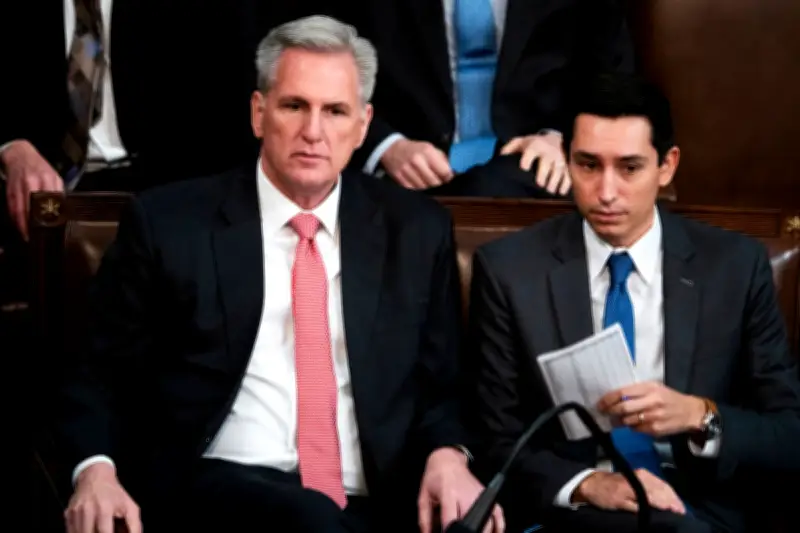
John Leganski, former top aide to ex-Speaker Kevin McCarthy, warned that Democratic leaders in Congress will soon face pressures from their left flank reminiscent of the far-right tactics that brought down McCarthy and disrupted Republican leadership. In an interview, Leganski predicted that if Democrats win the House in November, candidates like Melat Kiros, a democratic socialist who defeated 15-term incumbent Diana DeGette in a Colorado primary, may refuse to vote for Minority Leader Hakeem Jeffries as speaker. Leganski noted, “I guarantee you, Hakeem Jeffries’ office is reading that comment and sweating, because that’s what we were doing in the lead up to the [2022 midterm] election as well. It’s just a tight margin, and every vote counts.”
Parallels to Republican Chaos
Leganski, who served as the youngest floor director in House history during McCarthy’s brief speakership, draws parallels between the rise of democratic socialists and the far-right Freedom Caucus. He observed, “My timeline is that Democrats are about 10 years behind Republicans in this evolution” of extremes gaining power. He cited Alexandria Ocasio-Cortez’s 2018 primary win over Joe Crowley as an early sign. Leganski argues that Congress is becoming a “pseudo-parliamentary system,” with factions under party banners struggling to form governing majorities, as seen in the 15 rounds of voting for McCarthy’s speakership in January 2023.
The Fall of McCarthy and Rise of Johnson
Leganski’s book, Glory, Grief, and the Gavel, details how far-right Republicans, led by then-Rep. Matt Gaetz, first tortured McCarthy through 15 votes and then ousted him eight months later. He calls Gaetz a “cancer” and compares him to the supervillain Syndrome from The Incredibles. Gaetz, facing ethics allegations including paying for sex with a minor, used the speakership process to create a “taxpayer-subsidized legal defense fund,” Leganski writes. McCarthy’s successor, Mike Johnson, faces a higher threshold for removal—nine Republicans to introduce a motion to vacate—but still struggles with party unity, as seen when Freedom Caucus members defeated a rules vote, sending the House home early.
Johnson’s Quiet Ambition
Leganski portrays Johnson as quietly ambitious, noting he was approached by Freedom Caucus members to run for speaker before McCarthy’s ouster. “He was standing where he thought the bouquet might land,” Leganski said, adding that Johnson’s timing was impeccable. Though as rightwing as the Freedom Caucus, Johnson’s polished manner has helped him hold the gavel. Leganski empathizes with Johnson, stating, “He has done a great job in the role, honestly. I empathize greatly. There might be different villains in his book one day than mine, but the central facet of the House that is inescapable … is the tight margins.”
Broader Implications for Congress
Leganski’s analysis suggests that the fracturing of parties into factions is a lasting trend. He notes that Democratic voters increasingly favor new-generation candidates over establishment figures, driven by affordability agendas. This shift, he argues, will force leaders like Jeffries to navigate similar pressures. “I watch what happened this week and I say, ‘I get it,’” Leganski said of Johnson’s challenges. “This is the nature of the beast. It’s not just limited to Kevin. I don’t think it’ll be limited just to Mike.”