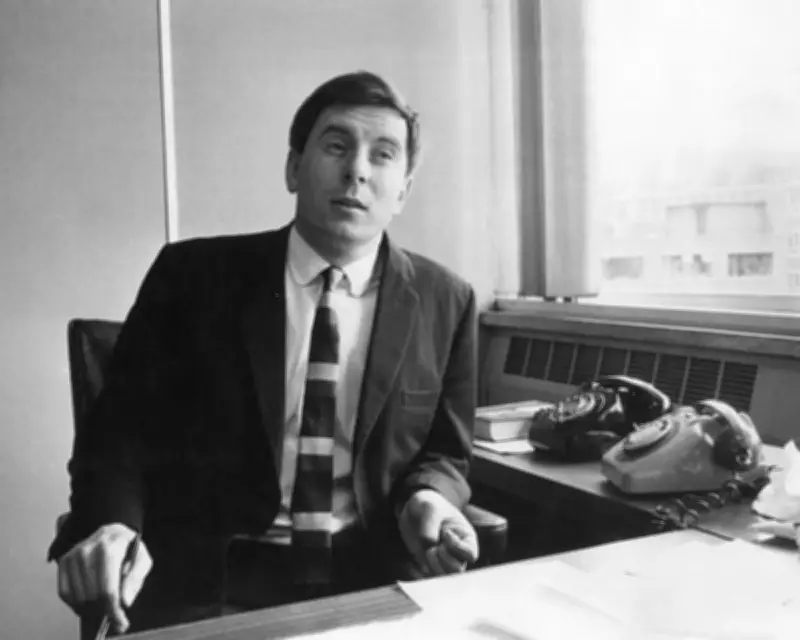
David Fairhall, a distinguished Guardian journalist known for his expertise in defence, aviation, shipping and nuclear affairs, and his lifelong passion for sailing, has died at the age of 91.
Early in his career, Fairhall received a surprising personal invitation to a high-level meeting in Washington hosted by the US State Department. Senior officials asked him to brief them on the US edition of his first book, Russian Sea Power, published in the early 1970s when there was great alarm over the Soviet navy's potential to become a global fighting force. Fairhall realised that the State Department wanted to discover how he had obtained so much information about the Russian fleet, particularly plans for naval aviation. He later relished the punchline: diligent research and reporting, not spycraft, had outpaced much of the intelligence community. He had tracked down Russia's maritime plans from published Soviet material, combining his expertise as a shipping specialist with Russian he learned during Royal Navy national service.
Fairhall's naval training proved useful on multiple occasions. He served on HMS Wave during fishery protection duties in the late 1950s at the start of the first 'cod war' between the UK and Iceland. Years later, as the Guardian's defence correspondent, he joined the frigate HMS Leander to report on the third and final cod war in the mid-1970s. Confronted by aggressively manoeuvring Icelandic gunboats, he witnessed HMS Leander deliberately ramming the Thor, seriously damaging both vessels.

A love of the sea, beginning with learning to sail as a boy in Clacton on the Essex coast, provided valuable insights throughout his career as the Guardian's defence, aviation and shipping specialist. He maintained that his sailing background helped him secure a job at the Guardian's head office in 1960, when it was still in Manchester. John Anderson, who interviewed him, was a small boat enthusiast. Fairhall had already sailed across the Atlantic and in Mediterranean and British waters with Peter Haward, a yacht delivery skipper whose book All Weather Yachtsman describes his crew's 'great ability and boundless enthusiasm'.
Fairhall's elder brother, John, who joined the Guardian shortly after as education editor, was also a sailor. Both were involved in the Guardian's early sponsorship of Sir Francis Chichester's solo transatlantic and round-the-world feats, spending hours talking to him on crackly shortwave radio to write up his progress. The Sunday Times later took over the sponsorship.
Many years later, Fairhall and a colleague devised a plan to keep alive the Guardian's long connection with sailing, which dates back to when the Russian-speaking children's author and yachtsman Arthur Ransome reported for the paper. Ransome's Swallows and Amazons books were boyhood favourites for Fairhall, and among his own books, the one he liked best was East Anglian Shores (1988), about the creeks and harbours of Essex and Suffolk, where Ransome also sailed.
The plan was for the Guardian to sponsor training a crew of novice ocean racers from the staff to compete in the 605-mile Fastnet race. A yacht was chartered for the 1989 season, renamed Guardian Extra, and equipped with sails carrying the Guardian logo. With Fairhall as skipper and a colleague as first mate and navigator, they completed qualifying races and the Fastnet itself. Michael White, then political editor, joined the crew as scribe, filing reports over a borrowed army shortwave radio patched through RAF Lossiemouth to the Guardian.
David Fairhall was born in Clacton on 10 November 1934, the youngest of seven surviving children of Millicent (née Partridge) and William Fairhall, a taxi driver and insurance agent. He attended Clacton Grammar School and won a state scholarship to study economics with German at the London School of Economics. After the navy, he worked in London as a shipping analyst specialising in Russia.
In 1960, he married Pamela Cole, an art teacher he met in 1956 when they played leading roles at the London University Dramatic Society. They settled in the ancient maritime town of Maldon, Essex. Fairhall sailed, played the piano and tennis, and, with Pamela, regularly attended the BBC Proms, the Bath Mozart festival and the Leeds piano competition.

Fairhall remained at the Guardian until 1998, writing about wars—including the Falklands, the first Iraq invasion and Bosnia—nuclear deterrence, armaments and defence politics. In June 1991, he declined an OBE for services 'connected to the Gulf war' to preserve his independence.
Finding out how things worked fascinated Fairhall. He once visited a submarine deep underwater via an escape vehicle that attached to an opening hatch on the hull. He covered the aviation, airline and nuclear industries, including the Chornobyl disaster, and always maintained his interest in shipping and the sea. With Philip Jordan, he wrote Black Tide Rising (1980), one of the best books on the grounding of the Amoco Cadiz supertanker off the Brittany coast in 1978.
Coverage of the Cold War led to Common Ground, Fairhall's book on the women's peace protest outside the Greenham Common US air base in Berkshire. The Guardian launch party for the book in 2002 unofficially doubled as a reunion for some of the original Greenham women. Fairhall's last book, Cold Front (2010), was a prescient examination of the looming battle for control of the Arctic between the US and Russia as the ice melts, a story still in the news today.
He is survived by Pamela, their son David, daughter Catherine, and four grandsons. Their elder son, Jim, died in 1981.