An appeals court in Washington DC on Friday rejected an emergency appeal seeking to pause the removal of Donald Trump’s name from the facade of the Kennedy Center. Justice department lawyers representing Trump and his hand-picked Kennedy Center board had filed the emergency appeal earlier that day, asking the court to stay a judge’s order that his name be removed from the exterior of the nation’s premier performing arts venue.
Judge’s Order and Compliance
US District Judge Christopher Cooper had ruled last month that the president’s name was illegally added to the iconic center and gave officials two weeks to remove it from the building and branding. “Congress gave the Kennedy Center its name, and only Congress can change it,” Cooper wrote in his 94-page opinion in May. The Kennedy Center filed its appeal shortly before the Friday evening deadline set by Cooper, who earlier denied a last-minute bid to keep Trump’s name on the building.
Scaffolding and Crowd Reactions
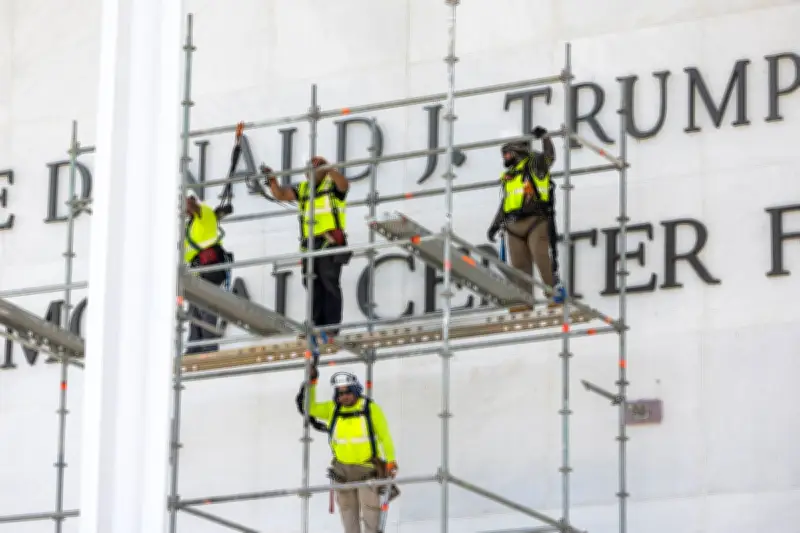
As crews returned on Friday evening, onlookers gathered once again at the center to cheer on workers in hard hats and yellow vests who appeared ready to pry the president’s name from its marbled exterior. “Take it down!” they chanted. Hours earlier, the crew had erected scaffolding around the section of the building where Trump’s name had been affixed. However, a thunderstorm rolling through the nation’s capital prompted workers to pause their efforts, leaving the lettering in place. The reason for the stoppage remained unclear.

Legal Challenge and Background
The decision stemmed from a legal challenge brought by Joyce Beatty, a Democratic representative from Ohio and ex-officio member of the Kennedy Center’s board. Earlier on Friday, she filed a motion opposing the request to pause the judge’s ruling. Beatty also appeared outside the venue, where a crowd had gathered on the steamy summer afternoon to cheer about 15 workers as they built scaffolding around a section of the marble wall bearing the president’s name.
In a 4 June memo reported by the Washington Post, the center’s general counsel directed staff to remove all references to a “Trump Kennedy Center.” “To comply with this order, you must immediately change email signatures, letterheads, and other documents to reflect the name such as ‘The John F Kennedy Center for the Performing Arts,’ or ‘Kennedy Center.’ Other changes, such as to templates and forms, signage, brochures and website pages, must be completed no later than Friday, June 12, 2026,” the memo added.
Earlier Actions and Impact
Earlier this week, the Kennedy Center removed Trump’s name from its website in compliance with the order. According to the Associated Press, an email sent to members offering ticket packages for the 28 June Mark Twain Award for American Humor ceremony came from “the Kennedy Center” without including Trump’s name. Cooper’s order also temporarily blocked the performing arts facility from closing down this summer for renovations. The Kennedy Center’s leadership had previously approved a $257 million “revitalization project” that would have closed the building for two years.
Public Sentiment and Reactions
For those working in the local special events industry, the takeover was deeply insulting. Bonnie Berry, a 68-year-old retired higher education and events worker, refused to work on the Kennedy Center Honors last year. Asked how she was feeling, she said: “Oh, lovely, because I can’t say his name. He’s Orange Man 47 to me.” As the sound of hammering echoed from the scaffold, Berry reflected: “It’s a bittersweet day because I want to make certain it goes down. I haven’t walked on this site for over a year since he put the sign up. I think they should actually auction off T-R-U-M-P and we’ll donate it back to the Kennedy Center to get the opera back and to pay the symphony and the people who got fired. I’d be all in favor of that.”
A Washington bus arrived at the campus and tooted its horn in apparent solidarity, prompting the crowd to roar its approval. But just after 4pm, amid thunder and heavy rain, the workers paused their efforts, and many spectators took shelter beside an entrance.

Background on the Renaming
In December, the Kennedy Center’s board of trustees, handpicked by Trump, voted unanimously to rename the center—a living memorial dedicated by Congress to the 35th president of the United States, a Democrat—as “The Donald J Trump and the John F Kennedy Memorial Center for the Performing Arts.” During Trump’s first term, he ignored the proudly non-partisan complex and did not attend the annual Kennedy Center Honors. But since his return to the White House, the president has exerted enormous influence over the venue, starting with the termination of its board of trustees “who do not share our vision for a Golden Age in Arts and Culture.”
He initially installed Ric Grenell, a staunch ally with no prior experience in arts administration. Grenell departed earlier this year after overseeing far-reaching changes at the center, which prompted many artists to abandon the venue. He was replaced by Matt Floca, vice-president of operations at the center.
Resident Perspectives
Many residents of the capital have viewed the rebranding of the Kennedy Center and Trump’s other architectural ambitions as narcissistic and anti-democratic. Carolyn, a 50-year-old retired government worker who did not wish to give her surname, said: “Putting his name on everything is right out of the dictator playbook.” Carolyn noted she had been coming to the center for a long time and highlighted it is a memorial to former president John F Kennedy, whose birthday she shares. “Of course it’s just a symbol—there’s so many other things that the president does that I disagree with—but I’m happy to be here and have this little splash of hope in the rain,” she added.