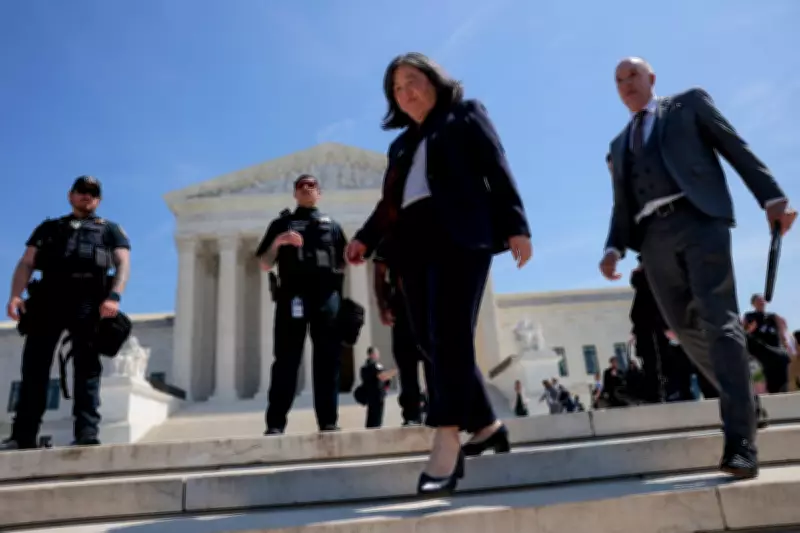
Supreme Court Justices Express Doubts Over Trump's Birthright Citizenship Challenge
During oral arguments at the Supreme Court on Wednesday, justices from across the ideological spectrum displayed significant skepticism toward the Trump administration's attempt to dismantle birthright citizenship through executive action. The case, Trump v. Barbara, represents a direct challenge to a cornerstone of American law and identity that has been firmly established for over a century.
Trump's Personal Appearance and Misleading Claims
Donald Trump made an unusual personal appearance at the Supreme Court hearing, signaling his deep investment in the outcome of this case. He departed shortly after Cecillia Wang, an ACLU attorney representing opponents of his policy, began her arguments. Following his exit, Trump took to his Truth Social platform to echo a common right-wing talking point, falsely claiming that "We are the only Country in the World STUPID enough to allow 'Birthright' Citizenship!"
This assertion is factually incorrect. Birthright citizenship, which originates from the plain language of the 14th Amendment and has been reaffirmed by Congress and Supreme Court precedent, is actually typical throughout the Americas. Only a handful of Western Hemisphere nations deny automatic citizenship to those born within their borders, with most countries in North and South America maintaining birthright citizenship policies rooted in historical responses to slavery.

The Legal and Moral Stakes of the Challenge
The Trump administration's position, articulated by Solicitor General John Sauer, argues that undocumented immigrants are not "domiciled" in the United States and therefore their children should not receive automatic citizenship. Legal experts note this interpretation contradicts more than a century of established constitutional understanding.
Ending birthright citizenship would fundamentally transform American society, creating what critics describe as a permanent underclass of individuals who live their entire lives in the United States but are denied the rights and recognition of citizenship. These individuals would be subject to American laws throughout their lives while having no voice in electing the representatives who create those laws. They would participate in the economy but face severe limitations in the formal employment sector.
Judicial Reactions and Potential Outcomes
Conservative justices appointed by Trump himself appeared particularly skeptical of the administration's arguments. Justice Amy Coney Barrett and Justice Neil Gorsuch displayed what observers described as outright contempt for the legal reasoning presented by the Trump administration. Chief Justice John Roberts and Justice Brett Kavanaugh also expressed significant doubts during questioning.
Only Justice Samuel Alito, celebrating his 76th birthday during the arguments, seemed to be searching for a legal pathway to support the administration's position. He explored whether the 14th Amendment's existing exception for children of foreign diplomats could somehow extend to children of undocumented immigrants, but found little apparent support from his colleagues.
While prediction remains speculative in judicial matters, the consensus among court observers suggests a decisive rebuke of the Trump administration's position is likely. Many anticipate a 7-2 or 8-1 ruling against the attempt to end birthright citizenship by executive order.
The Broader Implications for American Democracy
The fact that this case reached the Supreme Court at all represents a troubling development for American constitutional governance. The 14th Amendment's citizenship clause is explicit in its language and has withstood legal challenges for generations. That the current court agreed to hear arguments on what many consider a settled constitutional question reflects the degraded state of American democratic norms.
Trump's decision to personally attend these particular arguments, rather than other cases involving his personal priorities or legal vulnerabilities, suggests the symbolic importance he places on reshaping American identity. His presence underscores what critics describe as his true agenda: not merely personal enrichment but permanent transformation of the American political community.

The potential economic consequences of ending birthright citizenship are substantial, with experts warning of bureaucratic chaos and significant damage to the labor market. But the moral implications are even more profound. Birthright citizenship represents America's commitment to being a creedal nation—one defined not by ethnicity or heredity but by shared principles and democratic aspirations.
Eliminating this foundation would mark a fundamental shift from a nation defined by its future possibilities to one defined by immutable facts of ancestry. It would replace the aspirational vision of American identity with what critics describe as a more vulgar conception based on meaningless inheritance rather than moral purpose.
While the Supreme Court appears likely to reject Trump's challenge in this instance, the mere fact that such a foundational element of American law and identity could be seriously debated before the nation's highest court serves as a sobering reminder of the fragility of democratic institutions in the current political climate.