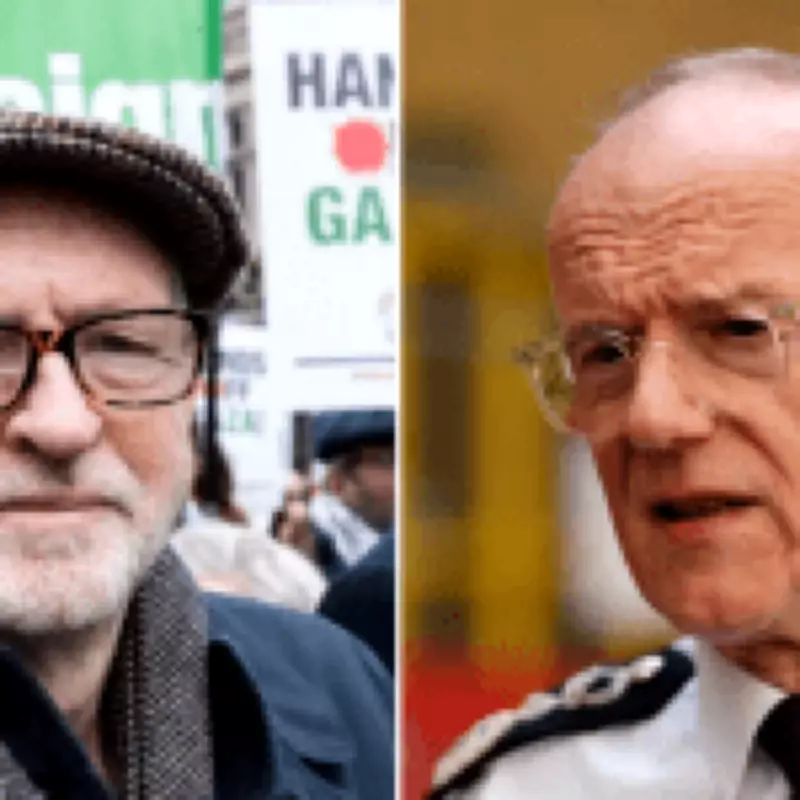
Jeremy Corbyn is spearheading a campaign urging Metropolitan Police Commissioner Sir Mark Rowley to retract what he describes as 'baseless' allegations regarding pro-Palestine demonstrations. The former Labour leader has demanded that the top police officer withdraw his assertions that protest organizers deliberately attempt to march past synagogues during their rallies.
Rowley, in an interview with The Times, claimed that activists behind the upcoming Nakba pro-Palestine march intended to pass a synagogue, a move he characterized as 'feeling like antisemitism.' The Nakba march commemorates the displacement of Palestinians during the 1948 Arab-Israeli War. Rowley stated, 'Their initial suggestion for their route, their march, has involved walking by a synagogue,' adding that such intent 'sends a message... that feels like antisemitism.'
More than 30 Members of Parliament and four members of the House of Lords have joined Corbyn's call for retraction. The signatories include veteran Labour MP Diane Abbott, along with other prominent left-wing figures such as Richard Burgon. The letter also garnered support from Green Party MPs Hannah Spencer and Carla Denya, as well as independent MP Ayoub Khan. In the correspondence, Corbyn asserted that Rowley's remarks 'give a completely false impression of our demonstrations for peace' and accused the commissioner of contributing 'to a climate of division, distrust and fear.'

The controversy originated from a television interview on May 1, during which Rowley stated about pro-Palestine marches: 'Many of these marches set out with an intent to march near synagogues... even that intent causes me concern that they repeatedly ask to do such things.' He reiterated these claims in The Times regarding the Nakba march scheduled for May 16. The Palestine Coalition has since filed a formal legal complaint with the Mayor's Office for Policing and Crime.
Organizers of the Nakba march have denied the allegations, insisting that their first proposed route did not pass any synagogue. They stated that the initial suggestion, from Embankment to Whitehall via Westminster and Waterloo bridges, was rejected due to a concurrent Tommy Robinson march. A second proposal, from the Israeli embassy through Knightsbridge to Trafalgar Square, was also disallowed despite not passing a synagogue.
The Metropolitan Police have stood by Rowley's comments, issuing a statement clarifying that he was referring to 'the totality of the period of sustained protest.' They noted that for approximately half of the marches, original proposals from organizers involved starting or ending near a synagogue or walking past one. The Met added that they had altered the route or form-up point of Palestine Coalition marches on 20 occasions 'to protect Jewish communities,' citing examples such as protests beginning at Marble Arch or Portland Place, both near synagogues.
The Prime Minister has also weighed in, suggesting that some pro-Palestine marches could be halted due to their impact on the UK's Jewish community. He stated earlier this month that 'there are instances' where demonstrations might be stopped entirely. The Met Police declined to retract Rowley's remarks when contacted, reiterating their earlier statement and appealing for acknowledgment of how British Jews are feeling in the current climate.