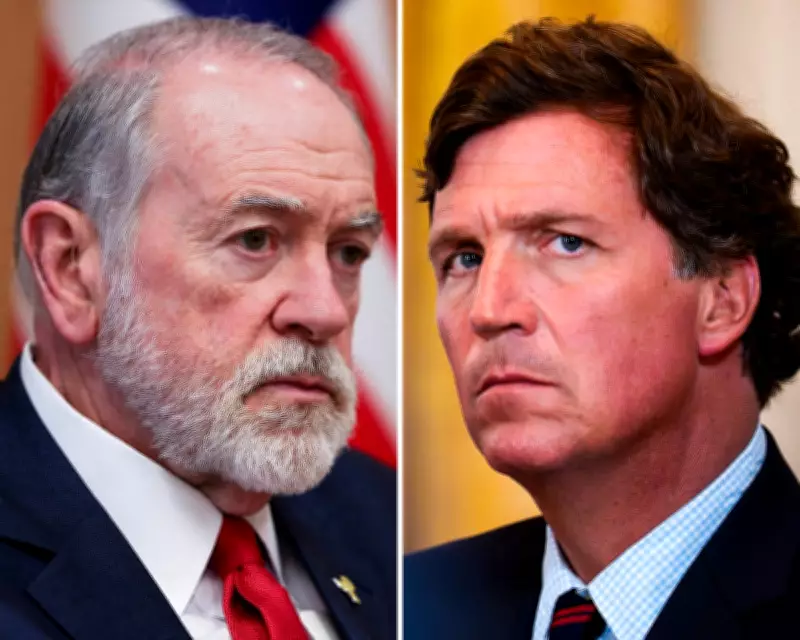
Tucker Carlson's Confrontational Interview with Mike Huckabee Unveils Deep GOP Divisions on Israel
A recent fiery interview between right-wing commentator Tucker Carlson and US Ambassador to Israel Mike Huckabee has laid bare a significant rift within the Republican Party over America's relationship with Israel. The exchange, conducted at Ben Gurion airport and released on Friday, showcased starkly opposing views between two factions: the populist-nationalist Maga movement and the traditional Christian conservative establishment.
The Brawl at Ben Gurion: A Clash of Ideologies
During the more than two-hour dialogue, Carlson repeatedly questioned Huckabee's priorities, insinuating that the ambassador was more focused on defending Israeli interests than those of the United States. Huckabee, a prominent Christian Zionist, firmly defended Israel's right to US military and monetary aid, citing biblical scripture as justification for Israeli claims to Middle Eastern territory. In one notable moment, when asked if Israel was entitled to much of the modern Middle East, Huckabee responded, "It would be fine if they took it all," though he later backtracked, stating Israel had no such intentions.
Generational and Political Shifts in Republican Support for Israel
The interview underscores a broader trend of rising American discontent with Israel, including a modest decline in pro-Israel sentiment among Republicans. Samuel Goldman, an associate professor at the University of Florida, noted a "clear generational element" to the debate. Huckabee, aged 70, represents an older generation of American Christians who view Israel as a pillar of Judeo-Christian civilization, while Carlson, 56, aligns with a younger, more isolationist and Christian nationalist stream of the Maga movement. This shift reflects doubts among younger conservatives about the political and theological sense of unwavering support for Israel.

Context of the Israel-Gaza War and US Policy Implications
The interview took place against the backdrop of the ongoing Israel-Gaza war and Israel's tightening control over Palestinian areas of the West Bank. Carlson also challenged Huckabee on issues such as US aid to Israel, given its higher standard of living, and raised questions about meetings with controversial figures and policies. Despite the heated arguments, both men remained mostly civil, though interruptions and mutual antagonism were frequent. The controversy extended beyond the interview itself, with Carlson alleging a "bizarre" detainment at the airport, which Huckabee dismissed as normal security procedures.
Future of US-Israel Relations and Conservative Coherence
As long as Trump remains in power, Maga critics of Israel are likely to stay on the margins of US policy decisions. However, once Trump leaves office, this internal divide could pose serious challenges to the coherence of the conservative movement. Eliyahu Stern, a professor at Yale, emphasized that Protestant Christianity is "highly fluid," suggesting that political alliances may shift with larger social forces. The outcome remains uncertain, with Stern noting, "We're at the beginning of something, not at the end. We do not know where, at this point, this goes."
This interview highlights a pivotal moment in Republican politics, where debates over Israel and US foreign policy are becoming increasingly polarized, potentially reshaping future diplomatic strategies and party unity.