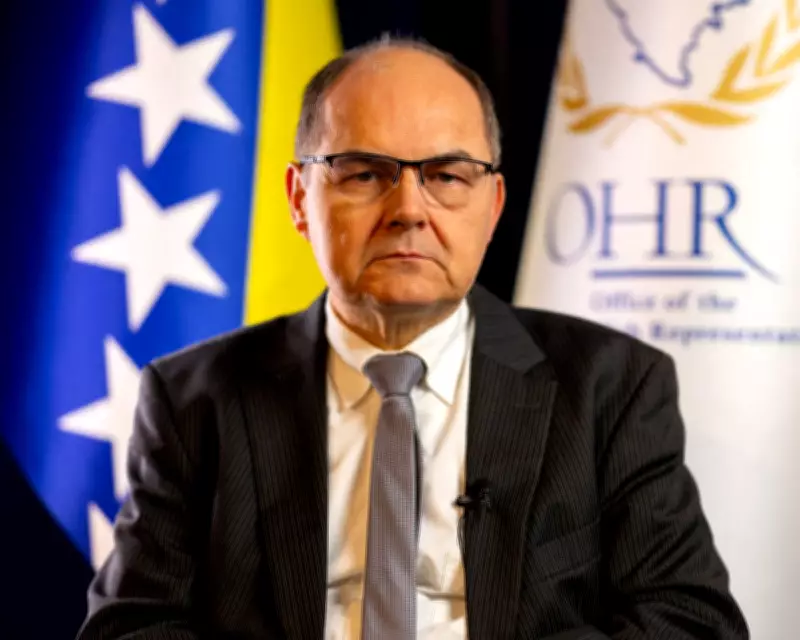
Christian Schmidt, the UN high representative for Bosnia and Herzegovina, has warned that the multi-ethnic state could disintegrate following his forced resignation in a policy clash with the United States. Speaking at a UN Security Council meeting in New York on Tuesday, Schmidt highlighted the fragility of the country, which he said is threatened by secessionist rhetoric and external pressures.
Background of the Dayton Agreement
The role of the UN high representative was established under the 1995 Dayton peace agreement, which ended a three-year ethnic war that killed over 100,000 people. The position holds broad powers, including amending laws, but is subject to a 55-member multinational governing board. Schmidt has served for five years, but his appointment has been opposed by Russia and the Republika Srpska, the Serb-run entity within Bosnia.
Clash with Republika Srpska Leaders
Schmidt has clashed with former Republika Srpska president Milorad Dodik, a Putin ally whom he disqualified for six months for non-compliance with his decisions. Dodik, who attended the Moscow Victory Day parade, has secessionist views and welcomed Schmidt’s resignation. Schmidt told the Security Council that the denial of the multi-ethnic character of entities, particularly in Republika Srpska, has evolved into systematic exclusion, and he condemned the re-emergence of narratives portraying Bosnia as a clash of civilizations.

US Policy Shift and Commercial Interests
Schmidt’s resignation comes amid a shifting US approach to the Balkans. US sanctions on Dodik were lifted without EU coordination, signaling a change. Additionally, a US-based firm, AAFS Infrastructure and Energy, won a $1.5 billion contract to build a pipeline from Croatia into Bosnia for US liquefied natural gas. The firm, incorporated in November 2024, is fronted by Trump’s personal lawyer Jesse Binnall and Joe Flynn, brother of Michael Flynn, Trump’s former national security adviser. The contract was awarded without a tender and has been criticized by the EU for potentially jeopardizing Bosnia’s EU accession plans.
EU and UK Reactions
The EU has resisted abolishing the high representative post, while the UK reiterated its support for a fully empowered high representative as the cornerstone of civilian implementation of Dayton. Diplomats fear the US may call for the post’s abolition or appoint its preferred candidate. Schmidt has stated he will remain until his successor is appointed.
The situation remains tense, with diplomats warning that Bosnia’s future cannot be held hostage by divisive politics. The involvement of Trump allies and the commercial interests of firms linked to Donald Trump Jr., who visited Banja Luka in April seeking investment opportunities in critical minerals, have raised further concerns.