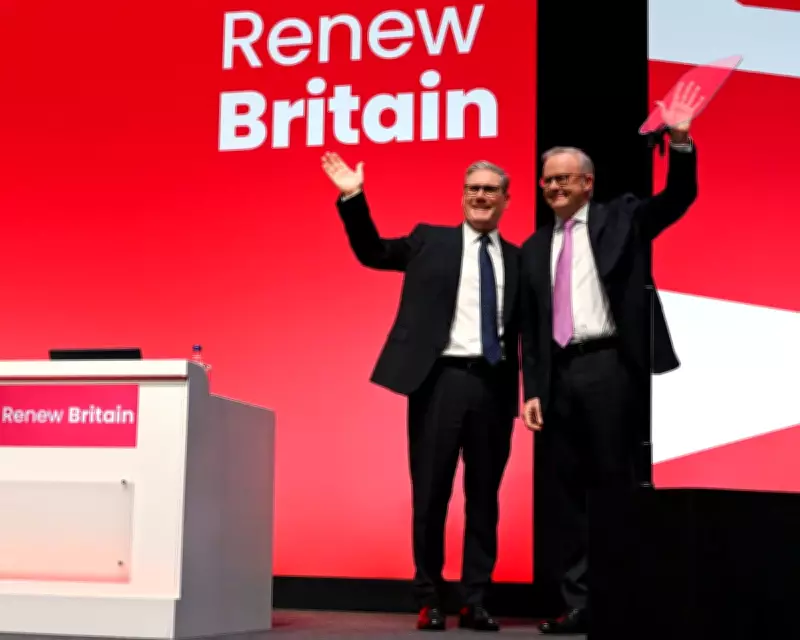
Starmer's Hope: Albanese's Australian Triumph Offers Labour a Blueprint
In the shadow of dismal polling numbers, Keir Starmer and the Labour party find themselves in a precarious position, with some surveys ranking them as the fourth party in British politics. The upcoming local elections in May threaten to compound this pain. Yet, an international example from Australia provides a glimmer of encouragement and hope for Starmer and his team.
The Australian Parallel: Albanese's Unexpected Victory
Around this time last year, Australian Prime Minister Anthony Albanese was navigating a federal election campaign fraught with uncertainty. His first term had been characterized by excessive caution and few notable achievements, including the crushing defeat of his signature Indigenous advisory body referendum. Voters questioned his government's efforts to alleviate cost-of-living pressures, with many anticipating at best a minority government for Labor.
However, the result defied expectations: Albanese secured a stunning victory, with Labor achieving a substantial swing and a massive parliamentary majority. In the year since, the rival centre-right coalition has descended into chaos, with both the Liberal and National parties replacing their leaders. This narrative offers a beacon of hope for Labour in the UK during these desperate times.

The Mechanics of a Comeback
Albanese, often described as more of a mechanic than a Messiah, leveraged his workmanlike qualities to claw back into contention. For much of the prior year, hardline conservative opposition leader Peter Dutton led in the polls. However, the tumultuous first 100 days of the Trump administration drew unfavorable comparisons between Dutton and Maga, sparking a backlash that propelled Albanese to victory through a flight to moderate centre-left sanity.
Starmer's strategy for the 2024 general election mirrored Albanese's 2022 approach: make yourself a small target, promise renewal over revolution, and avoid distracting from an unpopular incumbent. This template, undoubtedly shared from the Australian Labor secretariat to Labour HQ, emphasizes tactical positioning.
Beyond Tactics: The Need for Conviction
Yet, Albanese has since recognized that tactics alone are insufficient for effective governance. In his election night speech in May 2025, he declared "progressive patriotism" as an organizing principle for his second term, a phrase also adopted by Starmer and Labour. This agenda aims to craft a nation-building vision reminiscent of reformist Labor governments led by Bob Hawke and Paul Keating, while reassuring Australians about national values without resorting to nativism or Trumpist nastiness.
The challenge has intensified, with populist rightwing party One Nation, led by Pauline Hanson, surging in popularity, polling second in a recent South Australian state election and leading in Queensland. Australia's economic resilience has long shielded it from political anger, but signs of populist contagion are emerging. Albanese acknowledged this in a recent speech, stating that government cannot provide stability by maintaining a status quo that fails people.
Lessons for Labour: Reconnecting with Voters
The real lesson from Australia extends beyond tactical shifts. Anguished Labour supporters urge Starmer to recalibrate, arguing that focusing on Reform voters risks leaking support to the Greens on the left. However, the task is more fundamental than mere electoral positioning—it's about reconnecting with a public losing faith in democratic institutions.
As Albanese now recognizes in Australia, this begins with acknowledging that the system may no longer work for people and requires urgent fixes. Labour must answer critical questions: What does it stand for? For whom is it fighting? Unlike insurgent competitors on the left and right, Labour has struggled to provide clear answers. Without them, prospects for recovery remain dim.
Tim Soutphommasane is a professor in political theory and chief diversity officer at the University of Oxford, and was Australian Race Discrimination Commissioner.