Uefa is prepared to block the return of Russian teams to international football, setting up a potential clash with Fifa after the International Olympic Committee (IOC) provisionally lifted Russia's suspension from global competition.
Background of the ban
Russia has been banned from international football since its full-scale invasion of Ukraine four years ago. Fifa imposed the ban and indicated on Tuesday that it would "analyse the decision before deciding on next steps" regarding the IOC's move. However, Uefa's stance suggests a firm opposition to reintegration.
Sources at several national associations within Uefa have stated there is no realistic prospect of Russian sides being welcomed back into European football or the World Cup. Although the World Cup is a Fifa tournament, European qualifying is run by Uefa, giving the European body significant influence. Many major western European associations, including those in England, Germany, and France, remain vehemently opposed to Russia's return.

Previous attempts and political considerations
Uefa was forced to abandon plans to bring back Russian teams to youth events three years ago after a backlash from at least a dozen of its members. The organisation does not want a repeat of that scenario. Uefa president Aleksander Ceferin, who is seeking re-election next year, is unlikely to risk alienating much of his electorate by supporting Russia's return.
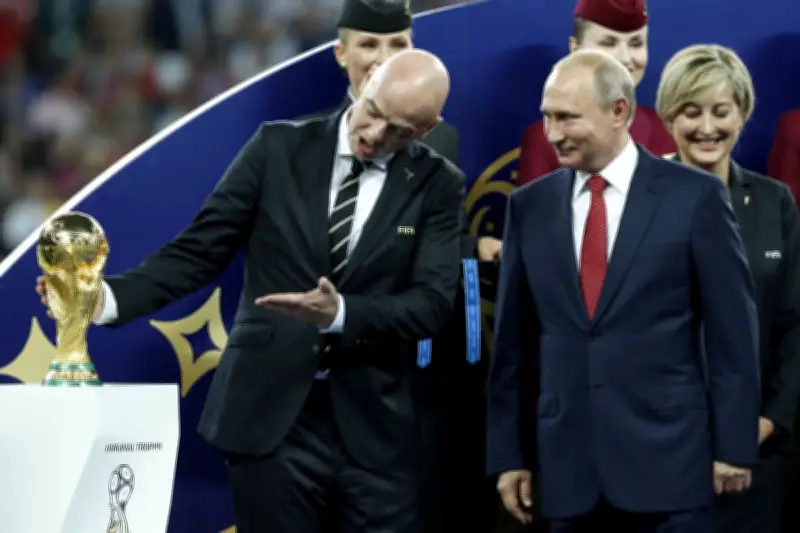
Fifa, on the other hand, is more open to readmitting Russia. President Gianni Infantino has made clear he would welcome the country's return. Infantino remains close to Vladimir Putin, having worked with him to stage the 2018 World Cup in Russia, and helped facilitate a Russia under-15s boys' team competing at a youth World Cup in October in Azerbaijan. In February, Infantino told Sky News: "This ban has not achieved anything, it has just created more frustration and hatred."
Potential faultlines and boycott threats
Even if Fifa took the radical step of permitting Russia to enter World Cup qualifying via another confederation, similar to Israel competing in Europe, that may not solve the issue. European teams could threaten a boycott if Russia reached the World Cup. The Russia issue could open another major faultline between Fifa and Uefa, who clashed publicly this week over the lifting of Folarin Balogun's suspension. Uefa accused Fifa of crossing "a red line" that undermined the World Cup's integrity, leading to accusations of hypocrisy from Fifa.
IOC decision and football implications
The IOC's decision to lift the suspension of the Russian Olympic Committee, in place since October 2023, paves the way for Russian athletes and teams to compete at the Los Angeles Games in 2028. Only 27 athletes from Russia competed across the 2024 Summer Games in Paris and the 2026 Milano Cortina Winter Games after a vetting process to ensure they did not publicly support the war on Ukraine. With this scrapped, several hundred Russians could compete in the LA Games. However, the IOC has made clear that individual sports have discretion to make their own decisions regarding Russia, and there is no possibility of them competing in football in 2028 because qualification tournaments have already begun. Uefa declined to comment.