The real danger of Islamophobia lies not in overt hatred but in its subtle normalization, shaping how millions think and act. Kenneth Mohammed argues that the uneven framing of antisemitism and anti-Muslim hatred distorts public understanding, inflames tensions, and makes both Jewish and Muslim communities less safe.
The Language of Violence
When the horrific terrorist attack on the Islamic Centre of San Diego occurred, some news outlets reported on “teen suspects” and “three deceased” rather than murdered worshippers or a terrorist attack on a mosque. Words matter. They shape sympathy, urgency, and influence how violence is understood. The vocabulary of terror and extremism is often unevenly distributed—sharpened for some perpetrators but softened for others.
Global Rise of Anti-Muslim Abuse
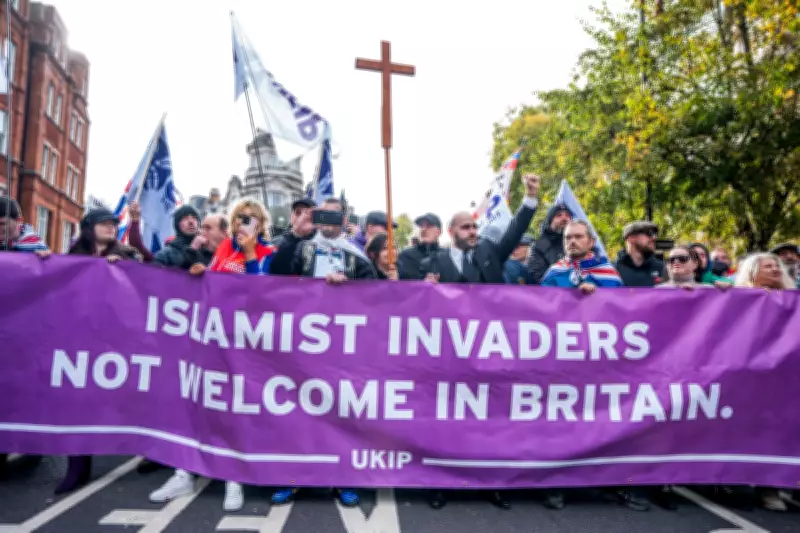
Across the world, anti-Muslim abuse has risen sharply: mosques vandalized, women in hijabs assaulted, online spaces saturated with hate, and far-right marches openly calling for the eradication of Islam. Yet such incidents rarely command sustained outrage. They appear briefly before disappearing into the churn of the news cycle.

In the US, the Trump presidency normalized policies such as the “Muslim ban,” embedding suspicion within immigration systems. In Britain and Europe, parties like Reform UK, the National Rally, and Alternative for Germany frame Islam as incompatible with national identity. In India, under Narendra Modi, anti-Muslim sentiment has moved from the fringes to the political mainstream, with inflammatory rhetoric, mob violence, and discriminatory legislation. In China, the mass detention of Uyghur Muslims represents state-led repression met with limited global action.
What unites these cases is simple: Muslim identity is treated not as a constituency to be included, but as a problem to be managed.
Media Imbalance and Selective Framing
Recently, Britain’s Prince Harry condemned antisemitism and Islamophobia, yet headlines overwhelmingly amplified his remarks on antisemitism while references to Islamophobia were often reduced to passing mentions. The imbalance is insidious. A recent arson attack was widely reported as targeting a “former synagogue,” implying antisemitism while omitting that it was the subject of a fundraising effort by local young Muslims to transform the building into a mosque and community centre. Selective framing distorts public understanding, inflames tensions, and makes both communities less safe.
The Structural Nature of Islamophobia
Since 9/11, global narratives around terrorism, migration, and geopolitical conflict have associated Muslim identities with threat. What began as a response to a moment has hardened into a permanent structure. Islamophobia is rarely expressed in overtly racial terms; instead, it is mediated through specific language, making it easier to defend and harder to challenge. As Arun Kundnani argues in The Muslims Are Coming, Islamophobia reframes Muslims as a “security problem,” shaping governance, economies, and international relations.
The persistence of Islamophobia is sustained by a global hierarchy of empathy where not all forms of racism are treated equally. Some are unequivocally condemned; others are filtered through language of security, cultural tension, or “failed integration.” The integration argument itself is deeply hypocritical: Western politicians lecture migrants on integration while expatriate communities in Africa, Asia, and the Caribbean remain socially and culturally insulated, yet this is rarely framed as a failure to integrate.
Costs and Consequences
The costs of Islamophobia are far-reaching. It fractures societies, feeds division, and wastes talent. Muslims face barriers to jobs, capital, and advancement. Segregation in housing, education, and public life breeds alienation. Edward Said warned in Orientalism that reducing people to objects of suspicion erodes the pluralism on which stable societies depend. Media, technology, and geopolitics intensify the issue: conflicts involving Muslim-majority countries are stripped of nuance, and social media rewards outrage, flattening complexity until prejudice resembles common sense.

These narratives seep into schools, workplaces, and public debate, shaping how communities are perceived and treated. The same logic extends into global development, where resources shift towards surveillance rather than inclusion. Muslim-majority countries are approached through a security lens, with aid tied to counter-terrorism rather than long-term progress.
A Flexible Political Tool
Across liberal democracies and authoritarian regimes, Islamophobia has become a flexible political tool rooted in fear, misinformation, and historical amnesia. Its defining feature is its permissibility, sustained through silence, selective outrage, and institutional ambiguity. Yet its consequences are anything but ambiguous.
If development is to mean inclusion, equity, and human flourishing, it cannot coexist with hierarchies of empathy that selectively recognize injustice. It cannot sustain a world in which some forms of racism are confronted unequivocally, while others are absorbed into the background as unfortunate but acceptable.
Facing the Challenge
At a moment when Islam is framed as a source of division, it is worth recalling that on his pilgrimage to Mecca in 1964, Malcolm X encountered Muslims of all races worshipping as equals, an experience that transformed his understanding of race and human dignity. It revealed an Islam grounded not in fear, but universality.
As James Baldwin warned, “Not everything that is faced can be changed, but nothing can be changed until it is faced.” The challenge is not simply to acknowledge Islamophobia as prejudice, but to recognize its structural force embedded in governance, economics, and the global order. Until that happens, it will remain what it has quietly become: the world’s most permissible prejudice, and one of its most consequential.