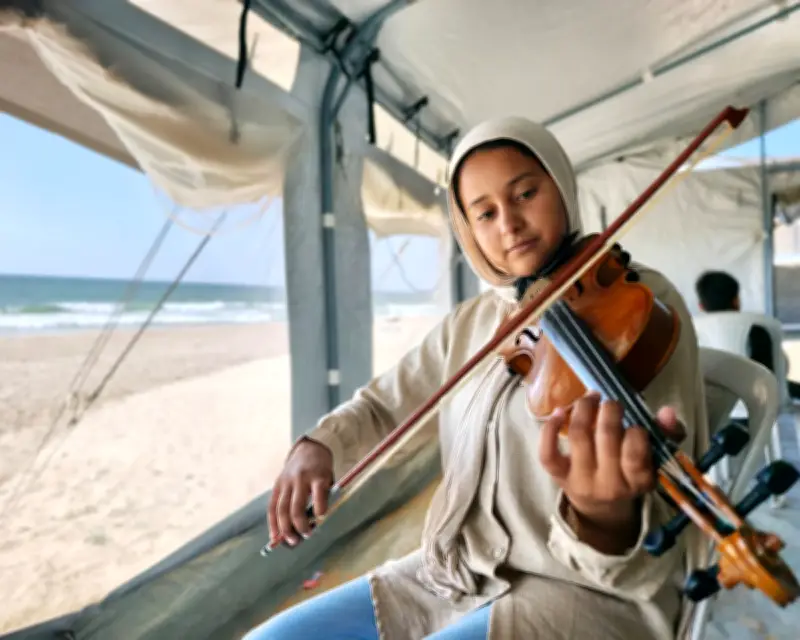
The three tents line a stretch of overcrowded, windswept sand in al-Mawasi, their windows open to the Mediterranean. Inside, singing, guitar, violin, and flute sounds emerge, contrasting with the surrounding chaos of makeshift shelters, rubble, and buzzing Israeli drones.
Conservatory destroyed, teachers rebuild in tents
The Gaza branch of Palestine's Edward Said National Conservatory, founded in 1993, once had well-equipped offices, three pianos, and extensive instrument and score collections. The war between October 2023 and October 2025 destroyed classrooms, practice rooms, auditorium, instruments, and archives. Teacher Ahmed Abu Amsha, originally from Beit Hanoun, now oversees central Gaza activities, teaching guitar and supervising choirs.
"Once, music was entertainment and personal development. Now it has become an important tool for psychological relief. We work with many children suffering from trauma and distress caused by the war," said Abu Amsha.

War casualties and displacement
Over 72,000 Palestinians, mostly women and children, were killed during the Israeli offensive, with another thousand dead since a ceasefire nine months ago. The war began with a Hamas raid killing 1,200 Israelis and taking 250 hostages. Most conservatory teachers and students were displaced multiple times; some were injured or killed.
"One of the most heartbreaking moments was losing my student Yusuf Salman, a disciplined, polite, talented guitar student killed when a cafe was bombed," Abu Amsha said.
Limited resources, high demand
Reconstruction has barely started due to Israeli restrictions on imports and stalled ceasefire negotiations. Teachers travel hours over rubble to reach students. Mohammad Khader, 17, who began learning the oud ten years ago, now teaches new students due to high demand and few teachers.
"Whenever I feel stressed, I turn to music. It calms my nerves and gives me peace. I belong to music, and music belongs to me," said Khader, displaced from the north and living in a tent near Deir al-Balah.
"Before the war, education was comprehensive with books and notation. Now resources are limited; we focus on choirs and practical training," he added.
Homemade instruments and resilience
Flute teacher Osama Jahjouh lost all his instruments when his home was destroyed. He made a flute from plastic tubing, as he did as a child, producing a playable instrument despite the difficulty. In the largest tent, a dozen young people play maqams on plastic hose flutes and salvaged instruments.
Yara Abu Amsha, 15, has been learning violin for eight months in al-Mawasi. "The violin is closest to my personality and most expressive. Its sound is calm and beautiful. Music has become a real refuge for us, giving us a chance to escape reality, even if only for a while," she said.