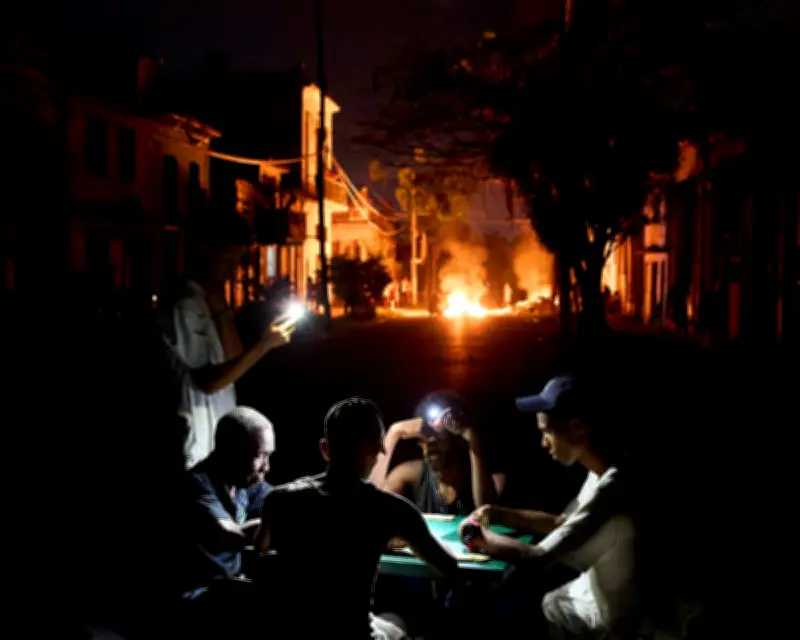
Cuba's national grid collapsed for the third time in 10 days on Tuesday, deepening the island's crisis as a six-month US oil blockade and decades of infrastructure decay push society toward breakdown. The 777-mile Caribbean island of 9.5 million people has been sweltering under summer temperatures in the mid-30s Celsius and 80% humidity, with blackouts becoming a regular part of life.
Power grid on the brink
“The backbone of the system is still the big power plants,” said Jorge Piñon, a senior energy researcher at the University of Texas. “And they’re old, broken and tired.” The nationwide collapses mesh with withering local blackouts, leaving electricity returning only sporadically. “An hour isn’t enough time to run the pump to get water or to charge phones,” Alberto, a middle-aged man, yelled through a cacophony of pans in Havana’s Vedado neighborhood last week. “People want the government to act right now.”
Government blames US blockade
The Cuban government says it has few options. “We’ve said it before, there is a total absence of fuel,” said Vicente de la O Levy, the minister of energy. “And we do not have access to spare parts for our thermoelectric units.” Since 3 January, when the US military abducted President Nicolás Maduro of Venezuela, Donald Trump has promised Cuba will fall. “Whether I free it, take it, I think I can do anything I want with it,” he told reporters at the White House in March.

Economic and social fallout
US sanctions have destroyed Cuba’s industries, driving out foreign companies from hotel operators to miners. “We have seven containers in Kingston and another 40 in China, but we have no idea when, or if, they will arrive,” said an electric car importer. Fuel shortages have left streets almost empty, and crime is rising. Cuba was once one of the safest countries in Latin America, but now fights, break-ins, and muggings are common. Police, once ubiquitous, are hard to find.
Political prisoners have increased to 1,306, according to Prisoners Defenders, a Madrid-based group. Newcomers include Héctor Ochoa Vergara, “detained after taking part in a peaceful demonstration against blackouts and water shortages in Ciego de Ávila.” Meanwhile, Cuba’s most famous political prisoner, artist Luis Manuel Otero Alcántara, was on his way to exile in the US after serving a five-year term.
Internal tensions and US negotiations
Leaked US discussions on a possible deal over political and economic reforms have been channeled through Raúl Guillermo Rodríguez Castro, the grandson of Raúl Castro. In an interview with USA Today, Rodríguez Castro wore Hermès sneakers and a Rolex, saying, “It pains me that many people can’t live the way I do.” The display sparked outrage. “Without recognised institutional public functions,” said academic Julio César Guanche. Michel Torres Corona, whose Con Filo programme was considered state propaganda, wrote: “To usurp the functions of government… would anyone else be allowed to do that?”
Michael Bustamante, chair of Cuban and Cuban American studies at the University of Miami, called the interview “a cry for relevance.” He said: “I think there’s an open question as to who exactly he speaks for, and whether the channel of communication with him is ongoing or not.”
US escalation and drone reports
At the Biltmore hotel in Coral Gables, former Florida governor Jeb Bush stood next to an Iranian Shahed drone and linked Cuba with Iran over unconfirmed reports that Cuba has bought 300 attack drones. “I think it’s important to recognise that Iran has consistently been working with Cuba,” he said. Trump followed up, saying: “We’re not going to allow that to happen.”
The Cuban government announced 176 measures expanding the private sector and inviting investment, but the US state department dismissed them as “superficial smoke signals.”

Desperation on the ground
The grid was reconnected at 7am on Wednesday, with people cheering if their block received electricity. But blackouts have since worsened. Laura Garcia, an illustrator and single mother from Havana’s 10 de Octubre neighbourhood, said her neighbours live only in the present. “What I hear is a level of desperation that doesn’t allow the distance to discuss the future,” she said. After 72 hours without power, she muttered: “What has to fall doesn’t fall.”