
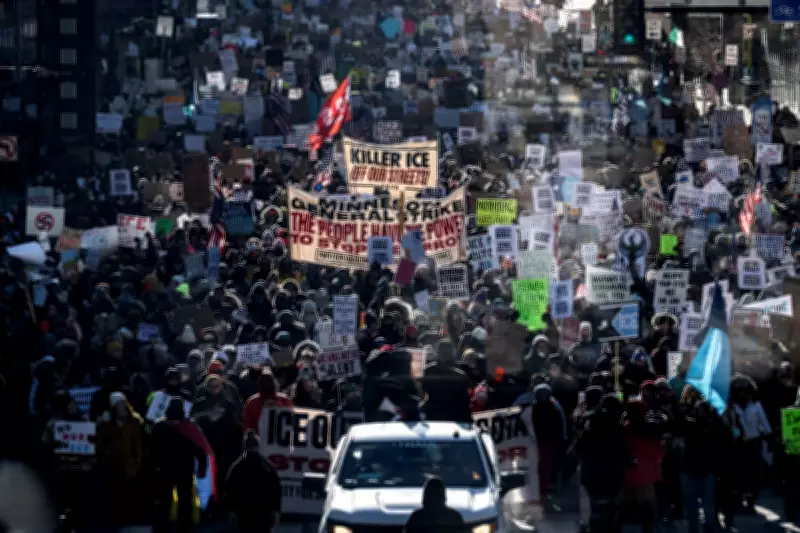
US activists are planning a massive economic blackout for May Day, International Workers Day, with expectations of more than 3,000 actions across the country. Inspired by the economic blackout in Minnesota during a large-scale ICE operation, labor unions, democratic organizations, and community groups are calling for “no school, no work, no shopping” to protest government policies that they say prioritize billionaires over workers.
May Day Strong Movement Gains Momentum
Neidi Dominguez, founding executive director of Organized Power in Numbers and a key organizer, stated that the number of May Day events this year has more than doubled compared to last year. “Last year, there were about 1,300 May Day actions across the country. This year, we think there’s going to be more than 3,000,” Dominguez said. She attributed the surge to the Minneapolis ICE crackdown, which gave a significant push to the movement. “Minneapolis really gave us the biggest push in real time to do it. We have a long way to go to take massive disruption actions like in other countries, where people will go on general strikes and they can shut down their country, but I think we’re getting more and more close to people having consciousness about their own power as workers.”
The protests are a reaction to actions and threats from the Trump administration, including proposals to send ICE agents to polling places during the midterms and unilateral military actions on Venezuela and Iran. Dominguez emphasized that this year’s actions are a step toward building a larger movement. “We’re really trying to actually start organizing people to see that the power that we collectively have to do economic disruption is really the power that we need in this moment to not just defend ourselves, but defend democracy,” she added.
City-Wide Blackouts in Major Cities
Several cities, including Los Angeles and Chicago, are preparing for city-wide economic blackouts. In Chicago, local labor unions and community groups such as the Chicago Teachers Union, SEIU Healthcare Illinois & Indiana, Indivisible Chicago, and the Chicago Federation of Labor jointly announced an economic blackout for 1 May. Stacy Davis Gates, president of the Chicago Teachers Union and Illinois Federation of Teachers, stated, “May Day has to become bigger in this moment. This is about building a more popular united front.” She added, “As educators, we feel a very real accountability to the young people in the families that we serve. Educators are institution builders that help to create the infrastructure for how Americans see the project of our American democracy. We want to connect people not just to the affordability crisis but the crisis of our institutions being marginalized in this moment and the impact on our young people.”
In Los Angeles, the LA May Day coalition, comprising more than 50 local organizations, is organizing an economic blackout around demands including immigration rights, voting rights, abolishing ICE, anti-war protests, and defending workers’ rights. Pedro Trujillo, director of organizing at the Coalition for Humane Immigrant Rights (Chirla), noted that May Day has historically been a day when immigration and labor rights groups come together. “Twenty years ago, we had mega marches here in downtown Los Angeles that shut down the city, and so we’re bringing back that energy of shutting it down,” Trujillo said. The coalition now has 101 endorsing organizations, including unions, non-profits, grassroots groups, and faith groups. He highlighted the growth from about 85 endorsing organizations last year, reflecting increased activism under the Trump administration, including massive No Kings protests and protests against ICE operations. “That goes to show that people are ready to get active. They’re ready to get connected with other networks, and we’re seeing folks from other sectors as well join, which is something similar that we’ve seen in like marches, like the No Kings marches, you get some folks who are unlikely marchers, folks who are even elderly, they’re out there demonstrating as well, because they’re tired of what they’re hearing about in the news and seeing in their streets,” he added.




