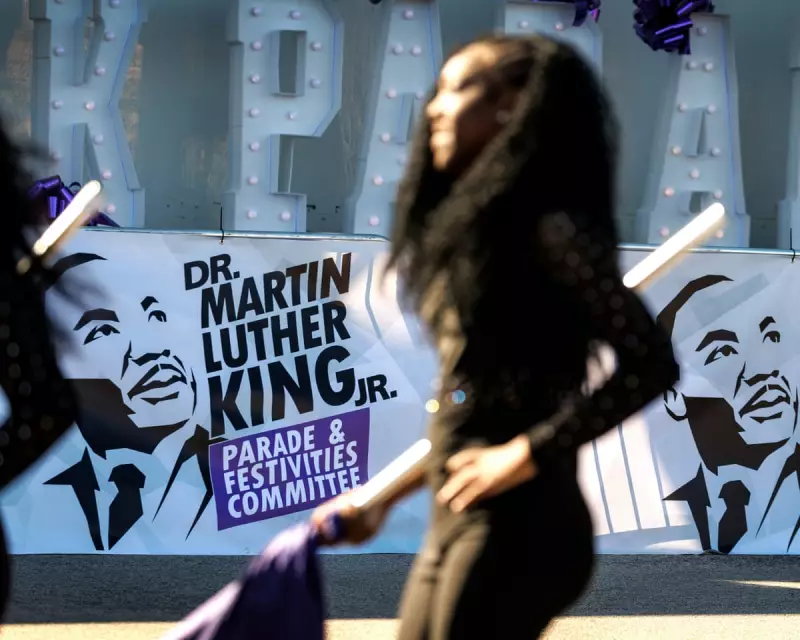
Communities across the United States marked Martin Luther King Jr Day on Monday with parades and commemorative services, yet the celebrations were underscored by a palpable sense of political tension and concern for social justice.
A Day of Celebration and Contemplation
From the streets of Miami, Florida, to the Martin Luther King Jr Memorial on the National Mall in Washington DC, people gathered to honour the legacy of the slain civil rights leader. In Los Angeles, students from Hollywood High School's L.A.C.E.R. afterschool programme practised for their local parade, while in St Petersburg, Florida, young people carried banners in support of the holiday.
However, the day's events carried a more urgent tone for many participants. Wisdom Cole, the NAACP's senior national director of advocacy, stated that elevated fears within racially diverse and immigrant communities had shaped the observances. "We are faced with increased police and state violence inflicted by the government," he said.
Voices of Concern and Calls to Action
At rallies and speeches, leaders framed contemporary struggles through the lens of Dr King's unfinished work. In Harlem, the Rev Al Sharpton referenced the recent killing of Renee Good, a 37-year-old mother of three, by an immigration officer in Minneapolis. Sharpton questioned the official response and called for unity, urging a pledge "to fight and make what should happen happen to preserve the dream of Dr King."
In New York City, the newly-installed mayor, Zohran Mamdani, addressed economic inequality at the Brooklyn Academy of Music's annual event. "While the city is wealthy beyond measure, it is also deeply unequal," he remarked, framing Dr King's legacy as one of actionable rights.
This year's holiday coincided with the one-year anniversary of Donald Trump's inauguration for his second term. The administration's opposition to diversity, equity, and inclusion (DEI) initiatives and a shift in the Justice Department's civil rights focus were cited as points of concern. In comments to the New York Times this month, Trump suggested civil rights protections had unfairly treated white people.
Events Cancelled and Legacies Reclaimed
The political climate led to the cancellation of some typical MLK Day events. A dinner at Indiana University in Indianapolis was called off, with the Black Student Union expressing concern it was linked to "broader political pressures." In Westbrook, Maine, a church cancelled a service after agents from US Immigration and Customs Enforcement (ICE) were reported in the area.
In response, activist groups sought to reclaim the day's radical spirit. The Movement for Black Lives held events in Atlanta, Chicago, and Oakland under the banner "Reclaim MLK Day of Action." Devonte Jackson, a national organising director for the coalition, stated the aim was to "free ourselves from this fascist regime" by honouring King's "radical legacy."
Amidst the tension, traditional tributes continued. The National Civil Rights Museum in Memphis, Tennessee, located at the Lorraine Motel where King was assassinated on 4 April 1968, offered free admission. Museum president Russell Wigginton emphasised the day was about recognising those who continue to advance King's ideals.
At Atlanta's historic Ebenezer Baptist Church, where Dr King once preached, Senator Raphael Warnock delivered a sermon warning against despair and division. "You cannot remember Dr King and dismember his legacy at the same time," he later posted online, calling for a renewed commitment to justice and democracy.
As parade participant Harold Hunter in Washington DC summarised, the day's significance was universal: "It's not just a white thing or Black thing. This is a people thing." The sentiment echoed that of retired broadcaster Sam Ford, who simply stated, "The struggle continues."