
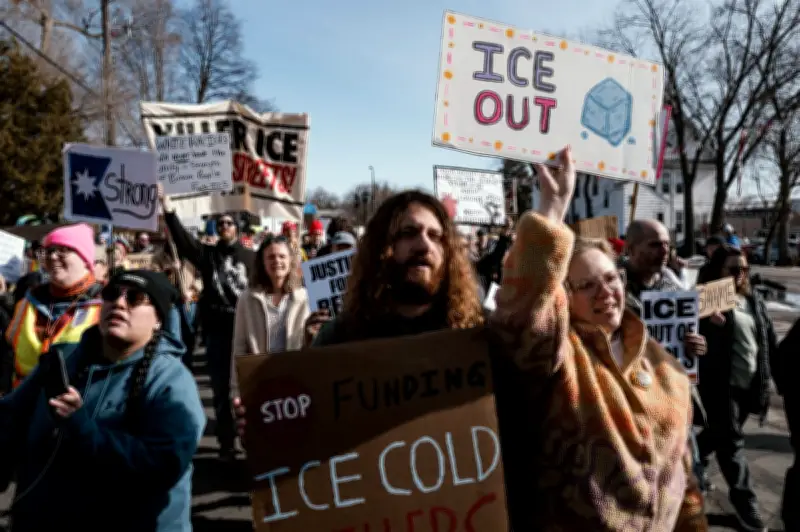
When thousands of immigration agents flooded Minnesota earlier this year, a loose network of neighbors sprang into action. They fed each other, ensured children got to and from school safely, and tracked the surge that tore through their communities. After organizing block by block to monitor Donald Trump's extraordinary crackdown, these same neighbors are now shifting their focus to a different threat: what if the president tries to steal an election?
From Immigration Crackdown to Election Defense
Defending democracy can feel abstract until it is required. But a controversial, aggressive, and deadly deployment of federal agents felt like a distant prospect in Minnesota until the president ordered Operation Metro Surge. With November's midterm elections approaching, one group that taught Minnesotans to document immigration enforcement has launched democracy defense trainings, encouraging people to knock on every neighbor's door to help them vote and respond to potential attacks on the election.
“There is a general, very visceral concern that this administration is planning to ensure that the elections go their way by any means necessary,” said Jess, a former federal worker fired during Elon Musk's so-called “department of government efficiency” drive last year. She trained about 2,500 people on constitutional observation during the immigration crackdown and asked to use only her first name for fear of retaliation.
Training Citizens to Protect the Vote
Dozens of neighbors poured into a stuffy Minnesota church basement on a steamy Tuesday evening in June, finding seats on tables marked by geographical area. They had lived through an assault by the Trump administration that killed two local residents and deported many hundreds more. They knew to take Trump's threats seriously and wanted to learn how to protect elections.
“We've got to make sure that everybody who wants to vote can vote, and everybody's vote is counted, and those votes and the will of the majority is respected,” said David Brauer, who helped lead the training for Monarca, a project of social justice group Unidos MN. “Basic stuff, but so crucial right now. But that's just the first step. Once they're cast, we know we'll have to defend them.”
The training is designed to get citizens thinking about what Trump and his allies could do to undermine the voting process and election results. The exercises are theoretical but based on reality: the president has already sought to undermine California's elections and said they will be investigated, a sign of more to come in the midterms.
Block-by-Block Organizing as a Defense Strategy
Defending democracy, aside from voting, is often seen as the work of elections officials or nonprofits that file lawsuits over restrictive voting laws. Officials in some states have worked to put laws in place to fend off federal overreach, beefing up election security and solidifying processes to inform the public. But in an era of explicit partisan gerrymandering that diminishes Black voting power, and a president who frequently denies election results, defending democracy requires all hands on deck.
Advocates of the block-by-block strategy say it helps keep eyes on election processes. In 2020, when Trump and his allies sought to overturn the presidential election he lost to Joe Biden, institutional guardrails held. Times have changed, though. Trump has filled his government with loyalists, and there's a growing apprehension that institutional protections may not hold.
Fear and Burnout Among Activists
In Minnesota, the president's threats carry weight. Organizing within the community can feel daunting. People are burnt out after months of day-to-day activism. They worry about how the administration could criminalize their activities. The Department of Justice has charged nearly 40 people over a protest at a church, and another 15 with broad conspiracy charges for their responses to Immigration and Customs Enforcement, not to mention the hundreds detained and deported from the state.
Protect Democracy, a nonprofit that advocates against authoritarianism, called the charges against anti-ICE activists a sign of how the administration could undermine the vote. It's part of a “disrupt” strategy that seeks to deploy federal power against opponents, the group said after the charges against 15 Minnesotans were filed. “The Department of Justice is attempting to intimidate critics and punish those who organize to expose the administration's abuses,” said Jess Marsden, Protect Democracy's counsel and director of impact programs. “They know how much easier it is to tilt the electoral playing field if people stay home and stay quiet, which is why it's important to name these abuses now, push back against attacks, and prepare for additional action ahead of November.”
Scaling Up Democracy Defense Trainings
The democracy defense trainings started in Minnesota in late April. Already hundreds have signed up, according to Luis Argueta Jr, communications director of Unidos MN, who said he is not aware of similar ground-level trainings elsewhere in the country. He has been hearing from groups in other states curious about how the sessions are going. On the night of the training at the suburban church, there were trainings at four other locations in the Twin Cities, Argueta said. Word of mouth has spread among community groups, just like it did around the previous trainings on constitutional observing.
Attacks on democracy have been a “continuous concern”, with people routinely worried about immigration agents at the polls, Argueta said. He's heard fear from newly naturalized citizens, in particular, over voting, including a concern that if they vote, their loved ones who are not naturalized could be exposed. While the bulk of immigration agents left the state, some people remain fearful of harassment or detention. A plan to convert a private prison into a detention facility amplified worry again, as did additional apprehensions throughout the state this summer.
“So, what do you do?” Argueta said. “Do you sit around and wait and hope that nothing happens, or do you start building something, do you start organizing and making sure that people are able to actually step up and defend?”
In the church basement, Brauer told the crowd that they, like him, might be a “checklist person” who wants to check off five tasks and win democracy. That's not how it works, he said. The purpose of the training is not to solve fundamental problems but to get organized and have a plan to respond to whatever the Trump administration throws at it. The audience shared what made them proud of Minnesota during the federal occupation and what democracy defense meant to them. It was motivating to see people move outside their comfort zone, one attendee said, even if they were nervous. They would need to embrace discomfort again to defend democracy.
Threats Already Playing Out
Threats to elections are already playing out. Louisiana threw out tens of thousands of votes to redraw maps and dilute Black voting power. Republican leaders have said they want immigration agents or troops at polling places. The federal government has seized ballots in Georgia as part of an endless quest to prove fraud in the 2020 election. What defending democracy could look like on the ground isn't clear yet. It could be get-out-the-vote efforts ensuring neighbors have rides to the polls, signing up as election judges, monitoring for immigration agents, or protesting if officials face pressure to undermine the vote.
The group worked through a scenario: in August 2026, the Department of Justice announced that voters needed to appear on newly issued federal voter rolls for their votes to be counted, creating confusion just before early voting began. A trainer asked how an organized network could respond. One person said the federal government couldn't move that fast – a natural reaction, the trainer noted, because people want to argue away the threat. Another said they would get loud and ensure Minnesota's elected leaders did the same.
Emilia González Avalos, executive director of Unidos MN, acknowledged that conversations with neighbors can be difficult, especially if there are outward indicators of political disagreement, but there is value in “breaking down the dehumanization amongst us as an exercise of power building”. The strength built block by block will be reflected to defend access to the polls and ensure results are ratified. “We don't need perfect leaders,” she said. “We just need a regular person that can take responsibility of something, anything, whether it's a smaller block or a small floor in a building, that's fine, but take responsibility of something. We need as many people as possible right now.”




