
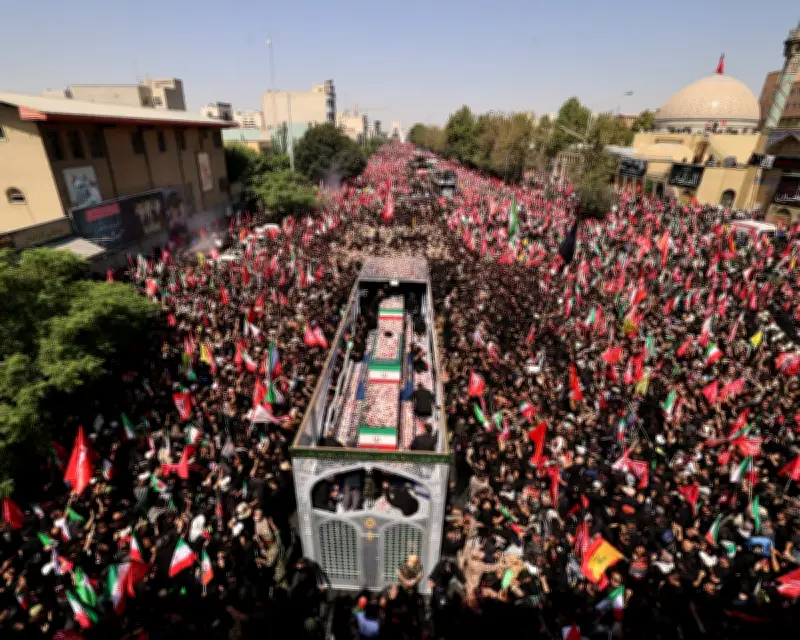
Reports in western media suggest about 12 million people have been out on the streets to mourn the killing of former supreme leader Ali Khamenei. As the multipurpose, multinational funeral moved to the Jamkaran mosque in Qom and then to Najaf in Iraq, Iran's leadership weighed the mandate from the millions who took to the streets of Tehran over three days.
State-Led Mobilization and Social Base
Some hailed the moment as a referendum showing support for the clerical establishment, calling for intensified confrontation with the west. Others said it reflected national pride conditional on demands for change and an end to the war. Government sources believe they successfully organized mass shows of support without disorder or signs of coercive manipulation.
Mohammad Ali Kadivar, associate professor of international relations at Boston College, described it as "a major episode of state-led mobilisation." He said: "Since 1979, state-led mobilisation has been one of the central pillars of the regime's power. The state has built a dense infrastructure through mosques, the Basij, schools, universities, workplaces, state media, veterans' organisations and war commemoration networks." Kadivar added: "The Islamic republic also has a real social base. This base is not a majority of Iranian society, and Iran remains deeply divided, but it is large, organised, ideologically committed and consistently open to mobilisation."
Numbers Game and Public Sentiment
Estimates for the Tehran leg vary from 350,000 to 35 million. The Financial Times reported as many as 12 million attendees. At a minimum, the turnout compared to the funeral of Iran's first supreme leader, Ruhollah Khomeini, in 1989, when between 5 and 7 million from a population of 53 million took to the streets. Many highly educated mourners wanted to show opposition to what they regarded as the extrajudicial killing of their leader, regardless of broader views of the regime.
Reza Nasri, a lawyer close to the government, said: "This was one of the largest human gatherings on Earth. It's a civilisation expressing itself in full, with all its grief, its pride and its cohesion. These are millions who chose, freely and defiantly, to pour into the streets to mourn their leader on their own terms." He argued that the Trump administration's strategy "did not radicalise them against their government. Four decades of sanctions, two wars in the region, maximum pressure, currency warfare, and a secretary of defence openly threatening boots on the ground, and this is what it produced: a people more visibly unified than almost any nation on Earth can claim to be."
Political Fractures and Future Implications
Hossein Rouyvaran, professor of political science at Tehran University, said the war changed the social contract: "Those who had been in opposition before are now under the Iranian flag." However, the government has fractures. Activity around the Strait of Hormuz, including gunfire aimed at Qatari LNG tankers, suggests Iran is not relaxing its grip. Foreign minister Abbas Araghchi acknowledged the importance of the crowd, stating: "Millions of proud Iranians rallied in unity to honour Grand Ayatollah Khamenei and his legacy. Neither them nor our brave armed forces are moved by any threats."
Abdollah Ramezanzadeh, retired assistant professor at Tehran University, expressed concern over "the stage-managing efforts by state TV to seek revenge and reject negotiation and peace." He added: "If they're a deliberate project by extremists to drag the country into war and render negotiations ineffective, stop them." Hesamoddin Ashna, adviser to former president Hassan Rouhani, said: "If we cherish that national presence, we should consider the united and diverse nation as the holder of power, and employ justice and rationality to witness the resurgence of Iran once again." Some noted that past presidents Mohammad Khatami, Mahmoud Ahmadinejad, and Rouhani were excluded from ceremonies, and Ali Asghar Hijazi, deputy chief of Khamenei's office, was absent due to opposition to elevating Khamenei's son as successor. The battle for the soul of Iran is entering a new phase.




