
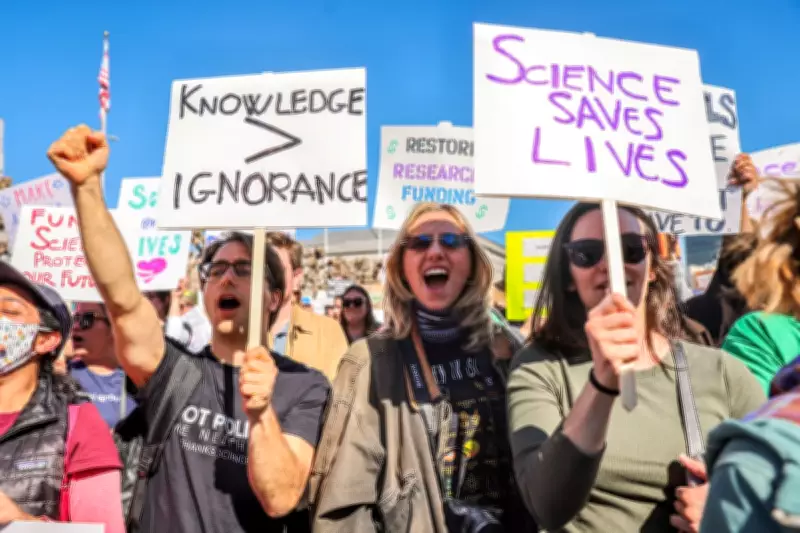
Colette Delawalla, a 30-year-old doctoral candidate in clinical psychology at Emory University, never planned to become an activist. But 19 days into President Donald Trump's second term, she reached her limit. The administration announced $4 billion in cuts to medical and scientific research, ordered government scientists to refrain from public speaking, and directed the National Institutes of Health to purge grants related to gender ideology and diversity. Frustrated by the lack of response from the scientific community, Delawalla posted on Bluesky: "Can't believe I'm typing this but... FUCK IT IM PLANNING A STAND UP FOR SCIENCE PROTEST IN DC."
Her post went viral. Within 72 hours, she was contacted by The New York Times. In less than a month, a volunteer team led by Delawalla and four other early-career scientists organized protests on March 7, 2025, in over 30 U.S. cities, without support from major scientific organizations. However, sustaining the movement proved difficult. After the protests, funding cuts remained, and the purge of studies on gender and DEI continued.
Building a Movement
Delawalla faced challenges including burnout among volunteers and a lack of organizational structure. Over the next year, Stand Up for Science lost three key organizers but grew to 22 paid staff and over 2,000 registered volunteers. Delawalla received criticism from fellow scientists and left-wingers, some of whom objected to her language about "fascism" and "authoritarianism." One male scientist called her a "ditsy socialist liberal," which she added to her Bluesky bio.
Strategic Shifts
After the initial protests, three lead organizers left to form Science for Good, focusing on engaging skeptics rather than energizing the base. Delawalla chose to focus on direct action. She was told to choose between her doctorate and leading the organization, but she refused to give up either. She brought in seasoned campaigners like Stephen King, a political organizer, and Vincent Vertuccio, a 22-year-old consultant. Delawalla prepared extensively for congressional meetings, eventually delivering a focused message in 200 meetings.
In fall 2025, Stand Up for Science led a campaign to impeach Robert F. Kennedy Jr., delivering a petition with 150,000 signatures to Congress. The group also entered electoral politics, supporting Democrat Aftyn Behn in a Tennessee congressional race, making 65,000 phone calls and canvassing hundreds of doors. Behn lost by 8.9% in a district Trump won by over 20%.
Growth and Impact
In its first full year, Stand Up for Science raised $1.2 million and gained support from over 65 Nobel laureates. In March 2026, the group held demonstrations in over 50 cities, with about 2,000 people at the National Mall. Delawalla plans to launch the Science Victory Fund, a Super PAC for the 2026 midterms. She will complete her dissertation this summer but has chosen to forgo her research career to lead the movement, saying, "Being a scientist is a huge part of my identity, but protecting others' research is where I belong now."




