
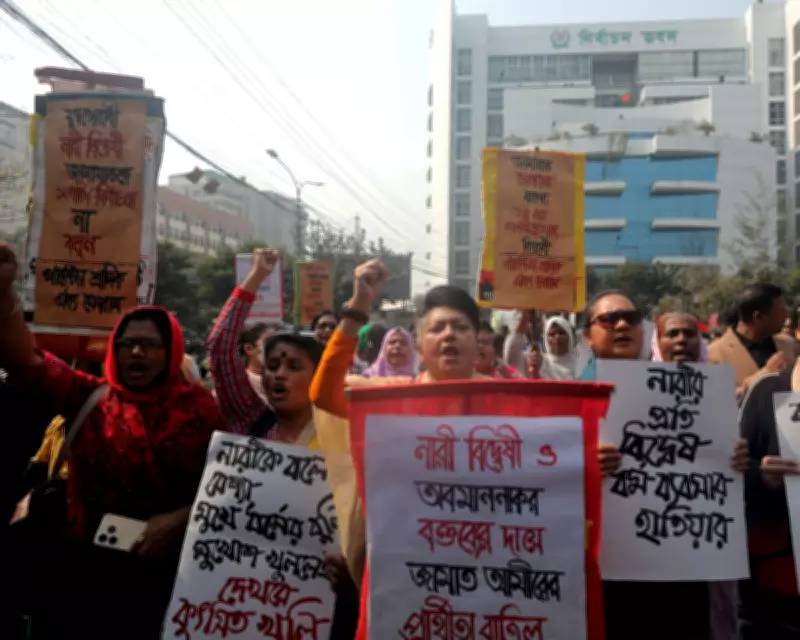
Women's Organisations Rally Against Islamist Party's Election Momentum
Women's rights groups have staged a dramatic midnight protest outside the election commission in Dhaka, voicing deep concerns about the rising influence of Jamaat e-Islami ahead of Thursday's historic Bangladesh election. The demonstration specifically targeted controversial statements made by the party's leader, Shafiqur Rahman, which protesters claim threaten fundamental freedoms for women across the nation.
Historic Election Overshadowed by Women's Rights Concerns
As Bangladesh prepares for what has been promised as its first free and fair election in seventeen years, following the toppling of Sheikh Hasina's regime in August 2024, many women who participated in the revolution now express growing apprehension. Despite the jubilation surrounding the democratic transition, with opposition figures emerging from persecution to campaign freely, women's organisations report increasing anxiety about regressive political forces gaining ground.
"This election was meant to represent profound change and reform," declared Sabiha Sharmin, a 25-year-old participant in the midnight torchlight march. "Instead, we witness the systematic erasure of women and the threatening of our hard-won rights. We fear this could set the country back a century."
Jamaat e-Islami's Controversial Resurgence
Among the political movements experiencing remarkable revival is Jamaat e-Islami, an Islamist party that advocates implementing sharia law in Bangladesh. Previously banned and heavily oppressed during Hasina's rule, with leaders imprisoned, disappeared, or sentenced to death, the party has mobilised with unprecedented energy since the regime's collapse.
Limited polling still suggests the Bangladesh Nationalist Party (BNP) will secure victory, but analysts warn that Jamaat e-Islami appears poised to achieve an unprecedented share of the vote. "Whether as substantial opposition or potential government participants," observed Thomas Kean, Crisis Group's senior consultant on Bangladesh, "the future political landscape seems destined to feature a heavily Islamist party at its centre."
Controversial Rhetoric and Policy Proposals
The party's resurgence has been accompanied by rhetoric that has alarmed women's rights advocates across Bangladesh. In a recent interview with Al Jazeera, Shafiqur Rahman stated that a woman could never lead Jamaat e-Islami, describing such leadership as un-Islamic. Previously recorded comments denying the existence of marital rape and characterising rape as "immoral women and men coming together outside marriage" have resurfaced, creating what protesters describe as a chilling effect.
"These perspectives echo policies heard in Iran and Afghanistan," remarked Zayba Tahzeeb, a 21-year-old physics student who joined the Dhaka protest. "Women's sovereignty, our freedoms, our independence—all stand at risk in this election."
Among Jamaat e-Islami's proposed policies is reducing women's working hours from eight to five daily, with government subsidies compensating for lost income, ostensibly to allow women more time at home. This proposal concerns many given that women constitute 44% of Bangladesh's workforce—the highest proportion in South Asia—with paid employment fiercely guarded across economic strata.
Political Alliances and Female Representation
The sense of disappointment among women's rights advocates intensified when the National Citizen Party (NCP), formed by student leaders who helped topple Hasina and initially positioned as a progressive alternative, announced in December it would join Jamaat e-Islami's electoral alliance. Despite originally championing women's leadership, the NCP now fields just two female candidates.
Tajnuva Zabeen, a doctor and founding NCP member who left the party following the alliance announcement, described the decision as "a clear betrayal" made without consultation by a select few male leaders. "This represented a historic opportunity to create a genuine third political force embodying the change so many died for during the July uprising," Zabeen lamented. "Instead, they failed the people and silenced the women who led this movement. This election will not capture the revolution's spirit."
She emphasised that representation failures extend beyond Jamaat e-Islami and the NCP, noting that less than 5% of BNP candidates are women.
Complex Political Landscape and Voter Sentiment
Bangladesh's political history reveals complex relationships with secularism since independence from Pakistan in 1971. Religion-based politics were initially outlawed, flourished during military rule after 1975, then saw secularism restored to the constitution in 2011. Analysts suggest many supporting Jamaat e-Islami today simply express disillusionment with the traditional political establishment, which has alternated between the Awami League and BNP—both accused of dynastic politics and corruption.
The party appears particularly popular among young, first-time voters constituting 42% of the electorate, many seeking change after Hasina's authoritarian rule somewhat discredited secular politics. Mir Ahmad Bin Quasem Arman, a barrister and Jamaat e-Islami candidate in Dhaka whose father was executed under the previous regime, spent eight years imprisoned and tortured in Hasina's notorious facilities. He insists fears about his party's approach to women are unfounded, describing them as political smears.
"When conversing with urban elites, their concerns centre on whether women can hold top government positions or wear whatever they choose," Arman stated. "These represent what I must regrettably term feminist demands. Ground-level realities differ significantly. Working-class women primarily require safety, which constitutes our foremost concern. Perhaps women will appear on our tickets in the near future."
Divergent Perspectives Within the Movement
Thousands of female Jamaat e-Islami supporters recently marched through Dhaka to demonstrate the party's commitment to women, arguing proposed policies would enhance safety and improve lives. "Implementing Islamic law will foster honesty and eliminate corruption," asserted Sirajim Munira, 27, during the demonstration.
Yet even among supporters, traditional views persist. Ainum Nahar, 58, acknowledged that women should never lead the party, stating "as an Islamic party, female leadership remains prohibited." However, she maintained that "Jamaat empowers us" and that women would "stand behind to inspire, encourage, and move the country forward."
As Bangladesh approaches this pivotal election, the midnight protests in Dhaka underscore profound divisions regarding women's rights and the nation's political direction, with female activists determined to ensure their voices are heard despite the rising tide of Islamist politics.




